7230372364_51f0318280_zYesterday, we reviewed the geographic sources of the Illinois Supreme Court’s civil docket in the first five years of our study period from 2000 to 2004. Today, we compare the originating counties for the criminal docket during the same years. We conclude that in many years early in the twenty-first century, Cook County did not account for a portion of the criminal docket equivalent to its population, and the criminal docket generally tended to be more widely dispersed around the state than the civil docket was.

The data for 2000 is reported in Table 163 below. Cases from Cook County comprised 42.68% of the criminal docket – almost exactly the same share that Cook County has of statewide population. Du Page and St. Clair counties accounted for 5% each of the docket, Kane and Lake counties 3% each, and Will, Madison, McLean, Jefferson and Vermillion counties originated 2% apiece of the docket. Another twenty-one counties were the source of one criminal case each, collectively accounting for 21% of the docket.

Table 163

Cases from Cook County were down sharply as a fraction of the criminal docket in 2001, falling to 25.86% of the docket of criminal, quasi-criminal and disciplinary cases. Cases from Kane County were up to 10.34% of the docket. Du Page and Champaign counties accounted for 8.62%. Three counties – Sangamon (the state capital), Adams and LaSalle – produced 5.17% of the docket apiece. Lake, Kankakee and Rock Island counties originated 2 cases each – 3.45% of the docket. Twelve different counties produced one case each, collectively accounting for 20.69% of the docket.

Table 164

Cases from Cook County rose somewhat in 2002 as a fraction of the criminal docket to 36.23% (although still below the county’s population share). The Court heard six cases each from Kane and Henry counties – 8.7% of the docket apiece. Cases from Du Page County were down slightly to 4.35% of the docket. The Court heard two criminal cases each from Sangamon, Winnebago, Will, Vermillion, Peoria and DeKalb counties – 2.9% of the docket apiece. The Court heard one case apiece from an additional seventeen counties.

Table 165

The data from 2003 is reported in Table 166 below. Cases from Cook County were up slightly, with the Court hearing 28 criminal cases, or 42.42% of the docket. Cases from Du Page and Will counties were up to 9.09% and 7.57% of the docket, respectively. Vermillion County accounted for 6.06% of the Court’s cases, Lake and Madison 4.55% each, and Bureau 3.03% of the docket. Finally, fifteen counties and administrative boards produced one case for the Court’s criminal docket apiece.

Table 166

We report the data from 2004 in Table 167 below. Criminal cases from Cook County were down again in 2004. Madison and Champaign counties produced three cases each – 5.26% of the docket. Ten counties – Winnebago, Sangamon, Du Page, Kankakee, La Salle, Livingston, Peoria, Rock Island, Macoupin and Macon – originated 2 cases apiece, or 3.51% of the docket. The final 21.05% of the criminal caseload consisted of twelve counties and administrative boards which produced one case each.

Table 167

Join us back here next week as we address the sources of the civil and criminal dockets for next five years of our study period – 2005-2009.

Image courtesy of Flickr by Bill Ingram (no changes).
 

4512437526_ef0f8c54f3_zLast week, we completed our comparative look at the sources of appellate jurisdiction in the Illinois Supreme Court’s civil and criminal dockets. We demonstrated that although the Court’s civil docket is heavily inclined towards final judgments, review of interlocutory orders is by no means uncommon. Interlocutory orders are even more numerous on the criminal side of the docket. Today, we begin our review of our next issue – where in the state are the civil and criminal dockets drawn from?

The data for 2000 is reported in Table 158 below. By way of context, for the calendar year 2001, 43.66% of the new civil filings statewide were filed in Cook County. According to the 2000 census, 43.3% of the population of Illinois was living in Cook County. The next largest counties, in descending order, were Du Page, Lake, Will, Kane and Winnebago.

For the year 2000, Cook County originated 51.35% of the Court’s civil docket, significantly above its share of the statewide population. Lake and St. Clair counties contributed 8.11% of the civil docket apiece. Winnebago County contributed an additional 5.41%. Ten different jurisdictions – Kane, Sangamon, McHenry, Du Page, Will, Monroe, Franklin, Adams and Madison counties and the Illinois Pollution Control Board – all originated one apiece of the Court’s civil cases, collectively amounting to 27% of the civil docket.

Table 158

Cook County’s share of the docket dropped only slightly in 2001 to 50%. Du Page County contributed 10.42%, and Sangamon, Will and McLean counties originated 4.17% of the docket apiece. Once again, a host of jurisdictions contributed one case each – Jefferson, Lake, St. Clair, Kane, Kendall, Madison, Macon, Tazewell, Hardin, Ogle, McDonough and Champaign counties and a certified question from the Seventh Circuit.

Table 159

The docket remained widely dispersed in 2002. Cases from Cook County fell to 44% of the docket, in line with Cook County’s share of the state population. St. Clair and Du Page counties were next at 8% apiece of the civil docket. Another six percent of the civil docket arose from Champaign County. Another four percent each arose from DeWitt, Williamson and Tazewell counties. Finally, the Court heard one case each from Jackson, Edgar, Peoria, Christian, Kane, McHenry, Will, Madison, McLean and Kankakee counties, and one on certification from the Seventh Circuit – collectively, 22% of the docket.

Table 160

We report the data for 2003 in Table 161 below. The caseload from Cook County fell further to 36.96% of the civil docket. Another 8.7% of the docket arose from Sangamon County, the home of the state capital. Several of the larger counties in the state – McHenry, Du Page, Will, Madison, Macon and McLean – were responsible for 4.35% of the civil docket each. One case each arose from another thirteen jurisdictions – Jefferson, Knox, Pope, Vermilion, Putnam, Randolph, Rock Island, Coles, Lake, St. Clair, Kane and Adams counties and the Seventh Circuit.

Table 161

Cook County’s share of the civil docket increase somewhat in 2004 to 43.39%. Du Page County contributed another 9.43% of the docket, followed by Champaign at 7.55%, Lake and St. Clair at 5.66% each, and Peoria County at 3.77% of the docket. Another thirteen jurisdictions – Will, LaSalle, McLean, Wabash, Madison, Winnebago, Kane, Crawford, Union, Sangamon and Rock Island counties, the Illinois Commerce Commission and the Seventh Circuit on certification – contributed one case apiece, or 24.53% of the docket.

Table 162A

Join us back here tomorrow as we compare our results to the sources of the Court’s criminal docket between 2000 and 2004.

Image courtesy of Flickr by Matt Turner (no changes).

4413403132_725cb1fd39_zToday we conclude our review of the data on the sources of appellate jurisdiction on the civil and criminal dockets of the Illinois Supreme Court between 2000 and 2015. We’ve shown that in a typical year, final judgments comprise between fifty-five and seventy percent of the Court’s civil docket, although that figure has at times drifted somewhat higher. Final judgments are somewhat less predominant on the criminal docket, typically amounting to between forty-five and fifty-five percent of the Court’s criminal docket.

The jurisdictional data for the criminal docket in 2010 is reported in Table 152 below. Appeals from final judgments were slightly down from 2009 as a fraction of the criminal docket at 49.09% (27 cases). Habeas corpus appeals were up from their trend level, amounting to twenty percent of the criminal docket (11 cases). The next three most common grounds for jurisdiction were Rule 604 – appeals by the State and by defendants following a guilty plea – at 9.09%, juvenile court appeals under Rule 660 (7.27%) and appeals based on various statutory grants of jurisdiction.

Table 152

In 2011, appeals from final judgments were at their highest level in five years as a percentage of the criminal docket – 58.33% of the caseload. Appeals under Rules 603 (6.25%) and 604 (14.58%) were sharply up as well, while habeas appeals under Rule 651 (4.17%), juvenile court appeals under Rule 660 (2.08%) and statutory appeals (2.08%) returned to their trend levels.

Table 153

The data for 2012 are reported below in Table 154. Appeals from final judgments under Rule 602 were down somewhat at 48.48% of the criminal docket (16 cases). Habeas appeals under Rule 651 returned to nearly their 2010 level at 18.18% of the docket. Rule 604 appeals were 9.09% of the docket as the caseload returned to its 2010 level. The Court heard two cases each – 6.06% of the criminal docket – under Rule 660 and constitutional and statutory jurisdiction.

Table 154

As shown below in Table 155, appeals from final judgments remained at about the same level in 2013 – 47.37% of the criminal docket (18 cases). Statutory appeals were up sharply in 2013, with the Court hearing 9 cases, or 23.68% of the criminal docket. Appeals pursuant to Rule 604 remained at about the same level, comprising 10.53% of the criminal docket.

Table 155

The data for 2014 are reported below in Table 156. Rule 602 appeals from final judgments were down to 38.24% of the docket (13 cases). Statutory appeals dropped back towards the historical trend level at 11.76% of the Court’s docket (4 cases). The Court heard three appeals each – 8.82% of the criminal docket – pursuant to Rules 603, 604 and 651.

Table 156

Appeals from final judgments remained static last year as a percentage of the criminal docket at 42.42%. Rule 604 and 651 appeals were up substantially. The Court heard six cases under each rule, with the share of the docket rising from 8.82% to 18.18%. Appeals under Rule 603 were also up significantly, from 8.82% of the docket to 12.12%.

Table 157

Join us back here next Tuesday as we turn to the next issue in our review of the Court’s civil and criminal dockets.

Image courtesy of Flickr by Matt Turner (no changes).

10177336773_e542612caa_zFor the past two weeks, we’ve been looking at the sources of appellate jurisdiction on the civil and criminal dockets of the Illinois Supreme Court, analyzing how heavily the Court inclines to reviewing final over interlocutory decisions. We’ve shown that throughout its recent history, although appeals from final judgments under Supreme Court Rule 301 form the largest single portion of the Court’s docket, such appeals are by no means all or nearly all of the Court’s cases. Today, we address the civil docket for the final six years of our period of study, 2010-2015.

The data for 2010 is reported in Table 146 below. Rule 301 appeals were 69.7% of the civil docket that year, slightly below the Rule 301 share for 2008 and 2009. Certified question appeals under Rule 308 were another 15.15% of the civil docket – a major increase over the Court’s trend in the previous five years. Appeals under Rule 304 – final judgments disposing of less than an entire proceeding and certain enumerated types of judgments – amounted to another 9.09% of the Court’s civil docket, a significant drop from 2006-2008. The Court heard one case each pursuant to Rules 302 and 307 – 3.03% of the civil docket.

Table 146

The following year, appeals pursuant to Rule 302 went even higher, with the Court hearing 27 cases (77.14% of the civil docket). Rule 308 appeals were down to 8.57% of the docket (3 cases). Rule 304 appeals were slightly up, amounting to 11.43% of the civil docket in 2010 (4 cases).

Table 147

The data for 2012 is reported in Table 148. For the year, appeals from final judgments under Rule 301 fell back to a rate slightly below the long term trend – 57.5% of the docket (23 cases). Appeals under Rule 304 went higher, amounting to 15% of the docket (6 cases). Appeals under Rule 308 were 12.5% of the Court’s docket, and cases under Rule 307 – interlocutory appeals as of right – amounted to 10%. The Court also heard one civil appeal on a certified question from the Seventh Circuit in 2012.

Table 148

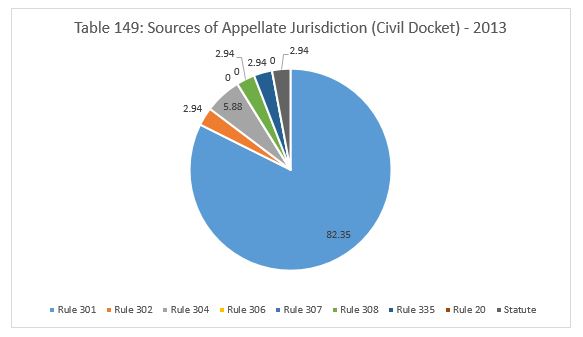
For 2013, appeals from final judgments comprised a larger fraction of the Court’s civil docket than ever before – 82.35% of the case load (28 cases). Rule 304 appeals fell to 5.88% of the Court’s docket, and the Court heard one case each under the several remaining jurisdictional bases.

Table 149

The data for 2014 is reported below in Table 150. Appeals from final judgments under Rule 301 rose to a new high for our study period – 85.19% of the Court’s civil docket. The Court heard civil cases under only two other rules during 2014 – 2 direct appeals under Rule 302, 7.41% of the docket, and one appeal each under Rule 304 and statutory jurisdiction.

Table 150

The Court’s civil docket returned to something more in line with its long-term trends in 2015. Appeals from final judgments fell to 56.82% of the Court’s civil docket. Direct appeals under Rule 302 were up substantially, amounting to 18.18% of the Court’s civil docket (8 cases). Appeals under Rule 304 were up somewhat to 11.36% of the docket (5 cases). The Court heard three civil cases pursuant to various statutory sources of jurisdiction (6.82%), and one case each pursuant to Rules 306, 307 and 308.

Table 151

Join us back here tomorrow as we review the Court’s jurisdictional data in the criminal docket for the years 2010-2015.

Image courtesy of Flickr by Teemu008 (no changes).
497353227_ce4938472d_zLast week, we showed that during the first five years of our study period, review of final decisions was not the dominant feature of the Illinois Supreme Court’s criminal docket (at least to the degree it dominated the civil docket). Yesterday, we discussed the data from the civil docket between 2005 and 2009. Now, we turn to the criminal docket for the same five years.

Although Rule 602 was far and away the most common basis for appellate jurisdiction, once again, it was less than half of the criminal docket in 2005 (25 of 58 cases). Habeas corpus (9 cases) and juvenile appeals (8 cases) were the second and third most common features on the docket at 15.25% and 13.56%, respectively. Rule 604 appeals (nearly all appeals by the State, and defense appeals following a guilty plea or certain adverse bail decisions) added another 11.86% of the docket, with the Court hearing 7 such cases.

Table 141

In 2006, Rule 602 appeals increased substantially as a fraction of the criminal docket, to a level roughly equivalent to what final judgments are in civil cases. The data is reported below in Table 142. Rule 602 appeals were more than 62% of the docket that year – 32 cases in all. On the other hand, nearly everything else was down in 2006 as a fraction of the docket – Rule 603 (from 6.8 to 3.9%), 604 (11.9 to 7.8%), 651 (15.3 to 2%) and 660 (13.6 to 7.8%) appeals.

Table 142

We report the data for 2007 in Table 143 below. Appeals from final judgments were down somewhat, as the Court heard 14 cases (50% of the docket). Habeas corpus appeals were up substantially in 2007, amounting to a quarter of the criminal docket (the year before, Rule 651 appeals had been less than 2% of the docket). Appeals pursuant to Rule 603 and 604 were relatively steady at 3.6% and 10.7% of the criminal docket.

Table 143

Rule 602 appeals drifted downwards slightly in 2008. Appeals under Rule 604 rose as a fraction of the Court’s civil docket from 10.7% (3 cases) to 15.7% (8 cases). After hearing no juvenile cases (Rule 660) in 2007, the Court decided seven in 2008 – 13.7% of the criminal docket. Habeas cases dropped by about a third as a fraction of the docket, from 25% to 17.6%.

Table 144

The Court decided 29 cases in 2009 arising from final judgments, leading to an eight percent increase in the share of Rule 602 appeals. The Court decided four cases under Rule 603 – 7.7% of the criminal docket – where it had decided only one the year before. Rule 604 appeals remained steady as a fraction of the docket, while habeas and juvenile appeals were down somewhat.

Table 145

Join us back here next Tuesday when we’ll take a look at the Court’s civil and criminal dockets between 2010 and 2015.

Image courtesy of Flickr by umjanedoan (no changes).
2331754875_e6a2a81429_b

Last week, we began the latest phase of our analysis of the decision making of the Illinois Supreme Court by looking at the question of whether the Court prefers to review final decisions from the trial courts rather than interlocutory orders.  [1] We found that during the years 2000-2004, appeals brought under Supreme Court Rule 301 – which authorizes appeals from final judgments of the Circuit Courts – tended to run around sixty percent of the Court’s civil docket.  We now turn to the Court’s civil docket between 2005 and 2009.

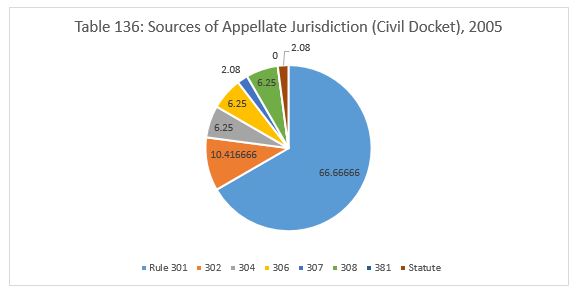
In Table 136, we report the data on the Court’s civil docket for 2005, with each source of jurisdiction measured as a percentage of the whole.  Appeals from final judgments increased somewhat from 61% in 2004 to two-thirds (32 cases) in 2005.  Appeals under Rule 302 dropped slightly from 2004 to 2005.  Rule 306 appeals – interlocutory appeals by permission – dropped by about one third, and appeals under Rules 304, 306 and 308 were remained at about the same level in 2005 as they were in 2004.

Table 136

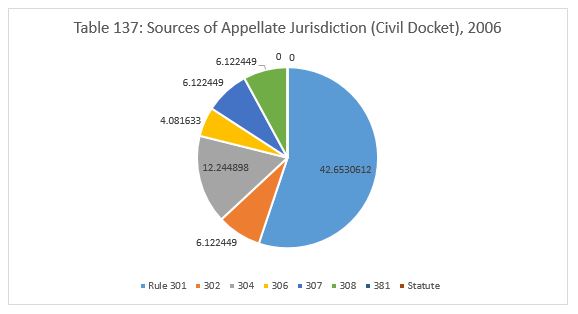
In Table 137 below, we report the data for the civil docket in 2006.  Appeals from final judgments were sharply down as a fraction of the entire docket, as were Rule 302 appeals.  On the other hand, appeals pursuant to Rules 304 (“final” judgments disposing of less than all parties) and 307 (interlocutory appeals as of right) were sharply up.  Rule 306 appeals were down in 2006 by one third as a fraction of the civil docket.  Appeals under Rule 308 (certified questions) remained at almost exactly the same level of the civil docket as they were in 2004.

Table 137

Table 138 below reports the data for the civil docket in 2007.  Appeals from final judgments pursuant to Rule 301 returned to the level they were in 2005.  Rule 302 appeals were up by fifty percent in 2007.  Appeals under Rules 304 and 308 were static as a fraction of the Court’s civil docket, but the Court heard no cases at all in 2007 pursuant to Rules 306 or 307.

Table 138

Appeals pursuant to Rule 301 drifted even higher in 2008 (30 cases), as shown in Table 139.  Appeals under Rule 302 and 308 were sharply down, although Rule 304 appeals were up by one third as a fraction of the total civil docket.

Table 139

In Table 140 below, we report the data for 2009.  The fraction of the docket accounted for by Rule 301 moved even higher, topping out at 73.8% of the Court’s civil docket.  Appeals pursuant to Rule 302 were 4.8% of the Court’s docket – double the level one year earlier.  On the other hand, Rule 304 appeals were sharply down.

Table 140

Join us tomorrow as we compare the data for the civil docket to the numbers for the criminal docket between 2005 and 2009.

Image courtesy of Flickr by John Morgan (no changes).

———————————————————————

[1]              While we were expanding the data library to encompass all of the Court’s decisions, we revisited the opinions we had previously assigned to the civil side of the docket.  Ultimately, on further consideration, we reassigned just below two percent of the collection from criminal to civil or vice versa.  Accordingly, the data we report on the civil side will not precisely match in all cases the numbers we discussed last spring.

21930415010_fec084fcb6_z

Yesterday, we announced the expansion of our data library on the work of the Illinois Supreme Court to encompass all of the Court’s decisions since January 1, 2000 – civil, criminal, quasi-criminal and disciplinary.  Today, we begin the next phase of our analysis of the Court’s work.

We begin by revisiting one of the first issues we addressed last year – does the Court exhibit any preference for reviewing final over interlocutory decisions from the trial courts?

Table 134 charts the sources of appellate jurisdiction for the Court’s civil docket between the years 2000 and 2004, the first five years of our sixteen-year study period. In all years, final decisions reviewed under Supreme Court Rule 301 are the biggest part of the Court’s civil docket, but not overwhelmingly so.  In 2000, 65.8% of the Court’s civil docket (25 cases) arose under Rule 301.  Two years later, the fraction rose slightly to 70% (35 cases), but in each of the other three years, Rule 301 accounted for between 58 and 61% of the Court’s civil docket.

Rule 302 – direct appeals to the Supreme Court from the trial courts, typically in cases where a Circuit Court has struck down a statute – amounted to only 2.6% of the Court’s civil docket in 2000, but increased to 11.8% in 2001 (6 cases).  Although the fraction accounted for by Rule 302 dipped slightly in 2003 and 2004, it returned to just over 11% in 2004.

Rule 304 governs appeals of final judgments in certain enumerated special proceedings and “final” judgments which don’t dispose of all claims against all parties (most Rule 304 orders require a special finding by the trial court).  Rule 304 appeals were 13.2% of the Court’s civil docket in 2000 (5 cases), and increased slightly the following year to 15.7% of the docket (8 cases) before dipping a bit in the succeeding years.

The remaining sources of civil jurisdiction played more minor roles in the Court’s docket.  Rule 306 – interlocutory appeals by permission – was 13% of the civil docket in 2003 (6 cases), but only 2% the previous year.  The Court heard no Rule 306 cases at all in 2000-2001 and 2004.  Rule 307 (interlocutory appeals as of right) and Rule 308 appeals (certified questions) amounted to between four and eight percent of the Court’s civil docket in most of these years.  Certified questions from the Seventh Circuit, statutory appeals and appeals based on constitutional provisions were an even smaller presence on the civil docket, never amounting to more than 2-3% of the total.

Table 134

Now let’s contrast those results with the criminal docket during the same years.  Perhaps because of the prevalence of death penalty and habeas corpus appeals, appeals from final criminal judgments under Supreme Court Rule 602 comprised a much smaller fraction of the criminal docket than Rule 301 appeals did on the civil side, ranging from 23.8% of the docket in 2000 (20 cases) to 32.1% the following year before rising to a high of 45.6% in 2004 (26 cases).  Habeas cases were the second biggest fraction of the criminal docket throughout the period, even outpacing Rule 602 appeals in 2000 (34.5% – 29 cases) and 2002 (27.1% – 19 cases) before dropping to around 10% in 2003 and 2004.  Death penalty appeals under Rule 609 were a significant concern as well – 20.2% of the Court’s criminal docket in 2000 (17 cases) and 13.2% the following year (7 cases) before dropping to only 2.9% in 2002 (2 cases).

Appeals under Rule 603 (direct appeals where a statute has been struck down) and Rule 604 (most appeals by the State, and appeals following guilty pleas and regarding bail decisions by the defendant) were a significant part of the Court’s docket, but varied significantly from one year to the next.  For example, in 2000, Rule 603 amounted to 4.8% (4 cases) of the Court’s criminal docket.  The next year, the Court heard no Rule 603 cases at all, but by 2003, Rule 603 appeals constituted 26.6% (17 cases) of the criminal/quasi-criminal/disciplinary docket.  Similarly, Rule 604 appeals were only 7.1% of the criminal docket in 2000 – 6 cases – but rose to 18.6% and 20.3% in 2002 and 2003, when the Court heard 13 such cases each year.

Cases arising from statutory, constitutional and Supreme Court Rule 753 (attorney disciplinary) matters amounted to an insubstantial part of the Court’s docket throughout this initial five-year period.  The Court heard 4 disciplinary cases in 2000 – 4.8% of this docket – but such cases amounted to less than 2% of the docket in 2002, 2003 and 2004.  The Court heard 7 criminal cases based on various kinds of statutory jurisdiction in 2004 – 12.3% of this docket – but otherwise, statutory cases were in medium-to-low single digits as a fraction of this docket, as were cases based on constitutional jurisdiction.

Table 135

Join us back here next Tuesday as we continue our examination of the Court’s docket with a look at the years 2005-2009.

Image courtesy of Flickr by Open Grid Scheduler (no changes).


4412634609_f9e23dc42d_zToday, we announce a major expansion of the data library that powers The Illinois Supreme Court Review. For the past year, our analysis of the Illinois Supreme Court’s work has been based upon a data library consisting of the 620 civil cases decided by the Court since January 1, 2000.

For the past several months, we’ve been hard at work expanding the data. Beginning today, our analysis will be based on a data library encompassing all of the Court’s decisions since 2000 – civil, criminal, quasi-criminal, juvenile and disciplinary. Through the end of 2015, this amounts to 1,493 opinions – collectively, more than 89,400 data points drawn from every one of the Court’s decisions for the entire high court careers of all but one of the current Justices. As a result, we can now base our analysis on the entire landscape of the Court’s work, as well as contrasting the Court’s decision making in its civil and criminal dockets.

As a reminder, our data fields are:

Table_132

Table_133

Join us back here tomorrow as we begin the next phase of our analysis of the Court’s work.

Image courtesy of Flickr by Matt Turner (no changes).

5579739816_5745e63f94_zFor the past few weeks, we’ve been concluding our quick trip through the oral arguments in criminal cases decided at the Illinois Supreme Court during 2015 by looking at the Justices’ question patterns, one-by-one, to determine what we can infer about the result and opinion writing. Today, we conclude our analysis with a look at the patterns for Justices Karmeier and Theis.

In Table 130, we present the data for Justice Karmeier’s patterns when he’s voting with the majority. Note that Justice Karmeier tends to average more questions to the losing party – questioning the appellee more heavily in reversals, and the appellant more in affirmances. Writing has a significant impact on Justice Karmeier’s questioning patterns in all cases. He averages more questions when writing the majority opinion than when he’s not writing regardless of the result (reversal or affirmance) and the side. The effect of writing is particularly significant in affirmances.

Table 130

In Table 131 below, we show the data for Justice Mary Jane Theis. Justice Theis tends to question the appellant more heavily regardless of the result, as opposed to Justice Karmeier’s pattern. Once again, writing has a significant impact – Justice Theis averaged significantly more questions this year to appellants when the Court reversed, and to both sides when the Court affirmed.

Table 131

Join us back here next Tuesday morning for a major announcement, as we begin the third phase of our data analytic look at the Illinois Supreme Court’s decision making. And with that, we conclude our first year at the Illinois Supreme Court Review – happy New Year to all!

Image courtesy of Flickr by Matthew Harrigan (no changes).

9423385629_171671f9c2_zToday we continue our Justice-by-Justice review of the questioning patterns for criminal, quasi-criminal and disciplinary cases decided during 2015, checking our conclusions against our work in the summer and fall with civil cases decided since 2008. Today, we review the data for Justice Freeman, Chief Justice Garman and Justice Thomas, working our way from left to right across the bench. We concentrate on cases in which the Justices voted with the majority – given the small dissent rate in criminal cases, the data for cases in which they didn’t vote with the majority is minimal.

In Table 127 below, we report the data for Justice Freeman. As we saw in our review of the civil cases, Justice Freeman is unusual in that one can’t reliably infer that he’s writing an opinion from close attention to the level of his questioning at oral argument. The same thing is true of our criminal case sample. With both reversals and affirmances, Justice Freeman asked slightly more questions when he wasn’t writing than he did when he wrote the majority opinion.

Table 127

In Table 128, we report the data on cases in which Chief Justice Garman voted with the majority. Here, there is some indication that writing may have an impact. For example, the Chief Justice averages more questions to appellants when she is writing an opinion – either the majority or a special concurrence – and more questions to appellees when she is writing a special concurrence. We have no basis for making an inference when it comes to affirmances, however – the Chief Justice wrote no opinions this year in cases in which she voted with the Court to affirm.

Table 128

In Table 129 below, we report the data for cases in which Justice Thomas voted with the majority. Here, we see the expected pattern – for either side in reversals, and for appellants in affirmances, Justice Thomas averages significantly more questions when writing the majority opinion than he does when he’s not writing.

Table 129

Join us back here tomorrow as we complete our review of the Court’s criminal arguments from 2015 – and our first year at Illinois Supreme Court Review – with a look at the question patterns for Justices Karmeier and Theis.

Image courtesy of MorebyLess (no changes).