Yesterday, we looked at the data for the number and type of insurance law cases the Court has decided, year-by-year, since 1990, as well as the insurers’ winning percentage in those cases.  Today, we’re reviewing the individual Justices’ voting records in insurance law cases.

In Table 1065, we show yearly votes for insurer parties for the years 1990 to 1999.  We’ll get to specifics later in the post, but several Justices who tended overall to vote with insurer parties at a bit over the courtwide average served in this decade and the next, including Justices Rathje, Heiple, Nickels and Miller.  Leaving aside Justices who were concluding their tenure in 1990, the only Justice in the chart who tended to vote for insurer parties somewhat less often than his colleagues was Justice Bilandic.


In the next Table, we see the Justices’ votes against insurer parties between 1990 and 1999.

In Table 1067, we review Justices’ votes for insurer parties between 2000 and 2009.  Justices supporting insurer parties at a higher than courtwide rate in this table include Justices Karmeier, Burke, McMorrow and Freeman.

And in Table 1068, we review the Justices’ votes against insurer parties.  Among the names on this list, Justices whose rate of voting with insurers was at least somewhat lower than the firmwide rate, we have Justices Garman, Thomas, Harrison and Fitzgerald.

And next, we report the votes in favor of insurer parties, Justice by Justice, for the years 2011 to 2018.  The Court decided no insurance cases in 2014, 2016 or 2017.

In the chart below, we report the yearly votes cast by each Justice against insurer parties for the years 2011 to 2018.

Finally, let’s take a look at the Justices’ cumulative voting record in insurance cases.  First, we calculate for each Justice the percentage of his or her total insurer votes which were cast for insurers between 1990 and 2018.  For the entire period, insurers had a winning percentage at the Court of 53.41% – forty-seven wins, forty-one losses.  So we divide the Justices into two tables – Justices voting for insurers at a higher rate than the full Court and Justices voting for insurers less often than the full Court (in reviewing the tables, keep in mind that several Justices’ percentages will either be very high or very low because they were close to retirement in 1990, when our data starts, or in Justice Neville’s case, because of joining the Court in 2018).

Justice Rathje voted with the insurer 80% of the time in insurance cases.  Three Justices are in the sixties – Justice Theis (66.67%), Justice Heiple (65%) and Justice Nickels (60%).  Six Justices were in the fifties but ahead of the courtwide number of 53.41% – Justice Karmeier (58.06%), Justice Miller (56.82%), Justibe Burke (56.52%), Justice McMorrow (56.25%), Justice Freeman (55.56%) and Justice Cunningham (also 55.56%).

In Table 1072, we report the Justices who were at least a bit less likely to support insurers than the Court overall.  Justice Garman’s insurer rate was 51.16%.  Seven Justices were in the forties – Justice Thomas (47.62%), Justice Harrison (47.06%), Justice Fitzgerald (46.88%), Justices Clark and Moran (both 46.15%), Justice Kilbride (43.9%) and Justice Bilandic (41.18%).  Justices Stamos, Ryan and Ward, each of whom left the Court in 1990, voted with insurers only a third of the time.  And finally, three Justices whose tenures only slightly overlapped our study period, Justices Calvo, Rarick and Neville, did not vote for the insurance company in any of their insurance cases.

Join us back here next Tuesday as review the same metrics for another important area of the law.

Image courtesy of Flickr by Brian Crawford (no changes).

Today and tomorrow, we’re going to be taking a close look at how insurance companies have been doing since 1990 in appeals at the Supreme Court.  Today, we’ll review the data about the types of cases the Court has heard, and insurers’ won-loss record year by year and overall, and tomorrow, we’ll be looking at the Justices’ individual voting records, and determining which Justices were more likely than the Court as a whole to vote in favor of insurer parties, and which Justices were less likely to.

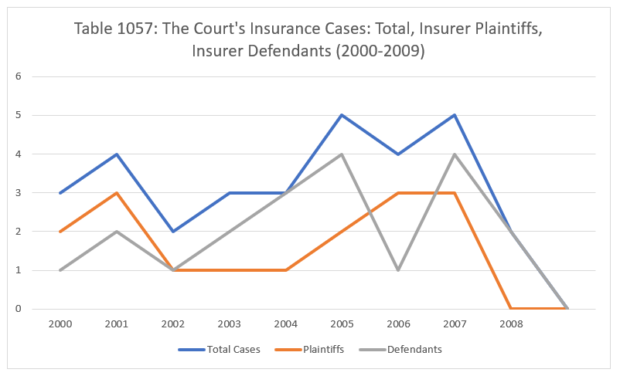
As a named party in litigation, insurers can be on either side of the “v.” – plaintiffs or defendants, depending on the issue involved.  In Table 1056, we begin reviewing the data for (1) how many cases per year did the Court decided and (2) in how many was an insurer the plaintiff, and how many the defendant.  Occasionally, the total of plaintiff plus defendant cases totals more than the “total cases” column – this represents cases in which an insurer was on both sides of the “v.”

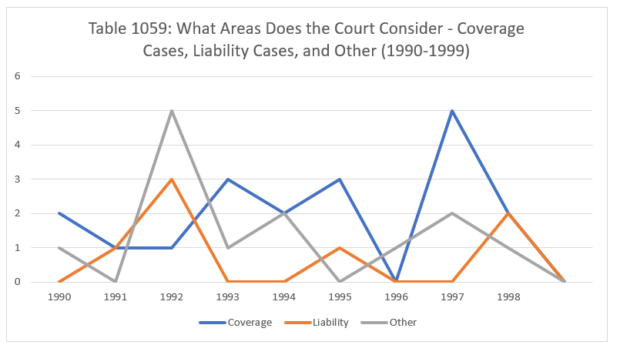
During the nineties, the Court decided a total of forty-two cases primarily involving insurance law issues.  That docket wasn’t a steady flow of cases from one year to the next; although the Court tended to decide three to four cases in most years, there were recurring spikes (total cases are tracked below in the blue line).  The Court decided nine insurance cases in 1992 and seven in 1997.  The Court decided only one insurance case in 1996.  In most years, insurer defendants outnumbered insurer plaintiffs.  For the nineties as a whole, 40.5% of insurer parties were plaintiffs to 59.5% defendants.

Between 2000 and 2009, the flow of insurance cases was a bit more predictable from year to year, albeit down a bit from the nineties.  For the ten years, the Court decided thirty-three insurance cases in all.  The spread between plaintiffs and defendants was closer too – 47.4% of the cases had insurer plaintiffs, 52.6% had insurer defendants (in this decade, there were several “insurer v. insurer” cases).

Since 2010, insurance law cases have continued to decline, as we see in Table 1058.  Between 2010 and 2018, the Court has decided only thirteen insurance cases, including none in 2014, 2016 or 2017.  For the first time, plaintiffs outnumbered defendants, with 69.23% of the cases involving an insurer plaintiff and only 30.77% an insurer defendant.

Next, let’s take a look at what these cases involved.  Although our data on the areas of law involved in far more granular, broadly speaking, insurance cases can be divided into “coverage,” “liability” and “other.”  In Table 1059, we follow the numbers for each group.  Overall, between 1990 and 1999, the Court decided twenty-two coverage cases, only seven liability cases, and thirteen cases that were “other.”

Between 2000 and 2009, the Court decided twenty-seven cases dealing with coverage issues, five dealing with liability issues, and none in the “other” category.

The Court has decided almost no cases since 2010 involving anything other than coverage decisions.  From 2010 to 2018, the Court has decided eleven coverage cases, one liability case, and no “other.”

Finally, we turn to the most fundamental statistic of all – the insurers’ win-loss record.  Between 1990 and 1999, insurers have had a won-loss record at the Court of 25-17 – a winning percentage of 59.52%.

Between 2000 and 2009, things shifted a bit towards the insurers’ opponents.  For the entire period, insurers had a won-loss record of 17-16.  Between 1990 and 2009, insurers had a winning percentage at the Court of 56%.

Between 2010 and 2018, insurers’ winning percentage weakened at the Court.  For those years, insurers were 5-8.  For the entire period of 1990 to 2018, insurers were 47-41: a winning percentage of 53.41%.

Join us back here tomorrow as we turn our attention to the individual Justices’ voting records in insurance cases.

Image courtesy of Flickr by Tomosius (no changes).


Today, we’re finishing our review of the agreement rates for the Justices between 2014 and 2018.  If you get the impression reading the data below that the agreement rates for criminal cases below are consistently lower than the agreement rates on the civil side during the same years reviewed here, you’re right.  I calculated an “average agreement rate” for each Justice – add up the agreement rates for each Justice below and divide by the number of observations – then did the same thing for the civil data.  Average civil agreement rates per Justice range from a high of 76.67 (Justice Neville) to a low of 43.03 (Justice Kilbride).  On the criminal side, average agreement rates range from a high of 60.71 (Justice Theis) to a low of 46.9 (Justice Burke).  In other words, excepting only Justice Kilbride, each individual Justice’s average civil agreement rate is higher than any Justice’s average criminal agreement rate – suggesting that the Justices’ philosophies in criminal law diverge from one another significantly more than they do on the civil side.

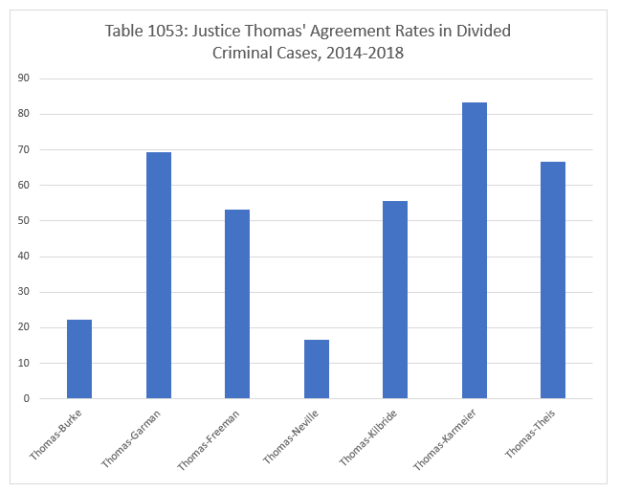
Justice Burke’s closest match was Justice Neville, in his part year in 2018, at 83.33.  Next was Justice Freeman at 70%.  Two Justices were in the forties – Justice Kilbride (44.44%) and Justice Garman (41.67%).  Two more were in the thirties – Justice Theis (36.11%) and Justice Karmeier (30.56%).  Finally, Justices Thomas and Burke had an agreement rate of only 22.22%.

No fewer than five colleagues had an agreement rate with Justice Garman in the sixties – Justices Thomas and Theis (69.44%), Justices Kilbride and Karmeier (63.89%) and Justice Freeman (60%).  Justices Garman and Burke were at 41.67%, and Justices Garman and Neville had an agreement rate of 33.33%.

Justice Freeman’s agreement rate with Justice Burke was 70%.  He had an agreement rate in the sixties with Justice Theis (66.67%) and Justice Garman (60%).  The remaining Justices were all in the fifties – Justices Kilbride (56.67%), Thomas and Karmeier (both 53.33%).

Because his part year in 2018 produced a very small data set, Justice Neville’s agreement rates spread across a very wide range.   He agreed with Justice Burke in 83.33% of cases.  His agreement rate with Justice Kilbride was 66.67%.  He agreed half the time with Justice Theis.  He had an agreement rate of 33.33% with Justices Garman and Karmeier.  Finally, Justices Neville and Thomas had an agreement rate of 16.67%.

Justice Kilbride had an agreement rate in the sixties with four Justices – Theis and Neville (both 66.67%) and Karmeier and Garman (63.89%).  Justice Kilbride and Freeman had an agreement rate of 56.67%, and Justices Kilbride and Thomas were at 55.56%.  Justices Kilbride and Burke had an agreement rate of 44.44%.

Justices Thomas and Karmeier had an agreement rate of 83.33%.  Two Justices were in the sixties – Justice Garman at 69.44% and Justice Theis at 66.67%.  Two more were in the fifties – Justice Kilbride at 55.56% and Justice Freeman at 53.33%.  Justices Thomas and Burke had an agreement rate of 22.22%, and as noted above, Justices Thomas and Neville were at 16.67%.

As we just mentioned, Justices Karmeier and Thomas had an agreement rate of 83.33%.  Justices Karmeier and Theis were at 69.44%, and Justices Kilbride and Garman both had agreement rates with the current Chief Justice of 63.89%.  Justices Karmeier and Freeman had an agreement rate of 53.33%.  Justice Neville had a rate of 53.33%, and Justices Karmeier and Burke were at 30.56%.

Five of Justice Theis’ colleagues had an agreement rate with her in the sixties – Justices Garman and Karmeier (69.44%), and Justices Freeman, Kilbride and Thomas (all 66.67%).  Justice Theis and Justice Neville had a rate of 50%, and Justices Theis and Burke agreed only 36.11% of the time.

Join us back here next Tuesday as we turn our attention to a new topic.

Image courtesy of Flickr by Brian Crawford (no changes).

For the past few weeks, we’ve been looking at the data for the Justices’ agreement rates in non-unanimous cases – in other words, how often did each possible combination of the seven Justices vote the same way in a case which had at least one dissenter.  Today, we’re looking at criminal cases between 2008 and 2013.  For purposes of the agreement rates, the only thing we’re looking at is the outcome – even if Justice A signed the majority opinion affirming, and Justice B wrote a special concurrence saying that she agreed that the decision below had to be affirmed, but otherwise disagreed with everything in the majority opinion, that’s still agreement for our purposes.  Since we’re now in a period with nearly the same Justices we have today, we’re arranging the data Justice by Justice in order to better identify each Justices’ leanings.

Justice Burke’s closest match by far was Justice Freeman, with an agreement rate of 86.15%.  Three Justices were in the forties – Justice Theis (48.48%), Justice Kilbride (47.69%) and Justice Fitzgerald (46.88%).  Justices Burke and Karmeier had an agreement rate of 35.94%.  The last two Justices were in the twenties – Justice Thomas (27.69%) and Garman (26.15%).

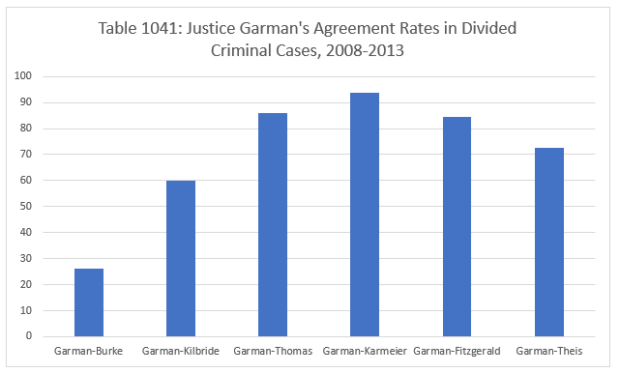
Justice Garman’s closest match was Justice Karmeier at 93.75%, but Justice Thomas (86.15%) and Justice Fitzgerald (84.38%) were right behind.  Justices Garman and Theis had an agreement rate of 72.73%.  Justices Garman and Kilbride were at 60%, and Justices Garman and Burke were at 26.15%.

As we mentioned above, Justices Freeman and Burke had an agreement rate of 86.15%.  Justices Freeman and Theis were at 51.52%.  Justices Kilbride and Fitzgerald were in the forties – 49.23% and 40.63%, respectively.  Justice Karmeier (34.38%) and Garman (30.77%) were in the thirties.  Justices Freeman and Thomas agreed in only 29.23% of divided criminal cases.

Justice Kilbride’s closest match during these years was Justice Fitzgerald at 75%.  Four Justices were in the sixties – Theis (66.67%), Karmeier (62.5%), Thomas (61.54%) and Garman (60%).  Justices Kilbride and Freeman had an agreement rate of 49.23% and Justices Kilbride and Burke were at 47.69%.

Justice Thomas’ closest match was Justice Karmeier, with an agreement rate of 92.19%.  Justices Thomas and Garman were at 86.15%.  Justices Thomas and Fitzgerald were at 71.88%.  Two Justices were in the sixties – Justice Theis (63.64%) and Kilbride (61.54%).  Two Justices were in the twenties – Justice Freeman (29.23%) and Burke (27.69%).

Justice Karmeier’s agreement rate during these years was in the nineties with both of his current Republican colleagues – Justice Garman (93.75%) and Justice Thomas (92.19%).  He agreed in 83.87% of divided criminal cases with Justice Fitzgerald.  Two Justices were in the sixties – Justice Theis (66.67%) and Justice Kilbride (62.5%).  Two were in the thirties – Justice Burke (35.94%) and Justice Freeman (34.38%).

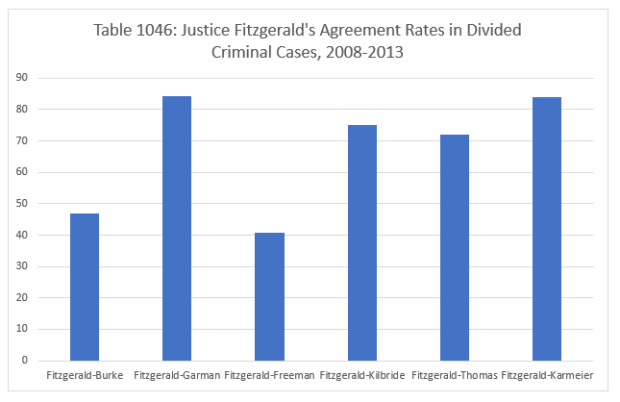
Justice Fitzgerald (who was Chief Justice in the final years of his tenure) agreed with two Republicans at least eighty percent of the time – Justices Garman (84.38%) and Karmeier (83.87%).  Two Justices were in the seventies – Justice Kilbride (75%) and Justice Thomas (71.88%).  Two more were in the forties – Justice Burke (46.88%) and Justice Freeman (40.63%).

Finally, Justice Theis’ closest match was Justice Garman, at 72.73%.  Three more Justices were in the sixties – Justices Kilbride and Karmeier (both at 66.67%) and Thomas (63.64%).  Justice Freeman was at 51.52% and Justices Theis and Burke agreed in 48.48% of divided cases.

Join us back here next time as we turn our attention to the years 2014 to 2018.

Image courtesy of Flickr by ForestWander.com (no changes).

Last time, we reviewed the Justices’ agreement rates in divided criminal decisions between 1996 and 2001.  In this post, we’re looking at the data for the years 2002 to 2007.

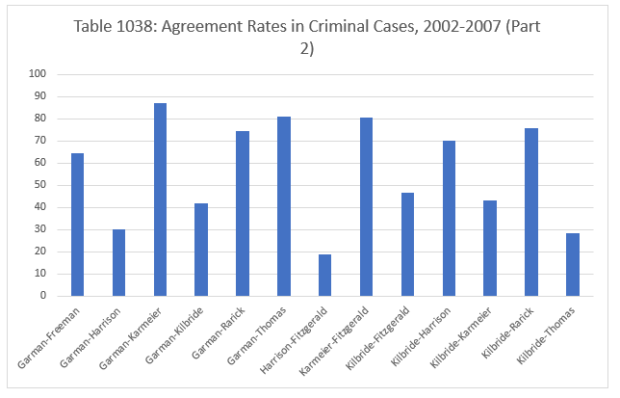
Because Justice Burke only joined the Court in 2006, her agreement rates vary widely among her colleagues – Justice Freeman 100%, Justices Fitzgerald, Garman and Thomas 44.44%, Justice Karmeier 33.33% and Justice Kilbride 22.22%.  Justice Freeman had an agreement rate of 88.37% with Justice Rarick, 69.81% with Justice Fitzgerald, 58.06% with Justice Karmeier, 55.66% with Justice Kilbride, 49.07% with Justice Thomas and only 25% with Justice Harrison.  Justices Garman and Fitzgerald had an agreement rate of 88.46%.

Justices Garman and Karmeier had an agreement rate of 87.1%.  Justices Garman and Thomas were close behind at 81.13%.  Justice Garman had an agreement rate of 74.42% with Justice Rarick, 64.42% with Justice Freeman, 41.9% with Justice Kilbride and 30% with Justice Harrison.  Justices Harrison and Fitzgerald had an agreement rate of 18.75%.  Justices Karmeier and Fitzgerald were at 80.65%.  Justice Kilbride’s agreement rates were 75.56% with Justice Rarick, 70% with Justice Harrison, 46.73% with Justice Fitzgerald, 43.33% with Justice Karmeier and 28.44% with Justice Thomas.

Justice McMorrow’s closest match during these years was Justice Rarick at 88.89%.  Her agreement rate was 88.42% with Justice Freeman and 70.83% with Justice Fitzgerald.  Justices McMorrow and Garman were at 65.96%, and her rates with Justices Kilbride, Karmeier and Thomas were all in the fifties (53.61%, 52.63% and 51.02%, respectively).  Justices McMorrow and Harrison had an agreement rate of only 19.05%.  Justices Rarick and Fitzgerald were at 74.47%.  Justice Thomas’ closest march was Justice Karmeier: 90.32%.  Justices Thomas and Fitzgerald were at 74.08%.  Justices Thomas and Rarick had an agreement rate of only 37.78%, and Justices Thomas and Harrison were at 30%.

Join us back here next week as we conclude our agreement rates series with the years 2008-2013 and 2014-2018.

Image courtesy of Flickr by Dun.can (no changes).

Today, we’re continuing our look at the agreement rates for every possible combination of Justices in criminal cases by reviewing the data for the years 1996 to 2001.

Justice Freeman’s highest agreement rate during these years was with Justice Fitzgerald, 86.96%.  Justice Rathje was next at 74.07%.  Three Justices were in the sixties – Bilandic (69.08%), Thomas (65.22%) and Nickels (63.49%).  Two more were in the fifties – Justices Kilbride (56.52%) and Heiple (56.49%).  Finally, Justices Freeman and Harrison had a criminal agreement rate of only 44.32%.

Justice Garman had an agreement rate of 93.75% with Justice Fitzgerald, and of 81.25% with Justice Freeman.  Her agreement rate with Justice Harrison was only 18.75%.

Justices Garman and Thomas had an agreement rate of 87.5% for these years.  Justices Garman and Kilbride were at 43.75%.  Justice Harrison had an agreement rate of 65.22% with Justice Kilbride.  His rate with Justice Heiple was 43.06%.  Justices Harrison and Bilandic were at 42.76%, and Harrison and Fitzgerald agreed in only 39.13% of divided cases.  Justice Heiple had an agreement rate of 71.6% with Justice Rathje, 68.21% with Justice Bilandic, and 63.49% with Justice Nickels.  Justice Kilbride had an agreement rate of 56.52% with Justice Fitzgerald, and 30.44% with Justice Thomas.

In the next Table, we report the data for Justice McMorrow.  Her closest match among colleagues during this period was Justice Fitzgerald, with an agreement rate of 86.96%.  Justices McMorrow and Garman had a rate of 81.25%.  Justices McMorrow and Freeman were at 78.41%.  Justice McMorrow had an agreement rate in the sixties with four of her colleagues – Justices Nickels (67.74%), Bilandic (64.71%), Rathje (63.41%), Miller (61.84%) and Thomas (60.87%).  Justices McMorrow and Heiple were at 56.58%.  Justice McMorrow’s agreement rate with two colleagues was in the forties – Justices Kilbride (48.73%) and Harrison (44.25%).

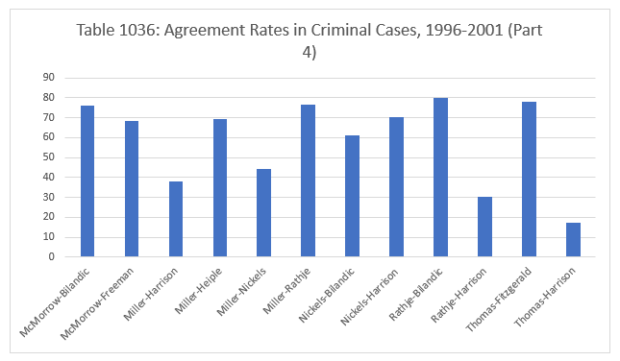
Justice McMorrow had an agreement rate of 76.16% with Justice Bilandic, and 68.63% with Justice Freeman.  Justices Miller and Rathje had an agreement rate of 76.54%.  Justices Miller and Heiple were at 69.28%.  Justices Miller and Nickels were at 44.44%.  Justices Miller and Harrison were at 38.16%.  Justice Nickels and Justice Harrison had an agreement rate of 70.49%.  His agreement rate with Justice Bilandic was 61.29%.  Justice Rathje’s agreement rate with Justice Bilandic was 79.75%.  With Justice Harrison, it was 30.34%.  Justice Thomas agreed with Justice Fitzgerald in 78.26% of divided criminal cases during these years, but with Justice Harrison in only 17.39%.

Join us back here next time as we turn our attention to the years 2002 through 2007.

Image courtesy of Flickr by SearchFunction (no changes).


Today, we start the second part of our ongoing analysis of agreement rates among the Justices since 1990 – the criminal docket.  We proceed just as we did with the civil docket, tracking agreement rates in non-unanimous cases.  “Disagreement” is defined as two Justices not voting exactly the same way with respect to the judgment – in other words, if one Justice votes to affirm and another to affirm in part and reverse in part, that’s a disagreement.  On the other hand, when the second Justice votes to affirm but files a special concurrence saying that he or she disagrees with some or all of the majority’s rationale, that’s still agreement with respect to the result.  Finally, because the Court had significant turnover in its members during the 1990s, we expect the numbers to be a bit more volatile during that period than the Court’s most recent years.  We begin with the years 1990 to 1995.

Justice Calvo had an agreement rate of 100% with Justice Bilandic, and 81.82% with Justice Ward.  Justice Clark’s agreement rates show his philosophy closest to Justice Freeman (71.88%), Justice Bilandic (70.37%), Justice Calvo (68.42%), Justice Cunningham (68.18%) and Justice Moran (65.91%).  His agreement rate with Justice Ward was 50%.  His agreement rate with Justices Stamos and Ryan was identical – 41.67%).  His agreement rate with Justice Heiple was 29.63%, and with Justice Miller, it was even lower: 18.18%.  Justices Cunningham and Bilandic had an agreement rate of 81.82%, and Justices Bilandic and Freeman were at 63.33%.

Justices Freeman and Calvo had an agreement rate of 87.5%.  His rate was in the seventies with two Justices – Nickels (79.03%) and Moran (78.13%).  His agreement rate with Justice Cunningham was 68.18%, and with Justice Harrison, it was 67.21%.  Justices Freeman and Heiple had an agreement rate of 48.89%.  That number was comparatively low compared to Justice Heiple’s agreement rates with other colleagues: Justice Nickels, 61.29%; Justice Moran, 59.26%; Justice Cunningham, 57.14%; and Justice Calvo, 50%.  His agreement rate with Justice Harrison was 36.07%.  Justice Harrison’s agreement rate with Justice Bilandic was nearly identical – 41.27%.  Justice McMorrow had an agreement rate with Justice Freeman of 67.74%, and with Justice Bilandic of 62.9%.

Justice McMorrow had an agreement rate with Justice Nickels of 85.25%.  Her rate with Justice Harrison was 61.67%, with Justice Miller, 54.84%, and with Justice Heiple, 48.39%.  Justice Miller had two agreement rates for this period in the sixties, with Justices Nickels and Heiple (67.74% and 65.56%, respectively).  His agreement rate was in the fifties with six different Justices – Bilandic, 56.67%; Freeman, 55.79%; Cunningham, 54.55%; Moran, 52.27%; Ryan and Stamos (both 50%).  His agreement rate with Justice Calvo was 42.11% and with Justice Harrison, 39.34%.

Justice Moran’s agreement rate with Justice Cunningham was 95.45%, and with Justice Ward, 91.67%.  His agreement rate with Justice Calvo was 84.21%, and with Justice Bilandic, 81.82%.  Justice Nickels had an agreement rate with Justice Harrison of 66.67%.  His agreement rate with Justice Bilandic during these years was 59.68%.  Justice Ryan had an agreement rate of 75% with Justice Ward and 72.73% with Justice Calvo.  Justice Ryan’s agreement rate with Justice Moran was 66.67%.  Justice Stamos had an agreement rate of 91.67% with Justice Ward, a rate of 83.33% with both Justices Moran and Ryan, and of 72.73% with Justice Calvo.

Join us back here next Tuesday as we address two more periods in the criminal docket – 1996-2001 and 2002-2007.

Image courtesy of Flickr by Eric Fredericks (no changes).

For the past two weeks, we’ve been reviewing the Justices’ agreement rates in divided civil cases across the period 1990 to 2018, working six years at a time.  Today, we’ve reached our fifth and last post on the civil docket, reviewing the years 2014 to 2018.  As we did last time, to facilitate comparisons for a single Justice and his or her colleagues, we group the results Justice by Justice.

Justice Burke’s highest agreement rate was with Justice Neville.  Justices Burke and Neville agreed in all five divided civil cases last year after Justice Neville joined the Court.  Justices Burke and Freeman had an agreement rate of 79.31%.  Justices Burke and Theis had an agreement rate of 73.53%.  Justice Burke’s agreement rate was in the sixties for three of her four remaining colleagues (Justice Karmeier – 67.65%, Justice Thomas – 65.63%, and Justice Garman – 64.71%.

Justice Garman’s highest agreement rates in divided civil cases were with Justice Thomas (84.38%), Justice Neville (80%) and Justice Karmeier (79.41%).  Her agreement rate with three Justices was in the sixties – Justice Freeman (68.97%) and Justices Burke and Theis (both 64.71%).  She agreed with Justice Kilbride in only 47.06% of divided civil cases.

Justice Freeman’s closest two matches in terms of agreement rate were Justices Burke (79.31%) and Theis (75%).  Justices Freeman and Garman agreed in 68.97% of divided civil cases.  Justices Freeman and Thomas agreed in 59.38%, and Justices Freeman and Kilbride had an agreement rate of 52.94%.  Justice Freeman and Chief Justice Karmeier agreed in 44.12% of divided civil cases.

As we noted above, Justice Neville participated in five divided civil decisions in 2018.  He agreed with Justice Burke in all five, with Chief Justice Karmeier and Justices Garman, Thomas and Theis in four of five, and with Justice Kilbride in two of five.

Justice Kilbride’s agreement rate was over 50% only with Justice Freeman – 52.94%.  His rate with Justices Garman and Theis was 47.06%.  Justices Kilbride and Thomas had an agreement rate of 40.63%, and his rate with Justice Neville, as mentioned above, was 40%.  Justice Kilbride’s lowest agreement rate was with Chief Justice Karmeier – 32.35%.

Justice Thomas agreed with his two Republican colleagues in a large majority of divided civil cases – Chief Justice Karmeier, 87.5%, and Justice Garman, 84.38%.  Justices Thomas and Theis agreed 68.75% of the time.  Justices Thomas and Burke had an agreement rate of 65.63%.  Justices Thomas and Freeman agreed 59.38% of the time.  Justices Thomas and Kilbride agreed in only 40.63% of divided civil cases.

With the exception of Justice Neville’s five cases in 2018, the Chief Justice’s highest agreement rates were with his Republican colleagues, Justices Thomas (87.5%) and Garman (79.41%).  Chief Justice Karmeier and Justice Burke had an agreement rate of 67.65%.  He agreed with Justice Theis in 58.82% of divided civil cases, and with Justice Freeman in 44.12%.  Chief Justice Karmeier agreed with Justice Kilbride only 32.35% of the time.

Justice Theis’ highest agreement rates among the Justices who served the entire six years were with Justice Freeman (75%) and Justice Burke (73.53%).  Justices Theis and Thomas agreed in 68.75% of cases, and Justices Theis and Garman had an agreement rate of 64.71%.  Justice Theis’ agreement rate with Chief Justice Karmeier was 58.82%.  Her agreement rate with Justice Kilbride was 47.06%.

Join us back here tomorrow as we begin our review of the Court’s criminal docket voting with the years 1990 through 1995.

Image courtesy of Flickr by Lisa Andres (no changes).

Yesterday, we reviewed the Justices’ agreement rates in civil cases for the years 2002 through 2007.  Today, we’re looking at the agreement rates for the next six years – 2008 through 2013, with one change.  Since we’re now getting into a period where nearly all the current members of the Court had begun their tenures, rather than presenting data several combinations at a time, we reorganize the data to compare a single Justice’s agreement rates with each other sitting Justice.  Of course, this creates a bit of repetition in the tables – to make comparisons easy, each pairing is repeated on both Justice’s charts.  In other words, the rate for “Burke-Karmeier” below is reported again on Justice Karmeier’s table as “Karmeier-Burke.”

We begin with Justice Burke.  Justice Burke’s closest match in civil cases during these years was Justice Freeman – the two Justices voted together in 84.85% of divided civil cases.  Next were Justice Theis at 67.5%, Justice Fitzgerald at 64%, Justice Garman at 62.12% and Justice Thomas at 60.66%.  Justices Burke and Karmeier agreed in 58.21% of divided civil cases.  Justices Burke and Kilbride agreed in only 36.36% of such cases.

The 84.85% agreement rates between Justices Freeman and Burke was Justice Freeman’s closest match also.  Justices Theis (67.5%), Fitzgerald (61.54%) and Thomas (59.02%) were next.  Justices Freeman and Garman agreed in 58.21% of divided civil cases, and Justices Freeman and Karmeier agreed 52.94% of the time.   Justice Freeman’s agreement rate with Justice Kilbride was the same as Justice Burke’s – 36.36%.

Justice Garman’s closest match during these years was Justice Thomas – the two agreed in 87.1% of divided civil cases.  Justices Karmeier (78.79%) and Theis (77.5%) were close behind.  Justices Garman and Burke agreed in 62.12% of cases, and Justices Garman and Fitzgerald agreed in 61.54%.  Justices Garman and Freeman agreed in 58.21% of civil cases, and Justice Garman agreed with Justice Kilbride 42.42% of the time.

Justice Kilbride’s closest match on the Court was Justice Fitzgerald, at 65.38%.  Justice Kilbride voted with Justice Theis in 52.5% of cases, and with Justice Thomas in 50%.  Justice Kilbride and Justice Garman’s agreement rate was 42.42%, and his agreement rate with Justice Karmeier was 40.3%.  His lowest agreement rates during these years were with Justices Freeman and Burke – both 36.36%.

Justice Karmeier’s highest agreement rates were, not surprisingly, with the other Republican Justices – Justice Thomas at 80.65% and Justice Garman at 78.79%.  Justices Karmeier and Theis agreed in 70% of divided civil cases.  Justices Karmeier and Fitzgerald agreed 62.96% of the time.  Justice Karmeier agreed with Justices Burke and Freeman 58.21% and 52.94% of the time, respectively.  Justice Karmeier’s lowest agreement rate was with Justice Kilbride – 40.3%.

Justice Thomas’ closest matches were Justice Garman at 87.1% and Justice Karmeier at 80.65%.  Justices Thomas and Fitzgerald had an agreement rate of 78.26%, and Justices Thomas and Theis were at 72.97%.  Justices Thomas and Burke agreed in 60.66% of divided civil cases.  His lowest agreement rates were with Justice Freeman (59.02%) and Kilbride (50%).

During these years, Justice Theis’ highest agreement rate was with Justice Garman (77.5%), followed by Justice Thomas (72.97%) and Justice Karmeier (70%).  Justice Theis’ agreement rate with Justices Burke and Freeman was identical at 67.5%.  Her lowest agreement rate was with Justice Kilbride at 52.5%.

Join us back here next week as we take the Court’s civil agreement rates up to the present day, and begin our trip through the data for divided criminal cases.

Image courtesy of Flickr by Bert Kaufmann (no changes).

Last week, we began our review, six years at a time, of the Justices’ agreement rates in civil cases.  First, we addressed the years 1990 through 1995, and then, we looked at the years 1996 through 2001.  Today, we’re turning our attention to the civil agreement rates for the years 2002 to 2007.

During these years, Justices Burke and Fitzgerald had relatively high agreement rates with several Justices.  Justices Burke and Freeman agreed 88.89% of the time.  Justice Burke agreed with both Justice Fitzgerald and Justice Kilbride 77.78% of the time.  Justice Fitzgerald voted with Justice Garman in 75% of divided cases and with Justice Freeman in 70.51%.  Justices Burke and Thomas agreed in 62.5% of cases, and Justices Freeman and Thomas voted together in 62.67%.  Justices Freeman and Karmeier agreed in 58.62% of divided civil cases.  Justice Freeman voted with Justice Rarick in 56% of cases and with Justice Kilbride in 53.85%.  Justices Burke and Karmeier voted together only 33.33% of the time, and Justices Freeman and Harrison were at 35.71%.  Finally, Justices Burke and Garman had an agreement rate of 28.57%.

Among our second group of combinations, Justices Kilbride and Harrison had the highest agreement rate – 84.62%.  Three sets of Justices were in the seventies: Justice Garman with Justices Karmeier (73.08%) and Thomas (79.17%), and Justices Karmeier and Fitzgerald (72.41%).  Justices Kilbride and Rarick had an agreement rate of exactly 60%.  Four combinations were in the fifties – Justices Garman and Freeman (55.26%), and Justice Kilbride with three Justices: Fitzgerald (58.44%), Karmeier (55.17%) and Thomas (50%).  Two combinations were in the forties – Justices Garman and Kilbride, and Justices Harrison and Fitzgerald (46.15%).  Justices Garman and Harrison were at 35.71%, and Justices Garman and Rarick agreed in only one-quarter of divided civil cases.

Our final group of combinations for the most part ran a bit lower than recent trends.  Two combinations, Justices McMorrow and Freeman (83.33%) and Justices Thomas and Fitzgerald (86.49%) were in the eighties.  Justices Thomas and Karmeier had an agreement rate of 76%.  Justices McMorrow and Fitzgerald (64.62%), Justices McMorrow and Karmeier (66.67%) and Justices Rarick and Fitzgerald (64%) were next.  Justices McMorrow and Garman were at 58.33%, and Justices McMorrow and Thomas agreed 59.38% of the time.  Four combinations of Justices had agreement rates in the forties – Justices McMorrow and Kilbride (41.54%), Justices McMorrow and Rarick (44%), Justices Thomas and Harrison (42.86%) and Justices Thomas and Rarick (44%).  Justices McMorrow and Harrison agreed in only 38.46% of divided civil cases.

Join us back here tomorrow as we address the years 2008 to 2013.

Image courtesy of Flickr by Michael Mooney (no changes).