4854192144_f659b8eb9a_zIn our last several posts, we considered how frequently the Illinois Supreme Court agrees to review summary judgments.

Next we consider the geographical sources of the Court’s civil docket.  The most obvious driver of caseload should be population – more residents equals more litigation, and therefore more candidates for possible Supreme Court review.  Therefore, as context for our results, we first identify the ten most populous counties in Illinois by percentage of total state population, as of the 2000 and 2010 censuses:

Table_5

One might speculate that the second most important factor driving the Court’s caseload geographically, after population, would be the offices of the state government, which are for the most part located in Springfield (Sangamon County) and to a lesser degree in Chicago (Cook County).  Since most (but by no means all) administrative appeals begin in the Circuit Courts rather than proceeding directly to the Appellate Court, if the Court has a significant interest in administrative law, caseload from those two counties should somewhat exceed the expected level due to population.

We begin with the first five years of the study period.  The data reported is cases arising from a particular county as a percentage of the Court’s decided civil caseload:

Table_6_AFor this initial five-year period, we see that Cook County accounts for a portion of the Court’s docket roughly proportional to its share of the state population.  Sangamon County is only slightly overrepresented, a difference accounted for by government cases.  Winnebago County is perhaps slightly underrepresented, while St. Clair County accounts for more cases than one would expect, based solely on population.

Next time, we’ll turn our attention to the second five years of our period, analyzing the geographic sources of the Illinois Supreme Court’s civil docket from 2005 to 2009.

Image courtesy of Flickr by Bert Kaufmann (no changes).


[1]           Jurisdictions accounting for one civil case each in 2000 were DuPage, Sangamon, Will, McHenry, Monroe, Franklin, Adams, Madison, Boone and Kane Counties, as well as the Illinois Pollution Control Board.

[2]           Jurisdictions accounting for one civil case each in 2001 were Lake, St. Clair, Kane, Kendall, Macon, Tazewell, Hardin, McDonough, Champaign and Jefferson Counties.

[3]           Jurisdictions accounting for one civil case each in 2002 were Will, Boone, Madison, McLean, Kankakee, DeWitt, Peoria, McHenry, Christian, Edgar and Kane Counties.

[4]           Jurisdictions accounting for one civil case each in 2003 were Lake, St. Clair, McHenry, Adams, Kane, Jefferson, Knox, Putnam, Rock Island, Coles, Pope and Vermilion Counties.

[5]           Jurisdictions accounting for one civil case each in 2004 were Sangamon, Will, Winnebago, Madison, McLean, Kane, Rock Island, Vermilion, Crawford and LaSalle Counties, as well as the Illinois Commerce Commission.

8103201165_498da54912_zLast time we began investigating whether the Illinois Supreme Court often accepts summary judgments for review on its civil docket, since (at least in theory), such cases present cleaner, purely legal issues for review.

Now we turn to a slightly different issue.  Since summary judgments should present clear legal issues with little room for factual disputes, one might expect them to spark somewhat less disagreement among the members of the Court.  To investigate this issue, we divide the summary judgments in our last post into cases decided unanimously by the Court, and cases which drew dissenters:

Table_4_B

Table 4B only partially supports our hypothesis.  During most of the first ten years of the study period, appeals from summary judgments did indeed form a large proportion of the Court’s unanimous decisions than of the non-unanimous ones.  But in more recent years, there are indications that that pattern may be reversing itself.

In our next post, we’ll turn to another series of questions: where in the state do the Illinois Supreme Court’s civil cases come from?

Image courtesy of Flickr by Ron Cogswell (no changes).

376900808_e6148e7227_zIn our last several posts, we’ve been addressing the jurisdictional origins of the Illinois Supreme Court’s civil docket – does the Court prefer final judgments, or does it often agree to review interlocutory decisions?

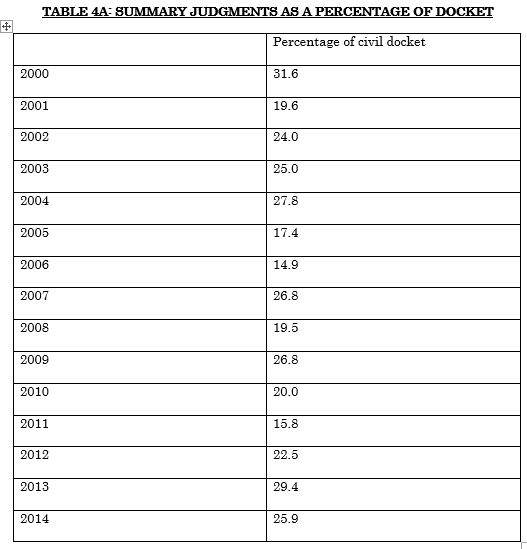
In this post, we turn to a slightly different subject.  Do summary judgments often reach the Court, since they present cleaner, purely factual issues?

During most of the study period, appeals from summary judgments have comprised between twenty and thirty percent of the Court’s civil docket:

Table_4_A

In our next post, we’ll address a related question: do summary judgments make for less disagreement on the Court, or more?

Image courtesy of Flickr by Jean-Etienne Minh-Duy Poirrier (no changes).


2949389569_1b6da5fcf8_zWe’ve been looking at the sources of appellate jurisdiction for the Illinois Supreme Court’s civil docket.  Does the Court prefer to review final decisions with fully formed records?  How often does the Court review interlocutory decisions?

Between 2000 and 2004, Rule 301 appeals comprised between sixty and seventy percent of the Court’s civil docket.

Between 2005 and 2009, appeals from final judgments remained more-or-less constant, which purely interlocutory appeals drifted downwards.

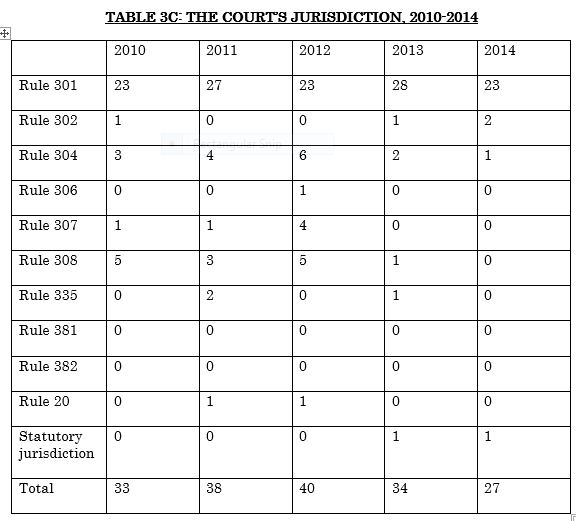
The final years of our study period includes the four years since Justice Mary Jane Theis replaced the retiring Chief Justice Thomas R. Fitzgerald.  Rule 301 appeals remain relatively constant, and aside from a one-year spike in 2012, purely interlocutory appeals have continued to comprise a smaller portion of the Court’s civil docket.  Although Rule 301 appeals from final judgments were a proportionally larger part of the Court’s civil docket in 2013, it remains to be seen whether that pattern will hold in 2014 and beyond:

Table_3_C_1

In our next post, we’ll examine whether the summary judgments present better or worse candidates for a petition for leave to appeal to the Illinois Supreme Court.

Image courtesy of Flickr by Aaron Vowels (no changes).

9684676149_d95f65161a_zIn our last post, we began looking at the sources of appellate jurisdiction on the Illinois Supreme Court’s civil docket.  Does the Court mostly review final decisions?  If the Court frequently hears interlocutory appeals on its civil docket, does it show a preference for any particular kind of interlocutory appeal – constitutional cases or appeals from injunctions – over other cases?

For the initial five years of our study, we concluded that Rule 301 appeals – appeals from final civil judgments – comprise between sixty and seventy percent of the Court’s civil docket.  The remainder of the Court’s docket was relatively stable from year to year.

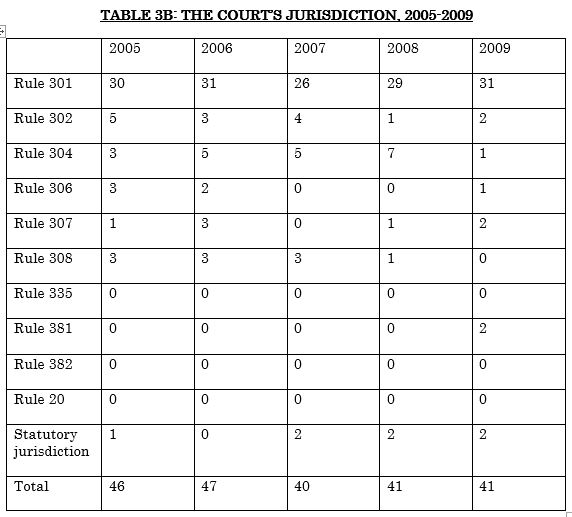
In the second half of the decade, Rule 301 appeals remained at a relatively constant level, while purely interlocutory appeals – Rules 306, 307 and 308 proceedings – drifted downwards as a percentage of the Court’s civil docket:

Table_3_B

In our next post, we’ll look at the appellate jurisdiction for the Court’s docket in the most recent five year period of our study, 2010-2014.

Image courtesy of Flickr by Patrick Feller (no changes).

9497252703_7c15a1c787_zThe most fundamental rule of appellate jurisdiction in Illinois is Supreme Court Rule 301, which makes “[e]very final judgment of a circuit court” appealable “as of right.”  Rule 301 operates in cases which have passed through the appellate system in the usual way, first being decided by one of the five districts of the Appellate Court.  Rule 302 deals with a small subset of decisions which skip the intermediate step.  Under Rule 302(a), when a Circuit Court strikes down a state or Federal statute, the appeal goes directly to the Supreme Court.  Rule 302(b) gives the Court discretion to order a case transferred directly from the Appellate Court to it in cases “in which the public interest requires prompt adjudication by the Supreme Court.”

A number of different rules address different types of interlocutory appeals, for the most part paralleling the Federal rules.  Rule 304 authorizes appeals from “a final judgment” as to one or more, but fewer than all claims or parties in the case.  Bringing such an appeal requires that the trial judge add what Illinois lawyers call “Rule 304 language” to his or her order – an express finding that there is no just reason for delaying the appeal.  Rules 306 and 307 deal with interlocutory appeals in certain specific types of cases, such as orders granting a new trial, orders on forum non conveniens motions or orders transferring venue (Rule 306) and orders granting, modifying or refusing an injunction or appointing or refusing to appoint a receiver (Rule 307).  Rule 308 is the Illinois analog to the federal 1292(b) appeal, authorizing review of “a question of law as to which there is substantial ground for difference of opinion” when an immediate appeal “may materially advance the ultimate termination of the litigation.”  Rule 20 is similar, authorizing the Court to agree to decide questions of state law certified to it by the United States Supreme Court or the United States Court of Appeals for the Seventh Circuit.[1]

The remaining sources of the Court’s jurisdiction contribute only a minor portion of its docket.  Rule 335 and several provisions of various Codes authorize the appellate courts to hear appeals from decisions of regulatory agencies.[2]  Rules 381 and 382 describe the Court’s original jurisdiction, authorizing petitions for writ of mandamus under several specific circumstances, including disputes over revenue, redistricting and the duties of officers of the government.

During the first years of the last decade, Rule 301 appeals accounted for between sixty and seventy percent of the Court’s civil docket, with the remainder of the docket relatively stable from year to year:

Table_3_A

In our next post, we’ll address the sources of appellate jurisdiction in the Court’s civil cases from 2005-2009.

Image courtesy of Flickr by Richie Diesterheft (no changes).


[1]           Like many states, Illinois law provides no mechanism for the Supreme Court to accept certified questions from Federal district courts.

[2]           Regulatory appeals taken directly to the Appellate Court are the exception rather than the rule in Illinois.  Thus, this data should not be taken as a reflection of the importance (or lack of importance) of administrative law to the Court’s docket.  The more routine route for an administrative appeal would be to a Circuit Court in the first instance – most often, the Circuit Court in either Sangamon or Cook County – and then to the Appellate Court.  These cases would be reported as Rule 301 appeals.

7322120278_6e6c447110_zThe composition of the docket of any appellate court of discretionary jurisdiction is a matter of interest to both academic researchers and practicing appellate specialists.

A number of different studies in the academic literature argue that changes in appellate courts’ dockets reflect changes in the nature of American law.[1]  For example, property matters and debt obligations form a significantly smaller part of the docket at all levels today that they once did.  Conversely, tort, domestic relations and regulatory issues – a minor-to-nonexistent part of court dockets in the 19th century – form an increasingly large source of business for courts today.[2]  This is partly a result of the growth of the state court system; in 1870, when one of the earliest large-scale studies of state Supreme Court dockets begins, very few states around the country had an intermediate appellate court.  Accordingly, state Supreme Courts simply heard whatever cases litigants chose to bring before them.[3]  The principal reason why Abraham Lincoln to this day holds the record for having served as counsel of record in more cases before the Illinois Supreme Court than any other attorney is that throughout his legal career, the Illinois Supreme Court was the first (and generally only) stop.[4]  Lincoln’s career as an appellate lawyer reflects this evolution.  A trip through the Lincoln Legal Papers or John Long’s The Law of Illinois reveals a host of property, domestic relations and debt cases which would be highly unlikely to reach the Illinois Supreme Court today.[5]

For the appellate bar, studying the nature of the cases which appellate courts accept for review helps specialists perform one of their most important tasks: predicting which cases the appellate courts will accept.  Like many of the topics we will consider on this blog, there is a good bit of anecdotal learning in the appellate bar about these matters.  For example, most argue that the courts seldom accept interlocutory appeals because of the paucity of the record and the possibility that the matter will settle before reaching them post-judgment.  It is said that obtaining review of an unpublished lower court decision is difficult-to-impossible.  Finally, many argue that the courts prefer to address issues de novo , rather than reviewing questions for abuse of discretion.  In our next post, we begin considering how well any of these bits of conventional wisdom hold up in the recent history of the Illinois Supreme Court.

Image courtesy of Flickr by Loozrboy (no changes).


[1]           E.g., Herbert M. Kritzer, Paul Brace, Melinda Gann Hall & Brent T. Boyea, “The Business of State Supreme Courts, Revisited,” 4 Journal of Empirical Legal Studies, No. 2 (Jul. 2007), 427-28; Robert A. Kagan, Bliss Cartwright, Lawrence M. Friedman, Stanton Wheeler, “The Business of State Supreme Courts, 1870-1970,” 30 Stanford Law Review 121-156 (1977).

[2]           Kritzer, et al., “The Business of State Supreme Courts, Revisited.”

[3]           Kagan, Cartwright, Friedman and Wheeler, “The Business of State Supreme Courts, 1870-1970,” p. 128.

[4]           In Illinois, an intermediate appellate court was first authorized in the Constitution of 1870.  The first Appellate Court did not begin operations until 1877.

[5]           Cook v. Hall, 6 Ill. 575 (1844); Frisby v. Ballance, 7 Ill. 141 (1845); Wren v. Moss, 7 Ill. 72 (1845); Hall v. Perkins, 5 Ill. 549 (1843); see John Long, The Law of Illinois, vol. 1, The Illinois Company (1993), pp. 60, 100, 118, 124; John Long, The Law of Illinois, vol. 2, The Illinois Company (1996); http://www.lawpracticeofabrahamlincoln.org/Search.aspx.  Still, there are exceptions, cases which a modern appellate specialist would feel comfortable addressing today, such as a party’s time to rescind a contract based on the seller’s fraud, an agent’s liability on a contract where the agent failed to disclose the principal, and whether admissions in an answer are binding on another party.  Lockridge v. Foster, 5 Ill. 570 (1843); Chase v. Debolt, 7 Ill. 371 (1845); Martin v. Dryden, 6 Ill. 187 (1844); see Long, The Law of Illinois, vol. 1, pp. 62, 69, 141.

9990024683_a37089e13d_zWe begin our analysis by selecting the parameters of the data library.  Since this research is intended primarily as a tool for civil appellate practice in full-service firms like mine, we limit the scope of the cases we study in order to ensure that trends elsewhere in the law do not obscure the Court’s decision-making in the areas of the law we are interested in.  We begin by excluding all criminal cases, as well as matters which are only technically civil, such as habeas corpus cases and civil commitments.  We also exclude all attorney disciplinary matters and juvenile cases; such practices tend to be pursued by subject-matter specialists (and not by large law firms engaged in a general civil practice.)  We focus on the period of 2000 through the present simply because gaps begin to appear in the data available online once we reach the late 1990s.  Our chosen period of study encompasses the entire career on the Illinois Supreme Court of every current Justice but one – Justice Charles E. Freeman.

The result is a data library of 620 civil cases decided between January 1, 2000 and December 31, 2014.  These opinions were reviewed and coded for forty-eight different data points:

Table_1_A

Table_1_B

The following Justices are included for all or part of their tenures.[1]  The Justices are arranged in the Table by individual seats on the Court, showing each Justice’s replacement as he or she left the Court, and therefore the philosophical evolution of the Court during the period of our study.  We also include the political party identification of each Justice (in Illinois, Justices must seek election and retention in partisan elections):

Table_2

The Illinois Supreme Court has been closely divided by party identification throughout our period of study.  The Court’s Republican wing lost one member in 2000 with the election of Democrat Thomas L. Kilbride, shifting the balance from four Democrats and three Republicans to five Democrats and two Republicans.  The party balance remained there for four years until late 2004, when Republican Lloyd A. Karmeier replaced Democrat Phillip J. Rarick, and the Court has been split 4-3 ever since.

Image courtesy of Flickr by rh2ox (no changes).


[1]               The Illinois Constitution provides that the Chief Justice is selected by the members of the Court to serve a single three year term.  Six members of the Court have served as Chief Justice during some portion of the period we study – Justices Harrison, McMorrow, Thomas, Fitzgerald, Kilbride and Garman.  We refer to each as “Chief Justice” when discussing the period of his or her tenure, and as “Justice” at all other times.

14999534034_8c7e1a4b57_oAppellate lawyers are to a considerable degree in the business of anticipating the views and inclinations of appellate judges and justices.  At every phase of litigation, whether it be selecting cases which should (or should not) be brought before an appellate court, to crafting arguments in a way most likely to garner the votes of a majority of the panel, counsel must try to understand not only the philosophy and jurisprudence of the judges on the appellate court, but also the influences which might cause an appellate judge to vote contrary to his or her judicial philosophy in a given case (a matter we’ll consider on this blog later).

During the past sixty years, a considerable scholarly literature has developed which applies empirical techniques – largely, sophisticated statistical analysis – to these very questions.[1]  Despite the recurring posting of “Stat Packs” on SCOTUSBlog and the publication of The Behavior of Federal Judges, by Lee Epstein, William M. Landes and Judge Richard A. Posner,[2] these techniques are still not well known among the bar.  Anecdotal “conventional wisdom” remains commonplace among lawyers practicing in the appellate courts regarding issues which could – and have – been rigorously measured.

Judge Posner and Professors Epstein and Landes succinctly captured the value of this kind of research to the appellate bar: “The better that judges are understood, the more effective lawyers will be both in litigating cases and, as important, in predicting the outcome of cases, thus enabling litigation to be avoided or cases settled at an early stage.”[3]

Image courtesy of Flickr by Torley (no changes).


[1]     The first well-known application of statistical techniques to understanding appellate decision-making was likely “Divisions of Opinion among Justices of the U.S. Supreme Court, 1939-1941,” by C. Herman Pritchett.  35 American Political Science Review 890 (1941).  Pritchett later expanded on his analysis in a book, The Roosevelt Court (MacMillan, 1948).  The literature analyzing the work of the U.S. Supreme Court and the Federal Circuits is enormous; lower federal courts and state courts have received considerably less attention.  Important works include Jeffrey A. Segal and Harold J. Spaeth, The Supreme  Court and the Attitudinal Model Revisited (Cambridge Univ. Press: 2002); Scott A. Comparato, Amici Curiae and Strategic Behavior in State Supreme Courts (Praeger Pub.: 2003); Laura Langer, Judicial Review in the State Supreme Courts: A Comparative Study (State Univ. Press of N.Y.: 2001); Andreas Broscheid, “Comparing Circuits: Are Some U.S. Courts of Appeals more Liberal or Conservative than Others?” 45 Law & Society Review 171 (2011); Denise M. Keele, An Analysis of Ideological Effects in Published Versus Unpublished Judicial Opinions, 6 Journal of Empirical Legal Studies 213 (2009); Stephen J. Choi and G. Mitu Gulati, “Trading Votes for Reasoning: Covering in Judicial Opinions,” 81 Southern California Law Review 735 (2008); Frank B. Cross, Decision Making in the U.S. Courts of Appeals (2007: Stanford Univ. Press); Cass R. Sunstein et al., Are Judges Political? An Empirical Analysis of the Federal Judiciary (Brookings Institution Press: 2006); Gregory C. Sisk and Michael Heise, Judges and Ideology: Public and Academic Debates about Statistical Measures, 99 Northwestern University Law Review 743 (2002); Michael Giles, Virginia Hettinger and Todd Peppers, An Alternative Measure of Preferences for Federal Judges, 54 Public Research Quarterly 623 (2001).

[2]     The Behavior of Federal Judges: A Theoretical and Empirical Study of Rational Choice, (Cambridge: Harvard Univ. Press, 2013).

[3]     Id., p. 6.

2206499946_e74a2b53c5_zAcademics in various disciplines have been developing sophisticated tools for analyzing the dynamics of group decision making for many years.  The leading figures in this research have been mostly law and politics professors, along with a number of economists, and their methods have included data analytics, game theory, organization theory and behavioral economics, to name just a few.

Although these tools have become increasingly common in the business world, they’re not especially well known in the appellate bar.  And that’s odd, because much of this research speaks directly to the essence of what we do as appellate lawyers.  All litigators are in the business of persuading judges.  But trial lawyers, with few exceptions, are tasked with persuading one decision maker at a time.  Appellate lawyers face a different challenge – persuading a majority of a panel – typically anywhere from three to seven, or once in a great while nine or more judges.  Understanding both the preferences of the decision makers, and what internal and external influences might constrain them from acting on those preferences, is a key concern.

We at Sedgwick founded the Illinois Supreme Court Review to contribute towards changing that – to bring the power of data analytics, and ultimately other academic tools for studying group decision making, to the rigorous study of the decision making of the Illinois Supreme Court.

The Review will be a different kind of blog.  For the past several years, authorities on the future of social media have been predicting that it’s only a matter of time before the rigorous scholarship that has been published in law reviews for generations begins to transition to blogs.  We think that evolution is inevitable, and we hope to contribute to it with the empirical research we’ll be posting here.

So while the conversation about last week’s appellate arguments or yesterday’s new opinions continues over at the Review’s sister blog, The Appellate Strategist, at the Review we’ll take a longer-term view, seeking new insights into the Court’s decision making in civil litigation based upon the entire span of what one might call the Court’s recent history, from 2000 to today.  Our analysis will rest on a foundation of an enormous data library, encompassing dozens of data points from each of the more than six hundred civil decisions the Court has handed down during our period of study.  We’re not aware of a comparable up-to-date database on the decisions of a state Supreme Court anywhere.[1]

We hope you’ll join us.

Image courtesy of Flickr by Sean Silverthorne (no changes).


[1]               Spoiler alert: yes, there will be math (and footnotes).  But at all times, we’ll make sure that the math is accessible to everyone.