8745757340_196f3dba24_z

For the past several weeks, we’ve been doing a quick review of oral arguments in cases decided by the Illinois Supreme Court in 2015, evaluating whether the Justices’ questioning patterns differ from their civil arguments.  Today, we finish our aggregate statistics and make a start on our Justice-by-Justice comparisons.

In Table 121 below, we see the data on which Justice asks the first question of appellant.  Justice Thomas has asked the first question in somewhat more than one-third of all cases decided in 2015.  Justices Burke and Freeman are tied at 15.63% of the Court’s cases, with Justice Theis not far behind.

Table 121

In Table 122 below, we report the data on which Justice most frequently asks the first question of appellees.  Justice Thomas is by far the most frequent first questioner, followed (relatively far behind) by Justice Theis and Chief Justice Garman.

Table 122

In Table 123, we see the data on question patterns in rebuttals in 2015 criminal cases.  By far the most frequent first questioner is . . . nobody – in 40% of all criminal cases, there were no questions during rebuttal.  Justice Theis was second, with Justice Thomas third and all the other Justices well behind.
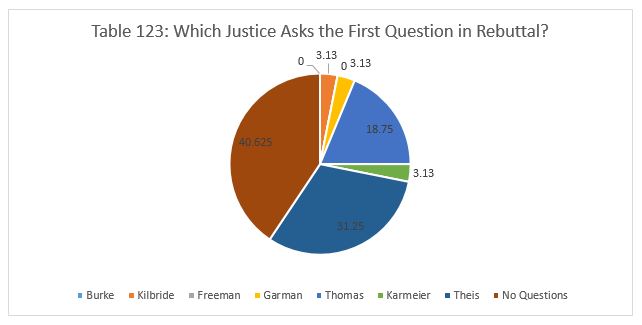
Table 123

Next, we begin reviewing the individual Justices’ questioning patterns.  In Table 124, we report the data on Justice Burke’s patterns when voting with the majority.  When the Court is voting to reverse (with Justice Burke joining), writing appears to have at least some impact on Justice Burke’s questioning patterns.  She averages 1 question per argument to appellants and 0.42 questions to appellees when not writing.  She averages 1 question to appellants in cases where she’s writing the majority opinion, and 2 questions to appellees.  Justice Burke has written no opinions in 2015 when she joined the majority in an affirmance.

Table 124

In Table 125, we report the data on cases in which Justice Burke voted with the minority.  At least with appellants when the Court reversed and Justice Burke voted to affirm, once again writing had an impact – she averaged four questions to appellants when not writing, but five in cases when she dissented.  Justice Burke asked no questions of appellees when she voted with the minority to affirm, nor of either side when she was in the minority to reverse.

Table 125

In Table 126 below, we report the data from cases in which Justice Kilbride voted with the majority.  Although Justice Kilbride has asked very few questions in cases decided this year, in cases where Justice Kilbride voted with the majority to affirm, writing an opinion had a significant effect in questioning to the appellant.  Justice Kilbride averaged 0.2 questions to appellants in cases where he wasn’t writing, but 0.67 questions when he was writing the majority opinion.  Justice Kilbride has asked no questions of either side in cases where he voted with the minority.

Table 126

Join us back here next week as we continue our Justice-by-Justice review with the questioning patterns of Justices Freeman and Thomas and Chief Justice Garman.

Image courtesy of Flickr by Teemu008 (no changes).


Golden Lady Justice, Bruges, BelgiumOver the past few weeks, we’ve been wrapping up this first year at the Illinois Supreme Court Review with a quick look at the questioning patterns at the Illinois Supreme Court’s oral arguments in criminal, quasi-criminal and disciplinary cases decided to date in 2015, comparing that data to our conclusions earlier in the summer and fall from the past seven years’ worth of civil case arguments.

Today, we begin our look at the individual Justices’ questioning patterns. First: which Justice asks the most questions?

The answer is the same as it is in the civil docket: Justice Thomas, followed by Justice Theis. Chief Justice Garman is next, followed by Justices Karmeier and Burke. Finally, we have Justices Freeman and Kilbride, who at least in cases decided during 2015 have asked very few questions of counsel.

Table 118

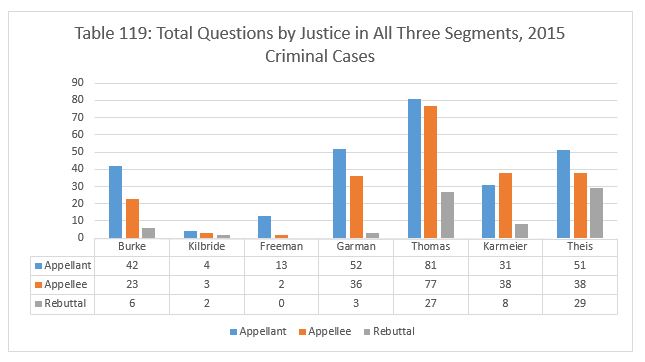
In Table 119 below, we consider the data on total questions, divided by the three segments of the argument. The data shows that Justice Thomas is the most active questioner during the initial presentations of both the appellant and the appellee. The Chief Justice is second among appellants, followed close behind by Justice Theis. Interestingly, among appellees, Justice Theis and Justice Karmeier are tied for the second position, followed by the Chief Justice. Justice Theis is the most active questioner during rebuttals, narrowly edging out Justice Thomas. Indeed, Justices Theis and Thomas have between them asked just short of three-quarters of all the questions asked during rebuttals in the criminal docket this year.

Table 119

Finally, in Table 120 below, we show the average questions per segment by each Justice. These data reflect that the Court in general asks significantly fewer questions during criminal arguments than it does in civil cases. Justice Thomas, for example, has averaged 2.53 questions to appellants, 2.41 to appellees and 0.84 during rebuttal in criminal cases decided this year. In civil cases, he has averaged 3.9, 4.42 and 1.35, respectively. At least this year, only Justice Theis in rebuttals and the Chief Justice with appellants has averaged more questions in any segment in criminal cases than in civil ones. Also note that with the exception of Justice Karmeier, each of the Justices averages more questions to appellants in criminal cases than to appellees.

Table 120

Join us back here tomorrow as we continue our Justice-by-Justice review of the Court’s questioning patterns in criminal cases decided to date in 2015.

Image courtesy of Flickr by Emmanuel Huybrechts (no changes).

5546598342_71b290d980_zYesterday, we continued our quick trip through the arguments at the Illinois Supreme Court in criminal, quasi-criminal and disciplinary cases, analyzing whether oral argument can give us grounds for inferring the likely time under submission, the length of the majority opinion and how often the winning party gets more questions. Today we turn to three more issues we analyzed earlier this fall in our discussion of civil oral arguments.

In Table 115 below, we address how likely the first questioner to each side is the author of the majority opinion. The first question is fairly likely to come from the author of the majority opinion in one type of case – but interestingly, it’s affirmances. The first questioner is almost never the author of the majority opinion when the Court reverses.

Table 115

In Table 116 below, we address whether cases where there was a dissent below tend to spark more questions in oral argument at the Supreme Court. The answer is, in general, no. Cases which were unanimous at the Appellate Court have averaged only a bit less than 20 questions to both sides, while divided decisions from the Appellate Court have sparked an average of only fifteen. Although questions to appellants are roughly equal, appellees have been questioned significantly more in cases which were unanimous below.

Table 116

In Table 117, we address whether cases from particular districts and divisions of the Appellate Court tend to bring more questions at the Supreme Court. Although the data should be treated with some caution given that we’re not talking about a lot of cases in each district, there is some indication that the Appellate Court district may have an influence. Division Two of the First District has averaged the most questions at oral argument, with the Fourth, Third and Second Districts close behind. Cases from Divisions 3, 5 and 6 of the First District have averaged the fewest number of questions.

Table 117

Join us back here next week as we continue our review of the Illinois Supreme Court’s oral arguments in the criminal cases decided so far in 2015.

Image courtesy of Flickr by Phil Roeder (no changes).

4373062612_8b0a4f9419_z

Last week, we began a quick trip through the oral arguments of 2015 in criminal, quasi-criminal and disciplinary cases, comparing our insights to our results in the civil arguments between 2008 and 2014.  In day two of our review today, we look at three more issues.

First, we present three scatter diagrams addressing our first question: do more questions suggest that the case will be longer under submission?  It’s easy to suggest a theory as to why that might be true – more questions might suggest that the Court is conflicted about a case, which might lead to a longer time under submission as the Court tries to reach a final resolution.

Table 110 below reports the time under submission plotted against the total questions asked both sides. A perfect relationship between total questions and time under submission would lead to a straight line anchored at the lower left hand corner of the plot.  We see that although there is some relationship between the variables – by and large, more questions does suggest longer time under submission – the relationship is only approximate.  Note, for example, the cases which were under submission for 134 and 176 days which sparked exactly one question each.

Table 110

Table 111 below shows the data on questions to the appellant plotted against the days under submission.  The relationship is about the same – more-or-less linear, but with a good bit of variation.  Compare, for example, the dot at the top of the chart, a case under submission for 135 days which brought 22 questions to the appellant, to the one under submission for 310 days which only brought 10 questions.

Table 111

In Table 112 below, we plot the data for questions to appellees against the time under submission.  Here, the data appears to be at least slightly more linear – but still, the relationship between how active the Court is at oral argument at time under submission is very much an approximate one.

Table 112

So let’s turn to another of the questions we analyzed several months ago in the context of civil cases – does a more active Court suggest that the Court’s opinion is going to be longer?

In Table 113 below, we plot the total questions to both sides against the length of the majority opinion.  The data reflects something fairly close to a linear relationship – there seem to be fewer outliers than was the case plotting questions against time under submission.  This plot suggests that at least in 2015, more questions from the Court suggested a longer majority opinion in criminal cases.

Table 113

In Table 114 below, we turn to our final issue for today – just how long are the odds against a litigant who gets more questions than his or her opponent (at least a moderately accurate indicator in civil cases that you might be headed for a loss)?  The result is quite interesting, and one that bears testing against a larger database.  As we see below, the winner nearly always gets more questions in the Court’s divided decisions.  On the other hand, when the Court is unanimous, the winner gets more questions in only one of every three cases – a result far more in line with our data from the civil cases.

Table 114

Join us back here tomorrow as we look at several more issues about the Court’s criminal oral arguments so far in 2015.

Image courtesy of Flickr by Takomabibelot (no changes).

5056060708_421c69b8dd_zToday, we begin another phase of our data analytic look at the Illinois Supreme Court’s oral arguments. Over the past five and a half months, we’ve reached a number of conclusions about what we can infer from oral argument about the likely result of a case and which Justice(s) are writing. Our analysis has been based upon our review of all 233 oral arguments in civil cases at the Court between January 1, 2008 and December 31, 2014. Now, we consider whether or not criminal cases are different. Our data is based on oral arguments in criminal, quasi-criminal (habeas and juvenile) and disciplinary cases decided so far in 2015.

In earlier posts, we reported here that in civil cases, both appellants and appellees averaged between ten and fifteen questions per argument, with about four additional questions in rebuttals. Here, we considered whether the Court’s unanimity (or division) in civil cases affected the level of questioning.

In Table 106 below, we report the average number of questions the Court asked in each segment of the oral argument in criminal cases, divided by non-unanimous and unanimous decisions. The Court was less active in every segment than it was in civil cases. Appellants averaged more questions than the appellees in both non-unanimous and unanimous decisions. Appellants tended to be asked more questions when the Court was divided, but the effect was reversed when the Court was unanimous – appellees were asked forty percent more questions by a unanimous Court than by a divided one.

Table 106

In Table 107 below, we analyze whether the Court’s question patterns differ according to how lopsided the decision is. It appears that the answer is no; appellants average re questions before a closely divided Court in criminal cases, but appellees average slightly more questions from lopsided Courts. The appellants average more questions regardless of the vote than the appellees.

Table 107

In Table 108 below, we address the same question in a somewhat different way – all other things being equal,modes the margin between the losing and winning parties suggest anything about the likely voting margin on the Court?  For civil cases, we concluded that more lopsided questioning did not reliably indicate a more lopsided decision.

In criminal cases, winning appellants tend to average more questions than appellee a regardless of the margin of the vote.  Although appellants average only slightly more questions than appellee when the Court unanimously reverses, losing appellants tend to average far more questions when the Court unanimously affirms.  When the Court returned a 5-2 decision in criminal cases last year, the appellant has averaged eight questions to the appellee’s one, regardless of which side won.

Table 108

But let’s look at the question in yet another way.  Unlike civil cases, where neither plaintiffs nor defendants are routinely on one side or the other, a significant majority of the Court’s criminal cases have involved defendants as appellants.  We concluded – unlike the result in civil cases – that the losing party does not necessarily average more questions measured by appellant and appellee.  But how about if we divide the data by defendants and the State?

The data is reported in Table 109 below.  There, we see the same result we saw in the civil cases – once the cases are divided by defendants and teh State (as opposed to appellants and appellees), the losing side reliably averages more questions.  Losing defendants average nearly a question and a half more than the government does when it wins.  When teh government loses, it averages three more questions than the endant.

Table 109

Join us back here next week as we continue our analysis of the criminal case arguments of 2015.

Image courtesy of Flickr by gt8073a (no changes).


5006396635_c5359a439d_z

Today, we conclude our Justice-by-Justice review of the question patterns of the Justices of the Illinois Supreme Court.  We’ve been looking for evidence that it’s possible to predict the Justices’ likely votes and whether the Justice is writing an opinion based on close observation of oral argument.  In our final post of this phase of our analysis, we wrap up our look of former Chief Justice Thomas R. Fitzgerald’s question patterns.

As we discussed last week, our analysis is simplified by the fact that former Chief Justice Fitzgerald voted with the majority in 87 of the 88 civil cases he sat and voted on between 2008 and 2010.  In Table 105 below, we show the data for former Chief Justice Fitzgerald as the first questioner in cases where he voted with the majority.  An active questioner, former Chief Justice Fitzgerald was significantly more likely to ask the first question of appellants than he was of appellees, regardless of which side won the case.  In all cases, writing the majority opinion had a substantial impact on Chief Justice Fitzgerald’s likelihood of asking the first question.  He was nearly twice as likely to be the first questioner of appellants when he wrote the majority opinion reversing, and more than twice as likely to be the first questioner of appellees in such cases.  Writing the majority opinion in affirmances had somewhat less impact on his question patterns, but still, it was significantly more likely that Chief Justice Fitzgerald was writing the majority opinion in cases where he asked the first question.

Table 105

Join us back here tomorrow as we begin a comparison of our conclusions about oral argument in the Court’s 233 civil cases between 2008 and 2014 to the Court’s 2015 oral arguments in criminal, juvenile and disciplinary cases.

Image courtesy of Flickr by Sam Howzit (no changes).

2529190203_b9caa65629_zYesterday, we concluded our analysis of Justice Mary Jane Theis’ questioning patterns from oral arguments during her five years on the Court, looking for indications about her likely voting and whether or not she might be writing an opinion. Today, we turn to Justice Theis’ predecessor, former Chief Justice Thomas R. Fitzgerald.

Our analysis of Chief Justice Fitzgerald’s questioning patterns is simplified considerably by an amazing statistic. The Court’s website contains audio and video files for every oral argument since January 15, 2008. Between that date and Chief Justice Fitzgerald’s final term in September, 2010, the Court heard oral argument in 88 civil cases which were decided before the Chief’s departure (so that we can compare his questions and votes). Chief Justice Fitzgerald voted with the majority for 87 of those 88 cases. He asked only one question – of the appellant – during the lone exception, a 2008 decision in Mikolajczyk v. Ford Motor Company (the Chief wrote a partial concurrence and partial dissent in Mikolajczyk).

We turn then to Table 104, which reports the Chief Justice’s question patterns when voting with the majority. We see that Chief Justice Fitzgerald, a comparatively active questioner during oral argument, tended to average more questions to the appellant than the appellee regardless of which side ultimately won the case. However, he averaged significantly more questions to the appellee – roughly the same number as to the appellant – when the Court reversed, so watching his question patterns closely did give a clue as to where the Court might be going with the case.

As we’ve seen with nearly all the other Justices, writing an opinion had a definite impact on Chief Justice Fitzgerald’s question patterns. In all four situations below – questions to appellants and appellees in reversals and affirmances – the former Chief Justice asked substantially more questions in cases where he was writing the majority opinion than when he wasn’t. Note also that Chief Justice Fitzgerald tended to average more questions of both sides when he wrote the majority opinion in a reversal than when he wrote the majority for an affirmance.

Table 104

Join us back here next week as we conclude our Justice-by-Justice review of the Illinois Supreme Court’s question patterns at oral argument with day two of our analysis of former Chief Justice Thomas Fitzgerald.

Image courtesy of Flickr by Padraic (no changes).
 

3537565243_c15d6e63fc_z (1)Last week, we continued our Justice-by-Justice review of the question patterns on the Illinois Supreme Court by beginning our look at the numbers for Justice Mary Jane Theis. We saw that in three of the four scenarios we studied, Justice Theis tends to average at least somewhat more questions to the side she ultimately votes against, whether or not that party prevails in the appeal (the lone exception being reversals with Justice Theis in the majority). We further demonstrated that all other things being equal, Justice Theis will tend to question parties more heavily when she is writing the majority opinion for the Court. Dissents, on the other hand, have relatively little impact on her questioning.

We turn now to the likelihood of Justice Theis asking the first question to each side. In Table 102 below, we report the data for cases in which Justice Theis is in the majority. Not surprisingly, given that Justice Theis tends to be one of the more active questioners on the Court, she asks the first question of appellants in approximately one of every four cases when she’s in the majority, regardless of whether the Court reverses or affirms. She is significantly less likely to lead off questioning to the appellees’ side. Once again, writing the majority opinion has a dramatic effect on the numbers. When she’s writing the majority opinion, Justice Theis is three to four times as likely to ask the first question of appellants. Although she relatively seldom asks the first question of appellees, Justice Theis is nearly five times as likely to ask the first question of appellees when she’s writing the majority opinion in an affirmance than when she’s not writing.

Table 102A

Turning to Table 103, we find that Justice Theis almost never asks the first question of either side when she’s in the minority – indeed, the only examples have been a scattered few cases in the five years’ worth of data in which Justice Theis dissented from a reversal and led off questioning to the appellants’ side.

Table 103A

Tomorrow, we’ll wrap up our Justice-by-Justice review of the Court’s question patterns with day one of our look at the record of the late Chief Justice Thomas Fitzgerald.

Image courtesy of Flickr by Wadester16 (no changes).

5820173025_3c7320616f_z

Today, we continue our Justice-by-Justice review of the question patterns of the Justices of the Illinois Supreme Court.  We’re looking at whether we can infer the Justices’ likely voting and opinion writing from the Justices’ question patterns at oral argument.  For this Thanksgiving Wednesday – day one of our analysis of Justice Mary Jane Theis.

In Table 100 below, we see the data when Justice Theis votes with the majority.  Across the entirety of the Court’s civil docket, Justice Theis is not an especially heavy questioner.  She averages slightly more questions to the appellant overall in reversals – the winning party, rather than the losing one (recall that the Court as a whole averages more questions to the losing party).  In affirmances, Justice Theis averages nearly three times as many questions to the appellant – this time, the losing party, consistent with the Court’s overall pattern.  Writing has a clear impact on Justice Theis’ question patterns when she is voting with the majority.  In each case – appellant and appellee, reversals and affirmances – she averages at least somewhat more questions when she’s writing the majority opinion; indeed, she averages nearly six times as many questions to appellants when she’s writing a majority opinion in an affirmance.  Special concurrences are always a very small data set at the Court, but Justice Theis averages more questions to both sides in reversals when she’s writing a concurrence even than when she’s writing a majority opinion.

Table 100

In Table 101 below, we turn to the data on Justice Theis’s patterns when she is voting with the minority.  When Justice Theis dissents from a reversal, she averages more questions to the appellant – the party she votes against, rather than the party which ultimately loses – than to the appellee.  The pattern is the same when Justice Theis dissents from an affirmance – she averages more questions of the appellee than of the appellant.  However, writing a dissent seems to have relatively little impact on Justice Theis’s patterns.  Although she averages more questions of the appellant when she’s writing a dissent from a reversal, in each of the other three scenarios we report, Justice Theis averages fewer questions when she writes a dissent.

Table 101

Join us back here next Tuesday for day two of our analysis of Justice Theis’s record at oral argument.  In the meantime – a Happy Thanksgiving to everyone!

Image courtesy of Flickr by Ben Sutherland (no changes).

14852799246_d1b2d22954_z

Last week, we resumed our Justice-by-Justice look at the patterns of questions in oral argument, searching for evidence as to whether questioning signals a Justice’s likely vote and whether or not he or she is writing an opinion.  Today, we conclude our consideration of Justice Lloyd A. Karmeier, looking at whether he is more likely to ask the first question of either side, depending on his vote and whether or not he is writing in a case.

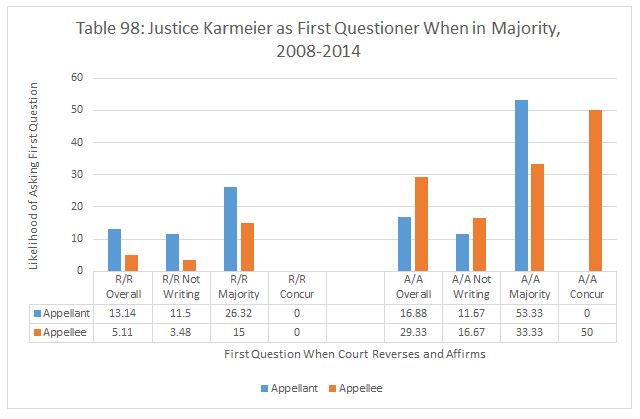
In Table 98 below, we report the data for cases in which Justice Karmeier votes with the majority.  Overall, it is not especially common for Justice Karmeier to ask the first question of either side.  However, we see that writing the majority opinion has a distinct impact on that likelihood.  For example, when Justice Karmeier is writing a majority opinion reversing, he is more than twice as likely to ask the first question of the appellant than when he is not writing.  Although he seldom asks the first question of appellees in such cases, the likelihood is more than four times as great when he’s writing the majority opinion than when he’s not.  The effect is similar when Justice Karmeier joins the majority in affirming.  When he’s writing the opinion, he asks the first question of the appellant more than half the time, and of the appellee, in exactly one of every three cases.  Both of these numbers are considerably less in cases where Justice Karmeier is not writing an opinion.

Table 98

In Table 99 below, we report the data on cases in which Justice Karmeier is in the minority.  We see that writing a dissent has no impact at all on the likelihood of Justice Karmeier asking the first question.  Although Justice Karmeier is far more likely to ask the first question when he disagrees with the majority, he has never led off the questioning in a civil case where he wrote a dissent, as opposed to joining another Justice’s dissent.

Table 99

Join us back here tomorrow as we begin our analysis of the questioning patterns of Justice Mary Jane Theis.

Image courtesy of Flickr by Phil Roeder (no changes).