4512437966_4d3ca42841_z

Last week, we began our examination of the Illinois Supreme Court’s lag time on civil cases in unanimous and non-unanimous cases.  This week, we turn to the Court’s criminal, quasi-criminal, juvenile and disciplinary cases.

Interestingly, criminal cases are under submission for less time, on average, for nearly every year since 2000 than the comparable numbers for civil cases.  In 2008, the average criminal case was under submission for 111.37 days.  The following year, the criminal average rose to 144.7 days.  The average time under submission dipped slightly in 2010 before rising to 146.82 in 2011.  In 2012, the average time under submission dropped to 125.63 days.  The figure increased by about ten percent in 2013 before dropping all the way to 100.41 days in 2014.  In 2015, the average days under submission for criminal cases was 127.88 days.

Table 245

We report the data in Table 246 disaggregated between unanimous and non-unanimous decisions.  Throughout the period, days under submission for non-unanimous cases were substantially higher than the average for unanimous decisions.  In 2008, non-unanimous criminal decisions were pending for an average of 142 days.  That same year, unanimous decisions were under submission for 107.96 days.  The following year, the average time under submission for non-unanimous cases increased by nearly 100 days, to 247.1 days, while unanimous decisions required only slightly longer than the previous year – 117.03 days.  In 2010, the average days under submission for non-unanimous decisions were down significantly to 215.42 days, but the average for unanimous cases was almost the same – 115.13 days.  The following year, the average for non-unanimous cases was back up to 257 days, while the average for unanimous decisions was almost exactly the same, at 115.34 days.  In 2012, the average days under submission for non-unanimous cases were down 29% to 184.5 days, while days under submission for unanimous cases dropped below 100 days for the first time, to 98.86 days.  Average days under submission were about the same for non-unanimous criminal cases in 2013, while the average for unanimous decisions was up 12%, to 111.28 days.  The average for both non-unanimous and unanimous decisions stayed roughly the same in 2013.  The average days under submission for unanimous cases dropped 42% in 2014, while non-unanimous decisions remained relatively static for yet another year.  Last year, days under submission was going in opposite directions – the average days for non-unanimous decisions were down 15%, to 159.67 days, while the average for unanimous decisions was up 54%, to 120.54 days.

Table 246

Join us back here tomorrow as we review the year-by-year time-under-submission data for the Illinois Supreme Court’s criminal cases.

Image courtesy of Flickr by Matt Turner.

11271766325_25c24f49fc_zYesterday, we began our analysis of the average time under submission at the Illinois Supreme Court for civil cases.  Today, we probe further the question of what can be predicted from time under submission by considering the year-by-year data.

In Table 237 below, we report the lag times for divided and unanimous civil decisions at the Court in 2008.  The lag time for divided decisions is generally – but not inevitably – above the time under submission for unanimous cases.

Table 237

In 2009’s civil docket, the relationship between divided and unanimous decisions was not as clear, as divided cases frequently were under submission for less time than unanimous ones.

Table 238

The relationship between non-unanimous and unanimous decisions was once again unclear in 2010.

Table 239

The following year, the mean lag time for non-unanimous cases rose slightly in relation to unanimous decisions, but by and large, there was not a sharp distinction between the two types of cases.

Table 240

By 2012, lag times were fairly consistently higher for non-unanimous civil decisions than for unanimous ones.

Table 241

Non-unanimous decisions were fairly consistently higher in time under submission than unanimous ones in 2013.

Table 242

In 2014, all of the Court’s non-unanimous civil decisions were under submission for longer than the Court’s unanimous decisions were.

Table 243

The same was true in 2015.

Table 244

Looking at the data collectively suggests that although non-unanimous decisions, all things being equal, are under submission for longer than unanimous decisions are, there is little direct relationship between days under submission and the number of dissenters, at least for the civil docket.  The mean days under submission for the entire eight-year period for unanimous decisions is 163.71 days, with a small standard deviation of 8.01.  Civil cases with one dissenter were under submission for an average of 198 days, with a standard deviation of 25.44 – suggesting a good bit of variability.  Two and three-dissenter cases were under submission for slightly less time – 194.13 days, with a standard deviation of 17.23.

Join us back here next week as turn to the time under submission for the criminal docket.

Image courtesy of Flickr by William Warby.


411899552_4e8658890b_z

Today we turn to another phase of our analysis of the Illinois Supreme Court’s decision making, asking what we can predict from the time a case has been under submission between oral argument and decision.

In Table 235, we report the overall data for civil cases.  The lag time at the Court has been consistently drifting downwards from 2008 until now.  In 2008, based upon incomplete data, civil cases were under submission for an average of 157.29 days.  The lag time was relatively consistent from 2009 to 2012 – 140.25 days in 2009, 150 days in 2010, 143.97 days in 2011 and 144.1 days in 2012.  The average fell to 137.5 days in 2013, but has dropped more sharply in the last two years – in 2014, the lag time for civil cases was 121.41 days, and last year, civil cases were under submission for an average of only 114.79 days.

Table 235

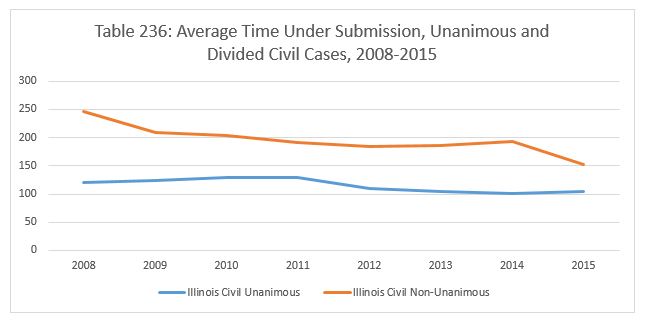
So all other things being equal, does a longer time under submission suggest that the Court’s decision will be unanimous?  In Table 236, we report the year-by-year averages, divided into non-unanimous and unanimous decisions.  Clearly, the average time under submission is significantly longer throughout our period for non-unanimous decisions than for unanimous ones.  Interestingly, however, the difference between the two is dropping.  Unanimous decisions handed down in 2008 were pending for 121.33 days, while non-unanimous ones remained pending for more than twice as long – 247.17 days.  By 2011, the average lag time for unanimous decisions had increased a bit to 128.96 days, but the average for non-unanimous opinions had dropped to 190.67 days.  By 2015, the time under submission for unanimous opinions had fallen to 104.76 days, but the lag time for non-unanimous decisions has fallen substantially more, to a low of 152.67 days.

Table 236

Join us back here tomorrow as we turn to the year-by-year data on the Court’s civil docket.

Image courtesy of Flickr by John Linwood.

4504031478_36c499eac2_zYesterday, we began our discussion of the impact of publication at the Appellate Court on the Illinois Supreme Court’s civil and criminal dockets. We analyzed whether decisions which were published below – presumably, the decisions more open to disagreement – were more likely to lead to dissenting opinions before the Court. Today, we address the question from a somewhat different angle: of the universe of unanimous decisions on each side of the docket, how many were published below?

In Table 232, we report the percentage of published and unpublished Appellate Court opinions in civil cases which were decided unanimously at the Supreme Court. Once again, our result is contrary to our expectation – for most years, all other things being equal, cases published below are more likely to end in unanimous decisions, not less likely. For the years 2000-2002, the numbers are very close; 57.14%, 75.86% and 66.67%, respectively, of cases published below were decided unanimously by the Court. On the other hand, 60%, 72.73%, and 64.29%, respectively of Rule 23 orders – decisions which were unpublished at the Appellate Court – were decided unanimously at the Supreme Court. By 2003, the numbers diverge substantially – 78.38% of published decisions were decided unanimously to only one-third of unpublished decisions. All told, a higher fraction of published decisions was decided unanimously at the Supreme Court in twelve of the sixteen years of our study. 2014 was one of the few years to the contrary – 83.33% of Rule 23 orders were unanimously decided to 73.33% of published opinions – but in 2015, the figures had reversed – 80% of published decisions, 77.78% of unpublished decisions.

Table 232

Criminal cases were slightly more evenly balanced, but the relationship was the same – a higher fraction of published decisions from the Court of Appeal were resolved unanimously by the Supreme Court than unpublished ones in ten of the sixteen years. As we saw yesterday, the gap was quite large in the unusual criminal docket of 2000 – 57.89% of published decisions were decided unanimously to only 17.91% of unpublished decisions. The following year, there was once again a thirty-point difference – 78.95% of published decisions were resolved unanimously at the Supreme Court to 48.72% of unpublished decisions. In the years that followed, the typical gap narrowed, often amounting to only a few points. In 2014, 81.82% of unpublished decisions from the Appellate Court were decided unanimously by the Supreme Court to 78.26% of published decisions. The following year (just as was the case with civil decisions), the relationship was reversed again – 84.21% of published opinions were decided unanimously to 75% of unpublished opinions.

Table 233

Join us back here next week as we turn our attention to a new issue in our analysis of the Illinois Supreme Court’s civil and criminal docket decision making.

Image courtesy of Flickr by Matt Turner (no changes).

8023550202_ea7f2670ae_zLast week, we began our analysis of the impact of publication at the Appellate Court level on the Illinois Supreme Court’s civil and criminal dockets. Today, we look at a related question – are published Appellate Court decisions a good predictor that the Illinois Supreme Court’s decision on the case will be divided? One would expect that the answer would be yes – at least in theory, a published decision should be more likely to be controversial, and therefore liable to spark dissent.

In fact, the answer may be no. In Table 230 below, we report the percentage of unanimous and non-unanimous Supreme Court civil decisions for each year from 2000 to 2015 which were published at the Appellate Court. In twelve of the sixteen years, the percentage of published decisions among the unanimously decided cases is higher than the percentage for non-unanimous decisions. For many years, the difference was not great; for example, in 2001, 57.89% of the unanimous cases were published below to 53.85% of the non-unanimous cases. Although the margin briefly widened in 2003 – 90.63% for unanimous decisions, 57.14% for non-unanimous – non-unanimous decisions briefly had a higher percentage of published decisions in 2004 and 2005. Beginning in 2007, the margin widened again. Published decisions were ten percent more of the unanimously decided cases in 2007, 5% in 2008, 22% in 2009, 14% in 2010, 8% in 2011 and 13% in 2012. More recently, the numbers have narrowed again. Two-thirds of all non-unanimous civil decisions were published below in 2014 to 52.38% of unanimous ones, and in 2015, 80% of all unanimous decisions were published below to 77.78% of non-unanimous ones.
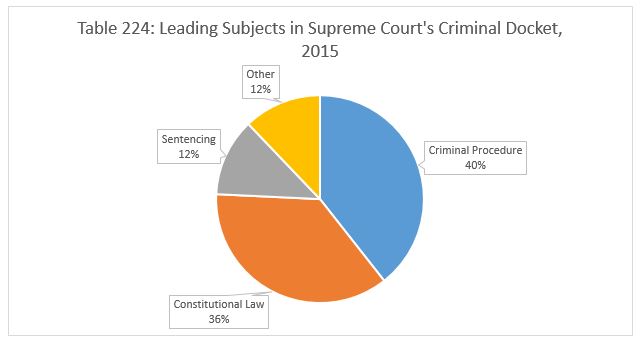
Table 230

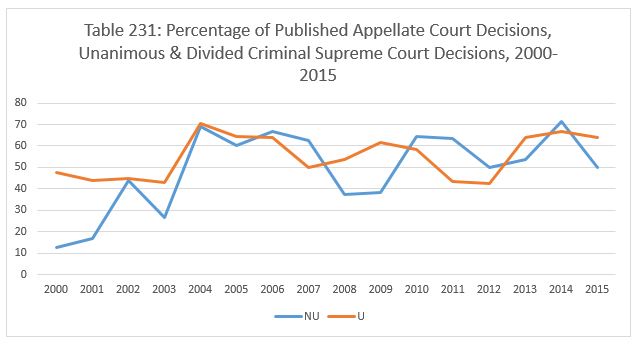
The relationships in the criminal docket are somewhat different. The fraction of the docket which arises from published decisions is lower on the criminal side from start to finish than it is on the civil side. At the beginning of our study period in 2000, almost none of the Court’s substantial number of non-unanimous decisions arose from published Appellate Court decisions (this is to a degree a result of the death penalty docket). Nearly half of the unanimous decisions were published below, while only 12.7% of the non-unanimous decisions were. Two years later, the numbers had nearly equalized – 44.74% of unanimous decisions were from published decisions below to 43.75% of non-unanimous ones. All told, non-unanimous decisions had a higher publication percentage below in six of the sixteen years between 2000 and 2015 – 2006, 2007, 2010-2012 and 2014. In 2015, 64% of the unanimous decisions arose from published decisions below, as compared to half of the non-unanimous decisions.

Table 231

Join us back here tomorrow as we address the issue of unpublished Appellate Court decisions from yet another angle.

Image courtesy of Flickr by Teemu008 (no changes).

129437165_53d911ebab_z

Last week we concluded our examination of the question of how much of the Illinois Supreme Court’s civil and criminal dockets comes from cases which sparked a dissent at the Appellate Court.  Today, we turn to a similar question: how much of the Court’s docket involves review of unpublished (and non-precedential ) Rule 23 orders?

The answer is – more than one might expect.  In Table 229 below, we report the year-by-year data for the civil and criminal dockets.  Clearly, publication is less crucial on the criminal side of the docket than it is on the civil side; the fraction of the criminal docket arising from published opinions has exceeded the civil docket number in only one of the past sixteen years.  On the civil side, the published percentage has dipped below 60% only twice, in 2001 (59.18%) and 2014 (55.56%).  The percentage was under 70% only one additional year – 2005 (67.75%).  Published opinions were between seventy and eighty percent of the docket six years of the period – 2000 (73.68%), 2002-2004 (72%, 75%, 75.93%), 2007 (70.73%) and 2015 (79.55%), in the eighties four years – 2006 (87.76%), 2009-2010 (80.49%, 87.88%) and 2012 (85%), and above ninety percent only three times – 2008 (95.24%), 2011 (94.74%) and 2013 (91.18%).

On the other hand, publication appears to be comparatively unimportant on the criminal side.  Although the numbers are depressed in the early years by the volume of death penalty litigation (death penalty appeals were taken directly to the Supreme Court – since they were tried by a single trial judge, there was by definition no dissent below), the Court’s published fraction of criminal cases has exceeded 70% in only one year – 2004 (70.18%).  Between sixty and seventy percent of the criminal, quasi-criminal and disciplinary docket arose from published decisions below in six years – 2005-2006 (63.79%, 64.71%), 2010 (60%) and 2013-2015 (60.53%, 67.65%, 61.29%).  The number was between fifty and sixty percent three times, between 2007 and 2009 (53.57%, 50.98%, 55.77%).  Between forty and fifty percent of the criminal docket arose from published opinions in 2002 (44.29%), 2011 (47.92%) and 2012 (44.19%).  In 2001 and 2003, between thirty and forty percent of the criminal docket involved published opinions (32.76%, 35.38%).  The published percentage reached its sixteen-year low in 2000, when only 22.09% of the criminal docket involved published opinions.

Tabel 229

Next week, we’ll divide the data by unanimous and non-unanimous Supreme Court decisions and look at publication again.  How often do unpublished Appellate Court decisions result in dissents before the Supreme Court?

Image courtesy of Flickr by Ken Lund (no changes).

5917576036_5fbcb90b09_zDISCLAIMER: Jacob H. Jost is a law clerk for the Hon. Rita B. Garman, Chief Justice of the Illinois Supreme Court. In that capacity, he sees Petitions for Leave to Appeal with a wide range of strengths and weaknesses.  In his personal capacity, he has analyzed what makes a winning PLA.  Jost is a 2013 graduate of the University of Illinois College of Law, where he was editor-in-chief of the University of Illinois Law Review.  Jost has no affiliation with Sedgwick LLP.  This analysis is not an official communication of the Illinois courts.  The opinions expressed do not necessarily reflect the views of Sedgwick, its partners or employees.

It did not go your way at the appellate court. The Rule 23 order came in this afternoon. Though you marshaled some strong arguments about a sister district’s precedent, two justices found room for distinction and went for the other side. You can take some comfort in knowing you persuaded one justice, as the fairly lengthy dissent indicates. As you prepare to inform your client, you wonder: should you file a petition for leave to appeal to the Illinois Supreme Court? What are the chances you can get review, and how can you improve your chances?

“Never tell me the odds.”

A petition for leave to appeal is, by the numbers, a bit of a long shot. The Illinois Supreme Court has discretion whether to take the vast majority of its appeals. The abolition of the death penalty in Illinois substantially reduced the number of direct appeals to be brought under Rule 603. Rules 302, 603, and 317 still provide for appeal as of right in the event a statute is found unconstitutional,[1] but this is a fairly rare event (implicated in just four of the Court’s forty-seven opinions from 2014).[2] Accordingly, almost all of the Court’s potential cases pass through Rule 315, which requires the filing of a petition for leave to appeal.

Jost Post 1Rule 315 spells out factors the Court considers: “the general importance of the question presented; the existence of a conflict between the decision sought to be reviewed and a decision of the Supreme Court, or of another division of the Appellate Court; the need for the exercise of the Supreme Court’s supervisory authority; and the final or interlocutory character of the judgment sought to be reviewed.”[3] The nonexclusive list makes the process appear straightforward.

Yet review remains elusive. In 2014, the Court disposed of some 1400 petitions outside the accelerated dockets for delinquent minors and child custody. Just 26 of the roughly 900 criminal case petitions were allowed, and 38 of the roughly 500 civil case petitions were allowed. The overall allowance rate is thus about 4.6%, with civil petitions being allowed a bit more than twice as often as criminal petitions. Is a petition worth the additional time and expense for less than a 1-in-10 shot?

But not all petitions are made equal. Certain characteristics of your case affect your chance of getting leave to appeal. Certain strategies can help you maximize your odds. This article identifies the common characteristics of successful civil case petitions for leave to appeal and contrasts them with those that did not garner the court’s approval in 2014. Some of these characteristics are binary, e.g., whether the petition claims a conflict in authorities, whether the appellate court acknowledged a conflict or distinguished it, whether there is an appellate dissent, and whether the appellate decision is published. The article contains an additional, holistic analysis on the primary focus of the petition, to gauge where the petition devotes the bulk of its argument. The analysis covers all civil petitions allowed in 2014 and a sample of the civil petitions denied, excluding the accelerated child custody and delinquent minor dockets. The denied petition sample provides a 5% margin of error, at a 95% confidence level.[4] By knowing the common elements of a successful petition and which aspects to emphasize, you can make an informed choice whether to proceed and how to frame your petition.

Conflict strengthens, but keep focus

By the numbers, the single most effective strategy in drafting a successful petition for leave to appeal is to state a conflict in authorities and maintain focus on it. Just over 84% of the petitions allowed by the Court in 2014 included a claim of conflict in authorities, either with other appellate decisions of the state, with decisions of the Illinois Supreme Court, or (less frequently) with persuasive federal decisions. Only 34% of the denied petitions claimed any sort of conflict in authorities. Successful petitions were thus more than twice as likely to claim a conflict.

Of course, some claims of conflict are too attenuated and some precedents ill-fitting. The appellate court distinguished about two thirds of the conflicts claimed in the denied petitions. Yet those who find their chosen conflict distinguished by the appellate court might still take heart, as this fact is far from fatal. The appellate court distinguished 34% of the conflicts claimed in the allowed petitions, in whole or in significant part. While a distinction by the appellate court clearly hurts your argument for a conflict, it may present an opportunity for some strong advocacy.

While about a third of the denied petitions stated conflicts, relatively few maintained a primary focus on that conflict, with far more focusing on error. More than half of the conflict-claiming denied petitions shifted to focus on errors of application of the law to the facts. Another 11% shifted to pure errors of law. Some stated conflicts were, in truth, mere statements of error. The petition would state a conflict with Illinois Supreme Court precedent but would then merely describe how that precedent had been misapplied below. Others briefly stated a conflict but swiftly abandoned discussion of it to focus on misapplication of other settled law below. Only 31% of the denied petitions stating a conflict maintained that focus throughout. Denied petitions at large overwhelmingly focused on claims of error, with 84% focusing on claims of error in application of the law or a pure error of law. Just under 11% of denied petitions overall maintained a focus on conflict in the law, with 5% focusing on development of the law.

Petitions focusing on claimed errors of law or fact have been, overwhelmingly, unsuccessful. This pattern suggests that petitioners should not consider the Illinois Supreme Court a court of error correction in any but the most extreme of cases. Likewise, the numbers suggest it is insufficient to claim a conflict and then focus on how you believe the appellate court erred. You will have much better luck by claiming a conflict and maintaining your focus on that conflict as the primary point of your petition.

As noted above, more than 4 in 5 allowed petitions claimed a conflict, and the allowed petitions typically maintained their focus on that conflict. Conflict remained the primary focus of 94% of allowed petitions that claimed one, with conflicts involving issues of jurisdiction making up nearly 19% of allowed petitions with conflicts. Only one allowed petition claimed a conflict then shifted its focus to errors in application of the law to the facts. The Court consolidated that petition with two others from the same case that did maintain a focus on conflict in the law, however, so it is difficult to draw a conclusion that it was a strong enough argument about error to warrant the Court’s attention. That petition may well have been pulled along by the momentum of the two petitions focusing on conflict. An additional allowed petition did not claim a conflict and focused its attention on claims of error, but it was likewise consolidated with a petition that did claim conflict and maintain that focus. Overall, a focus on conflict was central to 78% of the allowed petitions.

The spotlight on conflict thus far could cause pessimism for an attorney with no conflicting authority to point toward, but all is not lost. The Court did allow six petitions that did not state a conflict in authorities, which comes to about 16% of the allowed petitions. Of those successful petitions not claiming a conflict, 83% were focused on development of the law—how Illinois law is evolving and how the Court should guide it into the future. Petitions focusing on development of the law tended to advocate for common-law doctrines in Illinois to be abandoned or for common-law doctrines of other states or Restatements to be adopted. Other petitions focusing on development of the law noted tension or apparent conflict between existing statutes and recently enacted statutes, advocating for a particular harmonization of the two.

Some petitions focusing on development of the law claim an issue of first impression. Those that do should maintain a focus on developing the law. About 8% of the allowed petitions claimed an issue of first impression, while a bit over 11% of the denied sample did likewise. All of the allowed petitions claiming an issue of first impression maintained a focus on development, while only about 17% of the denied first-impression petitions did. The takeaway appears to be that claiming an issue of first impression is not, in itself, the strongest strategy, but it may be the strongest strategy available to a petitioner without a viable conflict to claim. If an issue of first impression is noted, the petition should maintain a focus on development of the law, rather than falling into a focus on errors in the courts below. The Court’s strong emphasis on conflicts in the law and its tendency not to take up claims of error both suggest another useful insight for an attorney claiming an issue of first impression: explain why the Court should take up the case now, rather than waiting for more appellate precedent to develop. Outline why your case should lead the way.

To summarize, as a petitioner you would do very well to invoke a conflict of authorities and maintain focus on that conflict. The Court’s allowed petitions overwhelmingly fit that pattern. If the appellate court has distinguished your conflict, try to explain why that distinction should not control. Having your conflict distinguished appears to have a fairly strong negative impact on its persuasive strength, but it is not fatal. If no strong conflict is available, consider focusing on development of the law and how Illinois law would best be interpreted going forward. A focus on whether the courts below erred, on matters of law or matters of fact, is unlikely to succeed.

Publish or perish, thrive on dissent

Both publication and an appellate dissent appear to give a petition a strong boost. Published opinions preceded 84% of the allowed petitions but only 32% of denied petitions. The strong relationship between publication and petition allowance is perhaps unsurprising, given Rule 23’s reservation of publication to those cases in which a majority of the appellate panel concludes the decision “establishes a new rule of law or modifies, explains or criticizes an existing rule of law” or “resolves, creates, or avoids an apparent conflict of authority within the Appellate Court.”[5] Unpublished decisions are without precedential effect, which necessarily reduces the urgency of review by the Supreme Court.[6] Note that the appellate court’s view of the case’s significance is not conclusive, however, insofar as 16% of the Court’s allowed petitions were from unpublished cases. In such cases, the Court may have seen sufficient need for clarity in the law, even in the absence of precedential effect of the appellate decision.

The existence of an appellate dissent likewise sends a relatively potent signal a petition is viable. Nearly 29% of the Court’s allowed petitions followed an appellate decision with a dissent, while only 10% of denied petitions did. The presence of a dissent may even occasionally overcome the negative impact of an unpublished decision. While unpublished orders made up only about 16% of the allowed petitions, a third of those cases had an appellate dissent. About 10% of unpublished decisions in the denied petition sample had appellate dissents; those petitions all focused on error, suggesting the dissents were similarly limited to the application of settled law to the particularized facts at hand.

It likely comes as no surprise that pro se petitioners rarely succeed in getting a petition heard by the Court. Pro se petitioners filed 22% of the denied petitions. One pro se petitioner did succeed in getting his case heard by the Supreme Court in 2014. As it turns out, that petitioner is an accounting professor and attorney admitted to practice in New York, who ended up writing a law journal article about his case before the Court.[7]  His petition stated a conflict and maintained a focus on that conflict.

Appeals as of right, answers

Additional factors to consider in drafting a petition are appeals as of right and the filing of answers. Two petitions allowed by the Court included an alternative pleading for appeal as of right under Rule 317,[8] making up about 5% of the allowed petitions. About 8% of denied petitions included Rule 317 claims, with most petitioners being pro se and failing to support the argument. Given the margin of error, the numbers do not quite support an inference that invoking Rule 317 is counterproductive, but it is mostly a misapplied tactic. In general, invoking Rule 317 does not appear to be especially effective.

As for answers, about 45% of the petitions allowed also had answers filed. Rule 315(f) allows a petition respondent to file an answer.[9] Typical answers explain why the petition does not properly satisfy the criteria contained in Rule 315(a) or argue against the petitioner’s characterization of the facts and proceedings below, with a goal of convincing the Court not to take up the case. Interestingly, answers were filed slightly more frequently for allowed petitions than for denied ones, with about 38% of denied petitions garnering answers. Again taking into account the margin of error, an answer might serve as some small indication that opposing counsel recognizes a petition as reasonably strong. However, it likely won’t be filed until three weeks or more after you have filed your petition, so an answer is no help in deciding whether to file one.

Victory by another name, and forfeiture

Even when a petition is denied, a petitioner might secure some measure of victory with a supervisory order. On the criminal side of the docket, this often occurs when a petitioner invokes a criminal law issue already pending before the Court, prompting a remand with directions to reconsider in light of the Court’s eventual decision. On the civil side of the docket, this often takes the form of the Court directing the appellate court to take an interlocutory appeal and consider it on the merits. While a denial with a supervisory order does not come with the opportunity to argue the issue before the Supreme Court, the petitioner gets another chance at the appellate court. Remember to ask for this type of relief in the alternative, if it makes sense in your case.

Finally, be wary of forfeiture.[10] The strongest conflict of authorities will do you no good if the issue to which it relates is forfeited. Preserve issues below and raise them in your petition. Where an issue has not been preserved, consider whether an exception to forfeiture might apply. The issues to be considered in argument before the Court will be framed by the successful petition.

Should you file that petition? Where should you focus?

Returning to the scenario described at the beginning of this article, you now know more about the likelihood of success and how to increase your chances. You have a viable conflict to point toward, a point in your favor. The appellate court has distinguished your conflicting authority, a point working against you. You have an appellate dissent to point toward, a point in your favor. The order is currently unpublished, a point working against you.

Jost Post 2If you decide to file that petition for leave to appeal, focus on the conflict in precedents you have identified. Avoid getting bogged down in claims of error applying settled law. To the extent the appellate majority has distinguished your conflicting authority, explain why that distinction is unavailing. Try to leverage the arguments present in the appellate dissent to further emphasize uncertainty in the courts below. Finally, you might consider filing a Rule 23(f) motion to publish[12]—though it may raise the stakes by making an unfavorable decision precedential, publication also maximizes the odds of securing review. If you craft an appealing petition, you may find yourself arguing before the Illinois Supreme Court. Good luck!

Image courtesy of Flickr by Denise Krebs (no changes).

————————————————————

[1] Ill. S. Ct. R. 302(a) (eff. Oct. 4, 2011); Ill. S. Ct. R. 603 (eff. Feb. 6, 2013); Ill. S. Ct. R. 317 (eff. July 1, 2006).

[2] In re Derrico G., 2014 IL 114463; In re Marriage of Donald B., 2014 IL 115463; People v. Clark, 2014 IL 115776; People v. Melongo, 2014 IL 114852.

[3] Ill. S. Ct. R. 315(a) (eff. Jan. 1, 2015).

[4] Sample size 209, out of 449 denied civil case petitions, excluding those petitions that were denied with a supervisory order.

[5] Ill. S. Ct. R. 23(a) (eff. July 1, 2011).

[6] Id. § (e).

[7] Huber v. American Accounting Association, 2014 IL 117293; Wm. Dennis Huber, The Curious, Perjurious Requirements of Illinois Supreme Court Rule 12(B)(3), 39 S. Ill. Univ. L.J. 451 (2015).

[8] Ill. S. Ct. R. 317 (eff. July 1, 2006) (allowing appeal where “a question under the Constitution of the United States or of this state arises for the first time in and as a result of the action of the Appellate Court”).

[9] Ill. S. Ct. R. 315(f) (eff. Jan. 1, 2015).

[10] See Ill. S. Ct. R. 341(h)(7) (eff. Feb. 6, 2013) (providing “Points not argued are waived”, and incorporated as to petitions by Ill. S. Ct. R. 315(d) (eff. Jan. 1, 2015)).

[11] 2013 IL App (1st) 082513-B.

[12] Ill. S. Ct. R. 23(f) (eff. July 1, 2011) (providing “any party may move to have the order published as an opinion”).


17257646452_bdf0b881b8_z (1)

Yesterday, we began our investigation of the importance of dissents at the Appellate Court for litigation at the Illinois Supreme Court.  We demonstrated that the often-heard claim that obtaining review at the Court is impossible without an Appellate Court dissent isn’t true, either on the civil or the criminal side.  Today, we address a related question: does a dissent at the Appellate Court reliably predict that there will be dissenters at the Illinois Supreme Court?

In Table 227 below, we plot the fraction of the Supreme Court’s non-unanimous and unanimous civil decisions which involved a dissent at the Appellate Court.  The table shows that dissent below is not an especially strong predictor of dissent at the Supreme Court.  Non-unanimous Supreme Court decisions were more likely than unanimous ones to involve a dissent below for only nine of the sixteen years since 2000.  In 2002, 41.18% of non-unanimous decisions involved a dissent below to only 21.21% for unanimous cases.  In 2005, one-third of non-unanimous decisions involved a dissent below to 20.51% for unanimous decisions.  The following year, 35% of non-unanimous decisions involved a dissent below to 17.24% for unanimous decisions.  In the years immediately following 2006, the share of dissents for unanimous and non-unanimous decisions remained quite close.  But in 2011, two-thirds of non-unanimous decisions involved dissents below to only 13.79% for unanimous cases.  The largest margins for unanimous decisions were in 2003 (40.63% unanimous, 28.57% non-unanimous), 2013 (35% unanimous, 21.43% non-unanimous), and 2014 (19.05% unanimous, 0% non-unanimous).

Table 227

The data for unanimous and non-unanimous criminal decisions in reported below in Table 228.  In contrast to civil cases, dissent below was more common in non-unanimous decisions nearly every year.  By 2005, 40% of non-unanimous criminal cases involved dissents below, to 25% for unanimous cases.  By 2009, 23.08% of non-unanimous decisions involved dissents to 7.69% for unanimous decisions.  In 2011, the margin was even larger – 45.45% for non-unanimous cases to 18.92% for unanimous decisions.  In 2013, 23.08% of non-unanimous decisions involved dissents to only 8% of unanimous cases.  By 2015, half of non-unanimous cases involved dissents below to 29.63% of unanimous decisions.

Table 228

Join us back here next week, as we turn to the importance of published decisions from the Appellate Court in the Illinois Supreme Court’s civil and criminal dockets.

Image courtesy of Flickr by Jeff Sharp (no changes).

4409760506_7072a0a546_z(1)Last week, we wrapped up our review of the areas of law addressed by the Illinois Supreme Court in its civil and criminal dockets, year by year from 2000 through 2015. Today we begin a new topic – dissents at the Appellate Court. One frequently hears that there’s little chance of getting a PLA granted unless there was a dissenter at the Appellate Court. But is that actually true?

In Table 225 below, we report cases with a dissent at the Appellate Court as a fraction of the civil docket. It’s clear from the graph that the conventional wisdom isn’t true, at least on the civil docket – cases with dissents below have never reached even forty percent of the total caseload. In 2000, cases with dissents below amounted to only 21.05% of the civil docket. The number plummeted to 7.84% the following year, but was back up to 28% in 2002. 2003 was the highest year in the entire study period for the statistic – 36.96% of the Court’s civil docket arose from cases with a dissenter below. Divided cases fell off somewhat between 2004 and 2006 before rising to 36.59% in 2007. With the exception of 2014, when divided cases fell to only 14% of the civil docket, the data has remained in the 30-36% range ever since.

Table 225

We report the same statistic below for the Court’s criminal docket between 2000 and 2015. Notice that divided Appellate Court decisions are somewhat less commonplace on the criminal docket throughout the sixteen-year period. In fact, 2015 was the highest year in the period – one third of the Court’s criminal cases involved a dissent at the Appellate Court. In 2010, 32.73% of the docket arose from dissents below. Between 2004 and 2008, divided decisions were between twenty and thirty percent of the criminal docket (2004: 28.07%; 2005: 27.59%; 2006: 21.57%; 2007: 28.57%; 2008: 27.45%). But in contrast, between 2000 and 2003, divided cases were only a tiny fraction of the criminal docket – (2000: 6.82%; 2001: 8.62%; 2002: 10%; 2003: 13.85%).

Table 226

Tomorrow, we’ll turn to a related question: are dissents at the Appellate Court a reliable predictor of dissents at the Supreme Court?

Image courtesy of Flickr by Matt Turner (no changes).

197747821_aeb4bb17df_z

Today, we conclude our trip through the areas of law from which the Illinois Supreme Court has drawn its civil and criminal dockets over the past sixteen years with our review of the years 2013-2015.

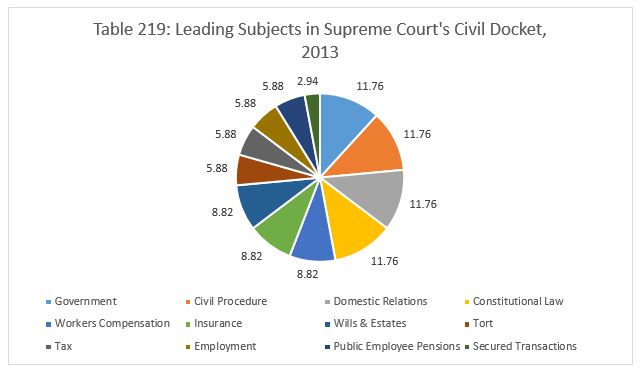
As you can see from the Table below, the striking thing about the Court’s civil docket in 2013 was its balance. Where the Court has historically drawn its caseload on both sides of the docket from two to three areas much more than others, in 2013, the leading subjects on the Court’s civil docket contributed only four cases apiece – government and administrative law, civil procedure, domestic relations and constitutional law. The Court decided an additional three cases each in workers’ compensation, insurance and wills and estates law (8.82%). Two cases apiece arose from tort law, tax, employment and public employee pensions (5.88%). Finally, the Court decided one case involving secured transactions (2.94%).

Table 219

The criminal docket, on the other hand, was dominated by thirteen criminal procedure cases – 39.39% of the total docket. The Court decided five cases each arising from constitutional law, sentencing issues and sex crimes (15.15% each). Three cases arose from habeas corpus claims (9.09%), and one each from attorney admission and fitness and juvenile issues (3.03%).

Table 220

The civil docket was once again widely distributed in 2014, with five different areas of the law accounting for at least 10% of the caseload. The Court decided five cases each arising from government and administrative law and civil procedure (18.52%). The Court heard four cases apiece in tort and constitutional law (14.81%), and three involving property law (11.11% of the civil docket). The Court decided two cases each in domestic relations and public employee pensions (7.41%). Finally, the Court decided one case each arising from election and employment law, respectively (3.7%).

Table 221

Over half the Court’s criminal docket in 2014 consisted of constitutional law claims and criminal procedure – con law produced 11 cases, or 28.95% of the criminal docket, and criminal procedure produced 10, or 26.32%. Habeas corpus cases partially reversed their lengthy decline, producing six cases, or 15.79% of the docket. Four cases involved juvenile issues (10.53%), three arose from sentencing disputes (7.89% of the docket), two involved sex crime issues (5.26%), and one each arose from attorney admission and fitness and property crimes (2.63%).

Table 222

Civil procedure led the Court’s civil docket last year, accounting for 11 cases – one quarter of the docket. An additional eight cases arose from government and administrative law issues (18.18%), and six involved tort law (13.64%). The Court heard four cases apiece in domestic relations and constitutional law (9.09% of the docket apiece). Two cases each arose from insurance and public employee pensions (4.55%). The rest of the civil docket was scattered, with one case each arising from seven different areas of the law – contract, tax, property, workers’ compensation, election law, environmental law and secured transactions.

Table 223

We report the data for last year’s criminal docket in Table 224 below. The principal issue in the vast majority of the Court’s criminal docket cases in 2015 was criminal procedure (13 cases – 39.39% of the docket) or constitutional law (12 cases – 36.36%). The Court decided four cases involving sentencing issues (12.12%). The rest of the docket was once again scattered, with the Court hearing one case each involving violent crimes, juvenile issues, obstruction and attempt offenses.

Table 224

Join us back here next week as we take up a new subject – how much of the Court’s docket involved dissents at the Appellate Court?

Image courtesy of Flickr by Brent Moore (no changes).