Today, we’re concluding our review of the individual Justices’ voting records in tort cases. Justice Theis has participated in 55 tort cases since her tenure began in 2010. Justice Theis has voted for defendants in 38 of those cases and voted for plaintiffs 17 times. From 2010 to 2013, she voted for defendants 21 times and for plaintiffs only 5 times. From 2014 to 2017, she voted for defendants in 17 of 25 cases. Since that time, she has voted for plaintiffs in all four tort cases.

Since taking her seat on the Court, Justice Theis has participated in 12 tort cases won by the defendants below. She has evenly split her votes – six votes to affirm, six to reverse.

Justice Theis has participated in 43 tort cases lost by the defendant at the Appellate Court, voting to reverse, at least in part, 32 of those 43 cases. From 2010 to 2013, she voted to reverse in 18 of 22 cases. From 2014 to 2016, she voted to reverse in 10 of 14 cases.

Justice Neville has participated in three tort cases since joining the Court, voting for defendants once and for plaintiffs twice. Two of those three cases were won by the defendant below, with Justice Neville voting to reverse both times. One tort case was won by the defendant below, and Justice Neville voted to reverse.

Join us back here next Tuesday as we begin our review of a new area of law.

Image courtesy of Flickr by Ron Frazier (no changes).

For the past few weeks, we’ve been studying the Court’s collective and individual voting records in tort cases. Chief Justice Burke participated in ninety civil tort cases since taking her seat on the Court. She has voted for defendants’ position (at least in part) in 57 cases and voted for plaintiffs 33 times. Between 2006 and 2010, she cast 18 votes for defendants and 17 for plaintiffs. From 2011 to 2015, she voted for defendants 30 times and for plaintiffs in 8 cases. Since that time, she has cast nine votes for defendants and eight for plaintiffs.

Twenty-nine of these cases were won by the defendants at the Appellate Court. The Chief Justice voted to affirm 11 of those defense wins and voted to reverse 18 times. From 2006 to 2010, she voted to affirm only five times and voted to reverse in twelve cases. Since 2011, the Chief Justice has evenly split her votes in twelve cases – six to affirm, six to reverse.

The Chief Justice has participated in 62 tort cases lost by the defendants below. Since taking her seat, she has voted to reverse 46 times and voted to affirm 16 times. From 2006 to 2010, she voted to reverse defense losses 13 times and to affirm in 5 cases. Since that time, she has voted to reverse, at least in part, three-quarters of 44 tort defendants’ losses.

Join us back here tomorrow as we turn our attention to Justices Theis and Neville.

Image courtesy of Flickr by Gary Todd (no changes).

Since joining the Supreme Court, Justice Karmeier has participated in 109 tort cases. He has voted for defendants in 73 of those cases and for plaintiffs 36 times. Between 2005 and 2008, he voted for defendants in 23 cases and for plaintiffs 15 times. Between 2009 and 2012, he voted for defendants 26 times and for plaintiffs in 12 cases. Between 2013 and 2016, he voted for defendants 18 times in 22 cases. Between 2017 and 2019, he has voted for tort defendants six times in 11 cases.

During his tenure, Justice Karmeier has voted in 36 tort cases won by defendants below. He has voted to affirm in 19 of those cases, and supported plaintiffs’ position in 17 cases.

Between 2005 and 2008, Justice Karmeier voted for defendants ten times and for plaintiffs in 8. From 2009 to 2012, he voted for defendants in five of nine cases. Between 2013 and 2016, he voted for defendants in three of five cases. Between 2017 and 2019, he has voted for defendants in only one of four cases.

Since 2005, Justice Karmeier has participated in 73 tort cases lost by defendants below. He has voted to reverse, at least in part, 54 times and for plaintiffs in 19 cases. Between 2005 and 2008, Justice Karmeier voted to reverse in 13 of 20 defendants’ losses. Between 2009 and 2012, he voted to reverse in 21 of 29 cases. From 2013 to 2016, he voted to reverse in 15 of 17 cases. From 2017 to 2019, Justice Karmeier has voted to reverse, at least in part, in five of seven tort cases which defendants lost below.

Join us back here next Tuesday as we continue our examination of the Justices’ individual voting records in tort cases.

Image courtesy of Flickr by Gary Todd (no changes).

Through the end of 2019, Justice Thomas had voted in 141 tort cases. He voted for defendants in 93 of those cases and voted for plaintiffs 48 times.

Justice Thomas’ voting patterns in tort cases have remained relatively stable throughout his tenure. From 2001 to 2004, he voted 30 times for defendants, 16 for plaintiffs. Between 2005 and 2008, he voted 19 times for defendants, 10 for plaintiffs. From 2009 to 2012, he voted 24 times for defendants in tort cases to 11 for plaintiffs. Since that time, he has voted for defendants in 20 cases and for plaintiffs 11 times.

Only 47 of these 141 cases were won by defendants at the Appellate Court. Before the Supreme Court, Justice Thomas has voted to affirm defendants’ wins 31 times and voted to reverse, at least in part, in 16 cases. Between 2001 and 2004, Justice Thomas voted to affirm 13 of 16 tort defendants’ wins. From 2005 to 2008, he voted for defendants nine times, for plaintiffs five times. Since 2009, Justice Thomas has split his votes evenly, voting to affirm nine times and to reverse nine times in cases won by defendants below.

Justice Thomas has voted in 95 tort cases lost by defendants at the Appellate Court, voting to reverse at least in part 63 times and voting to affirm in 32 cases. From 2001 to 2004, Justice Thomas voted to reverse in 17 of 30 cases. From 2005 to 2008, he voted to reverse in 11 of 16. From 2009 to 2012, Justice Thomas voted to reverse 19 times and to affirm in 8 cases. Since 2013, he has voted to reverse in 16 cases of 22.

Join us back here tomorrow as we review Justice Karmeier’s voting record in tort cases.

Image courtesy of Flickr by FormulaOne (no changes).

We’ve seen over the past several posts that tort defendants have fared well at the Court in the years since 1990. Justice Kilbride has been in the minority of many of these cases since 2001. For the years 2001 to 2019, Justice Kilbride has voted for tort defendants’ position in 73 cases while voting against defendants 79times. In 2002 and 2003, Justice Kilbride voted for defendants eight times while supporting the plaintiffs’ side 17 times. Since 2016, Justice Kilbride has voted in seven cases for defendants while supporting plaintiffs’ position in ten cases.

In cases won by tort defendants at the Appellate Court, Justice Kilbride has voted 23 times to affirm and 29 times to reverse. From 2008 to 2010, he voted to reverse in nine of thirteen such cases. From 2011 to 2019, he voted to reverse in seven of twelve cases.

Through the end of 2019, Justice Kilbride voted in 100 tort cases which the defendant had lost at the Appellate Court. He split his votes right down the middle – 50 times to reverse, 50 times to affirm. In 2005 and 2008, Justice Kilbride voted to reverse in 12 of 16 cases. Between 2009 and 2014, he voted to affirm in 20 of 36 cases lost by defendants below. Since then, he has voted to reverse in nine of 16 defendants’ losses.

Join us back here next Tuesday as we continue our review of the Justices’ voting records in tort cases.

Image courtesy of Flickr by Matthew Dillon (no changes).

Over the past few weeks, we’ve been reviewing the Court’s thirty year record in civil tort cases – defendants’ overall won-loss records, the frequency with which the Court affirms (or reverses) defendants’ wins from the Appellate Court, and the frequency with which the Court reverses (or affirms) decisions lost by defendants below. Now let’s take a look at the individual Justices’ records, beginning with Justice Garman. But before beginning, we should clarify one point: we’re taking a binary view of “winning” and “losing” in this data. Appellate litigation routinely includes several different issues and the ultimate decision on appeal is “affirmed in part and reversed in part.” Sometimes the issue where a party “wins” is comparatively minor in the context of the whole case. But we’re not making that subjective judgment about these cases – our standard is that if an adverse judgment is reversed in any respect, the appellant has won and the respondent has lost.

Since joining the Court, Justice Garman has voted for tort defendants’ position in 100 cases, while supporting plaintiffs 53 times. In 2004-2005, she supported defendants in 13 cases while voting against them 5 times. From 2006 to 2009, Justice Garman voted for defendants’ position 27 times, and against in 13 cases. For the years 2011 through 2017, Justice Garman voted for defendants’ position 38 times, voting against in 13 cases.

Forty-nine tort cases where Justice Garman participated were won by the defendant below. Justice Garman voted to affirm 30 of those decisions and voted to reverse 19 times. From 2001 to 2007, Justice Garman voted to affirm 17 defense wins from the Appellate Court while voting to reverse 6 times. From 2008 to 2019, Justice Garman voted to affirm 13 times while voting to reverse 13 times.

Finally, Justice Garman voted to reverse decisions lost by tort defendants at the Appellate Court 70 times from 2001 to 2019 while voting to affirm 34 times. In 2004 and 2005, Justice Garman voted to reverse 10 of 14 tort decisions lost by defendants below. In 2008 and 2009, she voted to reverse in 10 of 13 cases. In 2012 and 2013, she voted to reverse defendants’ losses in 11 of 13 tort cases.

Join us back here tomorrow as we continue our review of the Justices’ voting records.

Image courtesy of Flickr by Sajith TS (no changes).

Tort defendants continued to fare quite well at the Supreme Court over the past ten years, winning 41 cases while losing 23. Defendants won nine of twelve cases in 2011, seven of ten in 2012, six of seven in 2015 and five of seven in 2017.

The Court reviewed relatively few decisions where defendants prevailed at the Appellate Court. For the years 2010-2019, tort defendants received affirmances in eight Appellate Court wins, while nine lower court wins were reversed by the Supreme Court.

Tort defendants fared very well, however, in getting decisions which they lost at the Appellate Court reversed by the Supreme Court. Overall, defendants won 33 of such cases, losing only 14. Defendants won 13 of 19 cases during the years 2011-2013. They were 6-1 in 2015 and from 2017 to 2019, defendants won five of seven cases.

Join us back here next Tuesday as we begin reviewing the individual Justices’ voting patterns in tort cases.

Image courtesy of Flickr by Soki (no changes).

Tort defendants had another good decade before the Supreme Court during the years 2000 to 2009, winning 64 cases and losing 42. In 2001, defendants won eight of nine cases. In 2004, tort defendants went 10-3. In 2009, defendants won six of eight.

In our next Table, we review the data on how tort defendants fared during these years seeking affirmance of decisions they won at the Appellate Court level. These cases were closely divided, with the Court affirming 22 tort defendant wins and reversing 17 times. Defendants were 4-1 in defending appellate victories in 2001 and again in 2004.

Tort defendants fared especially well during these years when they were trying to obtain reversal of decisions they had lost at the Appellate Court. Defendants won 42 of those cases while losing only 25. Defendants were 4-0 in attacking losses in 2001, 6-2 in 2004 and 6-1 in 2009.

Join us back here tomorrow as we review the data for the years 2010 to 2019.

Image courtesy of Flickr by Susan Rose (no changes).

Today, we’re beginning our review of voting records for a new area of law – tort.  Today and next week, we’ll be working our way through the data showing how tort defendants have fared at the Appellate Court since 1990: total wins and losses; wins from the Appellate Court affirmed (and reversed); and losses from below reversed or affirmed.

Not surprisingly, the Supreme Court decided a lot of tort cases from 1990 to 1999.  Across the entire decade, tort defendants won 99 cases at the Court while losing 75.  Defendants hit .500 during 1990 and 1991, winning 18 and losing 18, before going 9-19 in 1992 and 4-8 in 1993, but after that, the defendants fared fairly well, winning 68 of 98 cases.

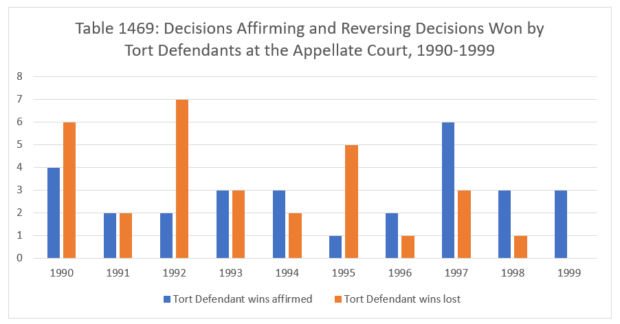
For the first half of the decade, tort defendants struggled to retain their wins from the Appellate Court, winning affirmances in only 14 while getting reversed 20 times.  But things turned around from 1995 to 1999, as winning defendants from the Appellate Court won 15 at the Supreme Court while losing only 10.

Finally, how did tort defendants fare in cases they had lost at the Appellate Court?  Across the entire decade tort defendants won 70 cases which they had lost below while losing only 45.  In 1992 and 1993, defendants had eight wins to 17 losses, but they fared much better in the second half of the decade.  From 1995 to 1999, tort defendants won 44 cases they had lost below while losing only 14.

Join us back here next Wednesday as we turn our attention to the numbers for the years 2000 to 2009.

Image courtesy of Flickr by Claudia Wollesen (no changes).

Today, because insurer cases have been comparatively uncommon in recent years, we’re reviewing our final two sets of Justices’ voting records in a single post.  First, Justice Theis.

Since joining the Court, Justice Theis has participated in ten civil cases involving insurers as named parties, supporting the insurers in six of those cases and voting against the insurers in four.

Only two of those ten cases involved decisions won by the insurer at the Appellate Court.  Justice Theis voted to affirm once in those two cases and to reverse once.

The remaining eight cases all involved Appellate Court losses by insurers.  To date, Justice Theis has voted to reverse in five on those cases and to affirm three times.

Since joining the Court in 2018, Justice Neville has participated in two insurer cases, voting for the insurer’s position once and against once.  One of those cases had been won by the insurer below, and Justice Neville voted to reverse the insurer’s win.  The other case was lost by the insurer at the Appellate Court, and Justice Neville voted to reverse the insurer’s loss.

Join us back here tomorrow as we begin a new area in our subject matter review of the Justices’ voting records – tort law.

Image courtesy of Flickr by Skeeze (no changes).