7237321820_8e413b84c8_zYesterday, we began a close look at the reversal rates in the Illinois Supreme Court’s civil docket between 2005 and 2009. Now, we turn to the central question: what were the Court’s reversal rates in its most common areas of the law for liberal and conservative Appellate Court decisions?

Despite the more equal distribution of cases, certain trends emerge when we turn to subject-by-subject reversal rates. During these five years, the Court continued to reverse liberal Appellate Court decisions involving tort issues at a significantly higher rate than conservative decisions (although the reversal rate on conservative tort decisions increased significantly). Liberal decisions in constitutional law – nearly always decisions holding a statute unconstitutional – were reversed at a much higher rate than conservative decisions as well. Liberal decisions in insurance law were reversed at a very high rate, while the Court reviewed four liberal decisions in workers compensation law and affirmed them all.

Table 18 C

Next week, we turn to the final five years of our study period, 2010-2014.

Image courtesy of Flickr by Ken Lund (no changes).


5917576036_5fbcb90b09_zLast week, we began to take a close look at the reversal rates of the Illinois Supreme Court, disaggregated by area of the law, for the first five years of our study period.

How did things change during the next five years, after the Court’s party balance had shifted from five Democrats and two Republicans to four to three? Once again, tort law accounted for the largest single share of the Court’s civil docket, although its share was down slightly. Constitutional law issues are significantly more common during these five years, with civil procedure cases somewhat less so. Government and administrative law cases and insurance cases are somewhat up, with domestic relations and workers compensation cases steady:

Table 18 A

During the five years that followed, the Court’s civil docket shifted towards a much more equal distribution of conservative and liberal Appellate Court decisions in most subject areas. Where sixty-five percent of the Court’s tort law cases involved plaintiffs prevailing at the Appellate Court between 2000 and 2004, and two thirds of its insurance law cases involved policyholder wins, cases are now almost evenly divided between plaintiff and defendant wins.

Table 18 B

Tomorrow, we continue with our close look at the Court’s reversal rates between 2005 and 2009.

Image courtesy of Flickr by Denise Krebs (no changes).

3281500785_1c179fc796_zIn our last post, we saw that tort law was the most common subject on the Court’s civil docket in the first five years of the twenty-first century, followed by civil procedure, constitutional law, insurance law, domestic relations, workers compensation and government and administrative law. We begin the next phase of our analysis by addressing whether defense or plaintiff’s wins were more common in each subject among the cases the Court accepted.

In two key subjects – tort law and insurance – approximately two thirds of the cases the Court accepted for review were plaintiffs’ victories before the Appellate Court. The Court’s cases in workers compensation, an area of the law which overlaps to a degree with tort, were also lopsidedly plaintiffs’ wins below. In another politically charged area, constitutional law, fifty-five percent of the Court’s cases involved liberal Appellate Court decisions:

Table 17_B

We next parse our overall reversal rate statistics by considering whether the Court reversed conservative or liberal Appellate Court decisions at a higher-than-expected rate in each separate area of the law. We see that the Court reversed relatively few Appellate Court decisions for defendants, while reversing decisions in favor of insurance companies at an unexpectedly high rate. Reversal rates in the areas of workers compensation and government and administrative law were relatively close to the overall reversal rate.

Table 17_C

Next week, we’ll turn to the second five years of our study period, 2005-2009.

Image courtesy of Flickr by Scott Tranchitella (no changes).

3236052269_58328bc076_zLast week, we addressed the reversal rate of the Appellate Court districts in civil cases at the Illinois Supreme Court.

Today, we begin taking a closer look at the data.  Even viewed from the District-by-District level, Appellate Court reversal rates are a composite statistic, and therefore may be hiding important insights. Suppose, for example, that the Supreme Court regularly affirmed cases reflecting a conservative approach to civil procedure issues, but often reversed opinions where a plaintiff suing the government had prevailed at the Appellate Court.

In order to learn more about the Supreme Court’s views on the law during our study period, we next study the top seven subject matter areas. These seven areas make up slightly less than thirty percent of the Court’s civil docket between 2000 and mid-2014.

We also address philosophical coding of our decisions for the first time. Philosophical coding of appellate decisions has a lengthy history in the academic literature; scholars have been attempting to rank both courts and individual Justices and judges along a conservative-to-liberal spectrum for more than sixty years.[1] Many different scoring systems have been developed and applied to enormous bodies of data.[2]

In order to minimize the subjectivity we add to the data, we apply a default rule in most cases: a vote for a plaintiff is coded as liberal, and a vote for the defendant is coded as conservative. There are two significant exceptions. For the most part in government and administrative cases, the government’s side as coded as liberal regardless of which side of the case style the government appears on, and the entity challenging the government’s position is coded as conservative.[3] Also, a vote for a party which would ordinarily appear as a defendant is still coded as conservative even when that party has taken the initiative in a particular case – for example, an insurance company which initiates litigation with its policyholder by filing a declaratory judgment action.

For the first five years of our study period, tort law was the most frequent subject of the Court’s civil docket, followed by civil procedure, constitutional law, insurance law, domestic relations, workers compensation and government and administrative law:

Table_17_A

Tomorrow, we’ll address additional questions about the Court’s docket between 2000 and 2004: in the most frequently heard areas, did the Court accept more conservative or liberal Appellate Court decisions, and how did the Court’s reversal rates for each type of decision differ?

Image courtesy of Flickr by Nick Jordan (no changes).

—————————————————————-

[1]               Although most of the academic literature uses the term “ideological” coding, I have deliberately chosen a different term here. While studies of the “ideology” of judicial decisionmaking have drawn significant criticism, mostly because of the arguable implication that appellate judges are sometimes political actors, the notion that any judge – indeed, any lawyer – approaches legal questions with a generally conservative, moderate or liberal legal philosophy should not be open to much question.

[2]               E.g., Corey Rayburn Yung, “Judge by the Company You Keep: An Empirical Study of the Ideologies of Judges on the United States Courts of Appeals,” 51 Boston College Law Review 1133, 1140-1153 (2010); Andrew D. Martin and Kevin M. Quinn, “Dynamic Ideal Point Estimation via Markov Chain Monte Carlo for the U.S. Supreme Court,” 1953-1999,” 10 Political Analysis 134 (2002); Jeffrey A. Segal, Lee Epstein, Charles M. Cameron, Harold J. Spaeth, “Ideological Values and the Votes of U.S. Supreme Court Justices Revisited”. The Journal of Politics 57 (August 1995): 812–823. For an example of philosophical coding applied to large numbers of cases, see SupremeCourtDatabase.org. For a discussion of the debate over ideological coding of judicial decisions, see Gregory C. Sisk and Michael Heise, “Judges and Ideology: Public and Academic Debates about Statistical Measures,” 99 Northwestern University Law Review 743-804 (2005).

[3]               There is one exception to the exception: votes for plaintiffs alleging that the government is being insufficiently rigorous in its enforcement of environmental laws are coded as liberal.

9497252703_7c15a1c787_zYesterday, we addressed the reversal rates of the districts and divisions of the Appellate Court. Now we turn to a related issue.

Reversal rates may conceal the true degree of disagreement on the Court with the decisions coming out of any particular District and division. Reversal is a binary variable: a 4-3 reversal affects a Court’s reversal rate as much as a 7-0 reversal does. Therefore, we revisit the data, calculating the average number of votes on the Supreme Court in favor of affirming the Appellate Court’s opinion. Once again, we report three-year floating averages:

Table 16

Although little seems apparent from the record of the six divisions of the First District – not surprisingly, given that cases are assigned to the divisions randomly – several conclusions are apparent from the performance of other Districts of the Appellate Court. Until recent years, the Third District’s decisions have fared slightly better than those of the Second District. Especially in the last four years, the decisions of the Fourth District have fared reasonably well before the Court. But the civil decisions of the Fifth District have met a consistently chilly reception before the Court for the entire fifteen-year period of our study, frequently averaging less than two votes to affirm.

Next week, we’ll begin disaggregating the data on reversal rates by different areas of the law.

Image courtesy of Flickr by Richie Diesterheft (no changes).

1388658196_42cbd8134e_zLast week, we addressed the dissent rate in civil cases at the Illinois Supreme Court. This week, we turn to a new aspect of the Court’s decision making.

During the past twenty years, the most frequently cited statistic among observers of the United States Supreme Court has been the “reversal rate” of each federal Circuit. What seldom gets reported is how misleading an apparently high reversal rate is, at least in absolute terms, given that even for the most supposedly disfavored Circuit, the Court is declining to review anywhere from ninety-five to ninety-nine out of every one hundred cases for which petitions for certiorari are filed.

The same is true of the Illinois Supreme Court. Because most petitions for leave to appeal are denied, viewed from the petition stage, few cases will ever be both reviewed and reversed. Nevertheless, there is something to be learned from comparing reversal rates across time for each District of the Appellate Court, and the various divisions of Chicago’s First District. Because the Court tends to hear relatively few cases from any particular District in a single year, random fluctuations cause year-to-year reversal rates to be misleading. Therefore, we report three-year floating averages:

Table 15

It is a truism often heard among appellate specialists that the Supreme Court does not grant leave to appeal in order to affirm the Appellate Court’s decision. But in the years since 2000, the data does not strongly support this view. In most districts and most years, the Court reverses between fifty and seventy percent of the civil decisions it reviews.

There is one obvious exception: the Fifth District. For many years tort reform organizations have insisted that the Fifth District is a particularly hostile jurisdiction for defense interests. Since Justice Lloyd A. Karmeier joined the Court at the end of 2004, the Court has consistently reversed between seventy and ninety percent of the civil decisions it reviews from the Fifth District.

Tomorrow, we’ll review a related aspect of this same inquiry: how many votes to affirm do the civil decisions of each District average between 2000 and 2014?

Image courtesy of Flickr by Katherine Johnson (no changes).

9684642673_175bcdc7dd_zYesterday, we addressed the Illinois Supreme Court’s rate of dissent in civil cases since 2000. But a 6-1 decision counts as not being unanimous – how many of these cases saw a closely divided Court?

The Court’s percentage of closely divided cases – decisions with two or three dissenting Justices – has remained relatively constant between 2000 and 2014, with approximately four in every five civil cases sparking little disagreement:

Table 14_B

Next week, we’ll turn to one of the most often-seen statistics in commentary on the appellate courts – the Court’s reversal rate. How often does the Court reverse decisions of each district of the Appellate Court?

Image courtesy of Flickr by Patrick Feller (no changes).

9721237619_1c160e640e_zLast week, we addressed the issue of the lag time between argument and decision as a predictor of whether the Court’s decision will be unanimous. This week, we address the Court’s dissent rate.

Many scholars (and quite a few judges) have argued that an appellate court’s dissent rate does not necessarily reflect how often the judges agree on the substantive issues coming before them.[1] Judicial behavior models argue that judges decline to dissent even when they disagree with the Court’s decision for a variety of reasons. Appellate judges tend to believe that an appearance of unanimity is worthwhile simply because it weighs against the cynical view that a court’s decisions are solely dependent on its personnel. Since most appellate judges tend to work in relatively close quarters with their colleagues for many years, simple collegiality can suppress dissent. Judge Richard A. Posner has argued that a dissent “usually has no effect on the law” and “tends to magnify the significance of the majority opinion.”[2] Finally, some analysts have argued that since judges do not receive credit against their share of the Court’s majority opinions for any dissents they choose to write, the press of the Court’s workload can reduce the incidence of published dissents, even when one or more of the Justices disagree with the Court’s ultimate decision.[3]

We saw above that dissent is comparatively uncommon on the Appellate Court – between one-in-four and one-in-twenty cases. On the other hand, in most recent years (although there was a curious dip in 2012 and 2013), the Illinois Supreme Court tends to decide at least seventy percent of its civil cases unanimously:

Table 14_A

Tomorrow we’ll look more closely at the non-unanimous decisions – specifically, how often is the Court almost evenly divided?

Image courtesy of Flickr by Surrey County Council News (no changes).


———————————————————————————

[1]           E.g., Choi and Gulati, “Trading Votes,” 81 S. Cal. L. Rev. 735; Epstein, Landes & Posner, The Behavior of Federal Judges, pp. 255-304; Jennifer L. Peresie, “Female Judges Matter: Gender and Collegial Decisionmaking in the Federal Appellate Courts,” 114 Yale L. Journal 1781-1786 (2005); Harry T. Edwards, “The Effects of Collegiality on Judicial Decision Making,” Univ. Penn. L. Rev. 1645-1652 (May 2003); Evan H. Caminker, “Sincere and Strategic Voting Norms on Multimember Courts.” Mich. L. Rev. 97, no. 8 (1999): 2297-380.

[2]           Richard A. Posner, How Judges Think (Harvard University Press: 2003), p. 32.

[3]           Historical data shows that dissent was relatively uncommon on the United States Supreme Court until the New Deal era. Historical data is sparse on the Federal Circuits and the state Supreme Courts, but one would expect those courts to follow the lead of the Supreme Court.

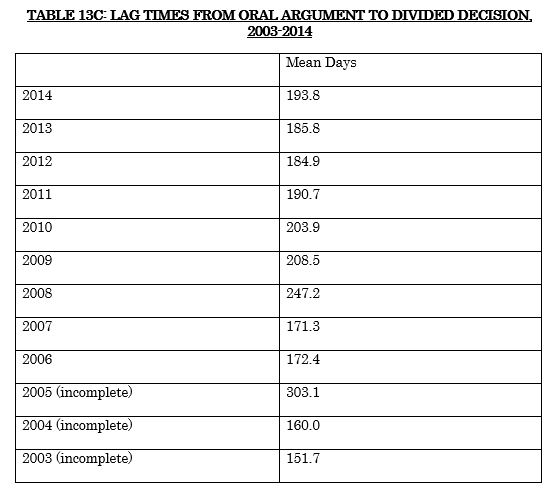
6209714304_3bfb086fcb_zYesterday, we turned from examining the sources of the Court’s docket to looking at what the data tells us about the Court’s decision-making process. There, we determined that the Court’s overall lag time has been relatively constant for at least ten years. When the Court hands down a decision in three to four months, the reasonable inference is that the decision is unanimous. But what about when the Court is divided?

When there are dissenters, decisions typically take six months or more from oral argument to opinion:

Table_13_C

Next time, we’ll turn to the question of the Court’s dissent rate.

Image courtesy of Flickr by Gerry Lauzon (no changes).

4286076672_2763323a1e_zFor the past several weeks, we’ve been investigating what the data tells us about how the Illinois Supreme Court assembles its docket: whether the Court prefers final judgments; how often the Court takes up summary judgments; what counties and areas of the law have contributed most to the Court’s civil docket; whether a dissent at the Appellate Court helps in getting review (and if so, how much), and whether the Court reviews unpublished opinions.

We now turn to the centerpiece of our inquiry: the Court’s own decision-making process. First up: what can we infer from the amount of time the Court has had a particular case under submission?

Although the data for 2005 and earlier is incomplete, the Court’s lag time from oral argument to decision has remained relatively constant for at least the past ten years:

Table_13_A

Not surprisingly, the Court’s lag time from oral argument to decision is a relatively strong predictor of whether or not the eventual decision will include dissenting opinions. Although lag times for unanimous decisions appear to be dropping in recent years, receiving a decision within four months after oral argument tends, more often than not, to indicate a unanimous Court:

Table_13_B

Tomorrow, we’ll address the Court’s lag time from argument to decision when the Court is divided.

Image courtesy of Flickr by Alexander Boden (no changes).

——————————————————

[1]           The Court’s published opinions do not list the date of argument, and for the years 2000-2005, numerous Calls of the Docket are missing from the Court’s website. Accordingly, it is not always possible to determine when a particular case was argued.