5332677555_fe3798fae4_zYesterday, we began our Justice-by-Justice review of question patterns at the Illinois Supreme Court with Justice Anne M. Burke. Our goal is to explore what we can infer about likely voting and opinion writing from each Justice’s questioning of the two sides. Today, we look at whether Justice Burke’s vote and opinion writing impacts the likelihood that she will ask the first question.

The answer is yes. As shown below in Table 77, there is a 24% likelihood that Justice Burke will ask the first question of the appellant when the Court unanimously reverses. Most of these cases involve cases where Justice Burke doesn’t write a decision. She asks the appellant the first question 20% of the time when she’s not writing an opinion, but 41% of the time when she is writing the majority. Justice Burke asks the first question of appellees only 5% of the time when the Court reverses – 3.3% when Justice Burke is not writing an opinion, and 8.11% when she is writing the majority opinion. (Justice Burke was not the first questioner in any case where she wrote a special concurrence.)

The effect is equally significant when the Court unanimously affirms. Overall, Justice Burke asks the first question of each side in unanimous affirmances 21% of the time. When she does not write an opinion, she is first with appellants only 9% of the time, first with appellees in 16% of cases. When Justice Burke is writing the majority in a unanimous affirmance, she leads off questioning to appellants – the losing party – 71% of the time, and 29% of the time to appellees.

Table 77

The data with respect to cases where Justice Burke was in the minority is simpler. Of the 233 civil oral arguments we reviewed, Justice Burke didn’t ask the first question to the appellee when she ultimately voted with the minority a single time. When the Court reversed with Justice Burke in the minority, writing a dissent (as opposed to merely joining one authored by another Justice) had no effect on the likelihood of Justice Burke asking the first question. In affirmances, Justice Burke was less likely to ask the first question when she wrote a dissent than when she did not.

Table 78

To summarize, like most of the Justices, Justice Burke tends in most cases to ask more questions of the party which will eventually lose the case. However, pay attention to which side Justice Burke questions most in comparison to the other Justices. If most of the other Justices are concentrating on one side, but Justice Burke is more heavily questioning the other, it can signal a possible dissent. Justice Burke tends to ask significantly more questions when she is writing an opinion, whether a majority or a dissent. Justice Burke is also more likely to ask the first question of each side when she writes an opinion.

Next week, we’ll address Justice Kilbride’s question patterns.

Image courtesy of Flickr by Anne Worner (no changes).

14689247947_7ba7b1f6b1_zToday, we begin a new series of posts, looking for patterns in the questions from each member of the Illinois Supreme Court during oral arguments in civil cases. We begin with Justice Anne M. Burke.

In analyzing an oral argument, we’re interested in two facts about the individual Justices: how is the Justice voting, and is she or he writing one of the opinions? Throughout this phase of our investigation, we divide the cases into four voting scenarios: reverse and affirm when the Justice votes with the majority, and reverse and affirm when the Justice is in the minority. For each potential voting combination in the majority – shown as R/R and A/A in the Table below – there are three possibilities: the Justice is not writing, she is writing the majority opinion, and she is writing a special concurrence. When the Justice is in the minority, we have only two possibilities: not writing, or writing a dissent. So this gives us ten potential scenarios to investigate.

In Table 75 below, we see Justice Burke’s question patterns when voting with the majority. Justice Burke consistently averages more questions when she’s writing the majority opinion – more than double to the appellant when the Court is reversing, around 50% more to the appellee. The effect is even more dramatic to the appellant when the Court is affirming – a nearly 270% increase – but interestingly, questions to the appellee when the Court is affirming are slightly less when Justice Burke is writing the majority. Recall our result earlier in this investigation showing that the losing party – in an affirmance, the appellant – tends to get more questions than the winner. Although we report data for special concurrences below, we shouldn’t draw any firm conclusions from it, since it’s based on quite a small sample. But with that caveat – Justice Burke asked more questions of both sides in reversals when she was writing a concurrence. Writing a concurrence had virtually no effect at all on Justice Burke’s question patterns when the Court affirmed.

Table 75

In Table 76 below, we see data for cases in which Justice Burke was in the minority. Compare the data for reversals where Justice Burke was in the majority to reversals where she was in dissent; Justice Burke asked more questions of the appellant, but somewhat fewer of the appellee when in dissent. The effect is the same with affirmances.

Also, compare appellants and appellees in reversals in Table 76. When Justice Burke is in the minority in a reversal, she averages somewhat more questions of the appellant – the party she ultimately votes against, rather than the party winning the case. The effect is reversed where the Court affirms – Justice Burke averages more questions to the losing party – but the difference is not substantial.

Table 76

Tomorrow, we’ll look at whether Justice Burke is more likely to ask the first question of either side depending on the result and her vote, and whether or not Justice Burke writes an opinion.

Image courtesy of Flickr by Phil Roeder (no changes).

14852779566_c058c302e2_z

Yesterday, we reviewed the year-by-year question patterns data for the Justices of the Illinois Supreme Court for the final four years of our study period, from 2011 to 2014. Today, we turn to a different question.

On September 24, 2015, the Supreme Court had its most recent decision day, handing down nine civil opinions:

Stevens v. McGuireWoods LLP, No. 118652

Seymour v. Collins, No. 118432

Gurba v. Community High School District No. 155, No. 118332

O’Toole v. The Chicago Zoological Society, No. 118254

Village of Vernon Hills v. Heelan, No. 118170

Lake Environmental, Inc. v. Arnold, No. 118110

Financial Freedom Acquisition, LLC v. Standard Bank and Trust Company, No. 117950

Walker v. McGuire, No. 117138

McElwain v. The Office of the Illinois Secretary of State, No. 117170

So far, we’ve concluded that the party that gets more questions is statistically significantly more likely to lose and that the Justices’ questioning patterns – the number of questions asked in relation to the other Justices and whether the Justice asked the first question – may suggest that the Justice is writing an opinion.

Let’s start with the balance of questions.  As it turns out, the side getting more questions lost seven of the nine cases – everything except O’Toole and Financial Freedom Acquisition.  Given that the losing appellant in O’Toole received only one question less than the winning appellee, there was only one real surprise for the day – Financial Freedom Acquisition.

The most active questioner wrote the majority opinion in four of the nine cases – Walker, McElwain, Gurba and Stevens.  Justice Burke, who wrote the majority opinion in Financial Freedom Acquisition, was the second most active questioner in that case.

But there were other signs even when the author of the majority opinion didn’t ask the most questions.  Justice Freeman, the author of the majority in Village of Vernon Hills, asked the first question of both appellant and appellee.  Justices Burke and Garman, the authors of the majorities in Financial Freedom Acquisition and Lake Environmental, asked the first question of the winning party.  Justice Theis, the author of the majority in O’Toole, asked the first question of the losing party in the rebuttal.  Only in one case – Seymour – did the author of the majority opinion neither lead the Court in questions nor ask the first question to either side.

Next week, we’ll begin the main event of our analysis of the Court’s oral arguments – a close look at the individual Justices’ questioning patterns, beginning with Justice Burke.

Image courtesy of Flickr by Phil Roeder (no changes).
5346367901_ee4b36de2f_z

Last week, we continued our analysis of the Illinois Supreme Court’s oral arguments in civil cases between 2008 and 2014.  We reported the year-by-year data for each Justice’s questions in each segment of oral argument between 2008 and 2010.  Today, we look at the yearly data for the past four years, 2011-2014.

For 2011, Justice Thomas asked the most questions of appellants (167), followed by Justice Burke (87).  Justices Freeman, Theis, Karmeier and Chief Justice Garman were tightly bunched behind.  Questions to appellees were more evenly distributed, with Justice Burke (95) only eight questions behind Justice Thomas (103).  Chief Justice Garman was third, with Justices Theis, Karmeier, Kilbride and Freeman next.  In rebuttals, Justice Karmeier was the second most frequent questioner (27) behind Justice Thomas (48).  Justice Burke was next (20) followed by Justice Kilbride (15).

Table 71

Patterns continued to shift in 2012.  Justices Burke (73) and Freeman (72) were second and third in questions to appellants behind Justice Thomas (125).  Justice Theis was close behind at 66.  Justice Thomas led by a wide margin in questions to appellees with 205.  Chief Justice Garman was next at 97, followed by Justice Kilbride at 73, Justice Burke at 68, Justice Theis at 59 and Justices Freeman and Karmeier at 53.  As usual, questions during rebuttal were comparatively uncommon.  Justices Thomas and Kilbride led the Court with 51 and 48 questions, respectively.  Justices Karmeier and Burke were well behind at 16 and 13, with the three remaining Justices asking fewer than ten questions each during rebuttals.

Table 72

In 2013, Justice Thomas (100) narrowly led Justice Theis in questions to appellants (92).  Justice Burke was third (63), followed by Chief Justice Garman (52).  Justices Burke (50), Karmeier (45), Theis (43) and Chief Justice Garman (49) were tightly bunched behind Justice Thomas (89) in questions to appellees.  Justice Theis led the Court in questions during rebuttal, with 36 questions to Justice Thomas’ 33.

Table 73

For 2014, Justice Thomas once again led in questions with appellants with 92.  Justices Theis and Burke were next at 76 and 74, respectively, with Chief Justice Garman fourth at 49.  Justice Burke was second behind Justice Thomas in questions to appellees, with Justice Theis third.  Only Justices Thomas (35), Theis (19) and Burke (13) asked more than ten questions during rebuttals in 2014.

Table 74

Tomorrow, we’ll compare the outcomes in the Court’s most recent nine civil decisions to the data on those cases’ oral arguments.

Image courtesy of Flickr by Andres Nieto Porras (no changes).


16271357344_bca0ba5f0a_zYesterday, we assessed how often each Justice of the Illinois Supreme Court asked the first question in each segment of the argument. Today, we address the year-by-year data.

Table 67 is the yearly data for 2008. Then-Chief Justice Fitzgerald is the second most frequent first questioner behind Justice Thomas. The third most frequent first questioner is Justice Freeman, followed by Chief Justice Garman. Chief Justice Fitzgerald is also second behind Justice Thomas for first questions to appellees. Justice Freeman and Chief Justice Garman are third and fourth, with Justices Kilbride, Karmeier and Burke behind.

Table 68

In 2009, Chief Justice Fitzgerald was the most frequent first questioner of appellants. Justice Thomas was second, followed, in order, by Justice Freeman, Chief Justice Garman and Justices Karmeier and Kilbride. Justice Thomas was the most frequent first questioner of appellees, followed by Chief Justice Fitzgerald. Chief Justice Garman was the third most frequent first questioner of appellees, followed by Justices Karmeier and Freeman. Justice Thomas was first on rebuttals, followed by Chief Justice Fitzgerald, Chief Justice Garman, Justices Kilbride and Karmeier.

Table 69A

In 2010, Justice Thomas narrowly led Chief Justice Fitzgerald with respect to appellants, followed by Justice Freeman, Chief Justice Garman and Justice Burke. Among appellees, Justice Thomas was the most frequent first questioner by a wide margin. Chief Justice Garman was second. Justices Freeman, Burke, Kilbride, Fitzgerald and Karmeier were close behind Chief Justice Garman.

Among rebuttal arguments, Justice Thomas was once again the most frequent first questioner. Justice Burke was second, with Justice Freeman, Chief Justice Fitzgerald and Chief Justice Garman right behind.

Table 70A

Next week, we’ll turn to the year-by-year data for the final four years of our study period, 2011-2014.

Image courtesy of Flickr by Sam Howzit (no changes).

3466699346_4e81b2c0ac_zLast week, we began our analysis of the individual Justices’ questioning patterns in oral arguments at the Illinois Supreme Court by looking at the Justices’ total questions, and average questions for each of the three segments of the argument. Today, we ask a related question – how likely is each Justice to ask the first question in each segment?

Not surprisingly (given the overall data), the most likely first questioner in all three segments of oral argument on the court for the entire seven year period is Justice Thomas. However, after Justice Thomas the data contains some surprises. As we noted last week, Justice Fitzgerald and his successor, Justice Theis, have been the second most active questioners on the Court. However, both Justices were less likely to be the first questioner than that data might lead one to expect. Behind Justice Thomas, the second most frequent lead-off questioner for appellants is Justice Freeman. Behind him, we see Justice Burke and Chief Justice Garman. Justices Karmeier, Fitzgerald and Theis are well behind the Chief Justice.

For appellees, once again Justice Thomas leads, having asked the first question ninety times. This time, the Chief Justice ranks second at 36. Tightly bunched behind the Chief are Justices Burke (29), Freeman (27) and Karmeier (23).

Rebuttals are interesting as well. Behind Justice Thomas in the third segment of the argument is Justice Karmeier, the first questioner in 23 rebuttals. Most of the rest of the Court is bunched behind Justice Karmeier – Justice Fitzgerald (17), Justice Theis (14), Justice Kilbride (14) and Justice Burke (11). Only Justice Freeman seldom leads off the questioning during rebuttal, with five “firsts.”

Table 66

Let’s assess the numbers a second time, taking into account the number of arguments in which each Justice has participated. The data in Table 66 is the percentage of each Justice’s total arguments in which he or she has asked the first question in each segment. These numbers don’t add up to 100% reading from left to right for a couple of reasons – we’re using the individual Justices’ arguments as the divisor rather than the total number of cases, and not infrequently, the Court hears argument from multiple lawyers on a given side. In our coding, when there are multiple appellants or appellees, we code a “first question” for each attorney.

Behind Justice Thomas, we see that Justice Freeman asks the appellant the first question in just over 22% of his arguments. Next, Justice Burke asks the appellant the first question in 18.58% of her arguments, and the Chief Justice leads off the questioning of the appellant 15% of the time. The least likely first questioners of appellants are Justice Karmeier – 5.6% of the arguments he’s participated in – and Justice Kilbride, who leads off with the appellants in only 2.67% of his arguments.

The pattern among appellees’ arguments is similar. Justice Thomas has asked the first questions of appellees in 39.13% of his arguments. The Chief Justice is the second most likely first questioner, asking the first question in 15.45% of her arguments. Justices Burke, Fitzgerald and Freeman are next, followed by Justices Karmeier, Theis and Kilbride.

Finally, Justice Thomas was the first questioner in rebuttals in nearly thirty percent of his arguments. Justice Fitzgerald is next, followed by Justice Theis, Justice Karmeier, Justice Kilbride and the Chief Justice.

Table 67

Tomorrow, we’ll start reviewing the year-by-year question data for the individual Justices.

Image courtesy of Flickr by Dave Bleasdale (no changes).

2661795078_50f9d19d74_zYesterday, we began reviewing the Justice-by-Justice question totals at the Illinois Supreme Court. Today, we look at per-case averages for the Justices.

Below we see the average total questions per argument by Justice. Justice Thomas averages 9.67 questions per argument. Justice Fitzgerald is not far behind, averaging 7.14 questions per argument, with Justice Theis averaging 4.22 questions per argument. Behind Justice Theis are Justice Burke (4.02) and Chief Justice Garman (3.85). The lightest questioners on the Court are Justice Freeman (3.07), Justice Karmeier (2.77) and Justice Kilbride (2.68).

Table 63

We turn next to average questions per Justice for each of the three segments of the argument – appellant, appellee and rebuttal. Justice Thomas has averaged 3.9 questions to appellants during the initial argument. Justice Fitzgerald was right behind, averaging 3.72 questions to appellants. Justice Theis averages 2.2 questions to appellants during the initial segment of the argument, and the rest of the Justices are only slightly behind that.

Justice Thomas averages slightly more questions to appellees than to appellants – 4.42 questions per argument. Justice Fitzgerald averaged 2.75 questions per argument to appellees, with the rest of the Court clustered behind. Justice Thomas averages 1.35 questions per argument during rebuttals, with the rest of the Court clustered around 0.5 questions or slightly less.

Table 64

In the table below, we look at the same data from a somewhat different viewpoint: the percentage of each Justice’s total questions asked during each of the three segments. We see that 58.2% of the total questions asked by Justice Freeman have been directed at appellants.  Justices Fitzgerald and Theis have asked 52% of their total questions of appellants.

Chief Justice Garman has asked 51.28% of her total questions of appellees. Justices Kilbride, Thomas and Karmeier have averaged between 44 and 46% of their total questions of appellees. Justices Freeman, Theis and Fitzgerald have asked the smallest fraction of their total questions of appellees – trending around one in three.

Justice Kilbride is the most active questioner during rebuttal, asking 20.36% of his total questions during that segment. Justices Thomas, Karmeier and Theis are clustered behind, averaging between 12 and 14% of their total questions during rebuttal.

Table 65

Next week, we’ll begin reviewing which Justices most frequently ask the first question in each segment, and the Justices’ individual question patterns year-by-year.

Image courtesy of Flickr by John Lambert Pearson (no changes).


647478939_938710c425_oLast week, we looked at whether the Appellate Court district from which an appeal arises affects the overall level of questions at oral argument before the Illinois Supreme Court. Today, we begin a new phase of our analysis, turning to the individual Justices’ question patterns.

We start with the most basic question of all: which Justices ask the most and fewest questions? As shown by Table 61 below, Justice Thomas is the most active questioner on the Court in civil cases by a significant margin. Although Justice Burke is the second most active individual questioner, this would be somewhat misleading. Given that Justices Fitzgerald and Theis served only parts of the seven year study period – Justice Theis took over Justice Fitzgerald’s seat in 2010 – one might argue that the second most active seat on the Court in terms of oral argument is the Fitzgerald-Theis seat. Those two Justices collectively asked 1,231 questions during the seven year period. After Justice Burke at 909 questions comes Chief Justice Garman at 897, followed by Justices Freeman (701), Karmeier (643) and Kilbride (604).

Table 61

Now let’s begin to drill down on these aggregate numbers, dividing the Justices’ total questions by the three segments of the argument – appellant, appellee and rebuttal. Justice Thomas is the most active questioner of appellants, but by not so wide a margin as the aggregate table above – Justices Fitzgerald and Theis have asked 641 questions of appellants to Justice Thomas’ 897. Justices Burke and Freeman are next at 431 and 408 questions, respectively.

The difference is far greater with respect to appellees, however. Justice Thomas has asked 1016 questions of appellees, and Chief Justice Garman is in second place with 460 questions. Justices Fitzgerald and Theis collectively have asked 456 questions of appellees, and the numbers drop off significantly across the rest of the Court. Interestingly, Justice Kilbride, the least active questioner in the aggregate numbers shown in Table 61, is the third most active questioner during rebuttal, only slightly behind the 134 questions asked collectively by Justices Fitzgerald and Theis.

Table 62

Tomorrow, we’ll address the average per-case data by individual Justice, as well as beginning to review the year-by-year totals.

Image courtesy of Flickr by Simon Adriaensen (no changes).

143623934_156d2d5098_zYesterday, we analyzed whether cases involving a dissent at the Appellate Court averaged more questions at the Illinois Supreme Court. The data suggested that appellees tended to get somewhat more questions when the lower court was divided.

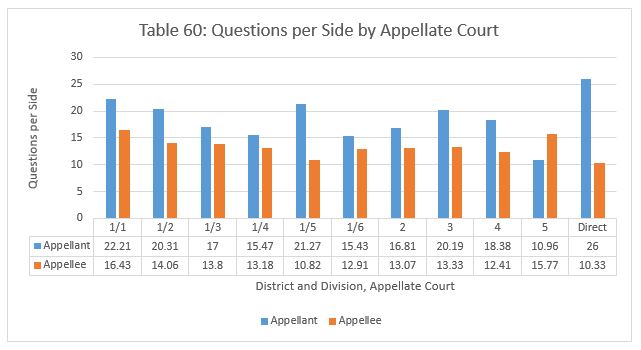
Today we turn to a different question: do decisions from certain districts of the Appellate Court tend to get more questions at the Illinois Supreme Court than decisions from other districts? A few months ago, we looked at the reversal rates of the various districts and divisions and concluded that while the Fourth District tended to average a somewhat lower reversal rate than the rest of the state, the Fifth District averaged a higher reversal rate.

Given that result, one would expect that the originating district of the Appellate Court might well have an effect on the level of questions at oral argument in the Supreme Court. The data is in the Table below.

Note that the appellant averages more questions than the appellee in nine of the ten Appellate Courts. Average questions to appellants differ significantly among the districts of the First District, with Divisions Four and Six receiving one third fewer questions than Division One. Similarly, average questions to appellees are about twenty-five percent higher in Division One of the First District than in Divisions Five and Six. Question levels for cases from the Second District are roughly comparable to Division Six of the First District, and significantly below Divisions One and Two.

Appellees – the party defending the lower court decision – average more questions than appellants only in the Fifth District. Average questions to the Appellant in the Fifth District are less than half the average to Appellants in Divisions One, Two and Five of the First District. Average questions to appellees are roughly equal to all the other Appellate Courts, but still half again as much as the average questions to the appellant.

Table 60

Next week, we’ll begin our analysis of the individual Justices’ patterns at oral argument.

Image courtesy of Flickr by Stefan (no changes).

7004084680_46fea91b78_zLast week, we took a break from our data analytics work on the Illinois Supreme Court’s oral arguments between 2008 and 2014 for a statistical preview of two big cases from the upcoming September term. Today we resume our statistical search for indicators of what kinds of cases are more likely to spark heavier questioning at the Court with a new question: does a dissent at the Appellate Court suggest that there will be more questions at oral argument before the Illinois Supreme Court?

Readers will recall that last month, we asked whether one side getting far more questions than the other is a reliable indicator of a unanimous decision. Although the answer then was no, one can still imagine reasons why disagreement among the three-judge panel deciding a case at the Appellate Court might lead to heavier questioning at the Supreme Court: one can speculate that all other things being equal, the Court might probe an Appellate Court decision more deeply when the decision was unable to garner the agreement of a three-judge panel.

Beginning with appellants, we see that there is no consistent relationship from year to year between appellants in divided Appellate Court decisions and appellants attacking unanimous decisions.

Table 58 A

However, when we turn to appellees – the party defending the Appellate Court decision – we find some support for the theory that a dissent below might affect questioning at the Supreme Court. In 2008-2011 and 2014, appellees – the party defending the Appellate Court’s decision – received somewhat more questions in relation to divided Appellate Court decisions than when defending unanimous decisions. In 2008, 2011 and 2014, the difference between divided Appellate Court decisions and unanimous ones was particularly significant. For the entire seven-year period, appellants attacking divided Appellate Court decisions averaged fewer questions than appellants in unanimous cases – 16.78 to 17.75. However, appellees defending divided decisions received an average of 15.87 questions over the entire period to 12.64 questions to appellees defending unanimous decisions.

Table 59

Tomorrow, we continue our analysis of the Court’s overall question patterns by asking whether the Court tends to average more questions when reviewing decisions of particular districts of the Appellate Court?

Image courtesy of Flickr by Scott McLeod (no changes).