6834861529_17460479aeEarly last year, we founded the Illinois Supreme Court Review to bring rigorous, law-review style empirical research founded on data analytic techniques to the study of appellate decision making.  Today, we expand our focus with the California Supreme Court Review, a new blog devoted to sharing insights culled from tens of thousands of pages of opinions about the California Supreme Court, the Justices and their decision-making process and the parties and issues which come before the Court – all based upon a unique database of dozens of data points taken from every one of the 1,600+ decisions handed down by the Court from 2000 to 2015.

Here at ISCR, our ongoing analysis of the past sixteen years’ decision making by the Illinois Supreme Court will continue as always, twice weekly.  And for a longer-term view devoted to the California Supreme Court, using techniques proven in sixty years of empirical academic research into judicial decisionmaking, join us at the California Supreme Court Review.

Image courtesy of Flickr by Michael Elleray (no changes).

4413403132_725cb1fd39_z (1)

Yesterday, we reviewed the rate at which the Illinois Supreme Court reversed the Districts and Divisions of the Appellate Court in civil cases between 2006 and 2010.  Today, we turn to the criminal docket.

The Court’s overall reversal rate in criminal cases increased somewhat in our study period.  Between 2000 and 2005, the reversal rate was nearly always between forty and fifty percent.  For the most part in our second period, the reversal rate was ten points higher.  In 2006, the Court reversed in 56% of all criminal cases.  The following year, the reversal rate increased to 70.37%.  In 2008 and 2009, the rate was between fifty and sixty percent – 52.94% in 2008 and 57.14% in 2009.  The period ended in 2010 with a dip in the reversal rate to 41.82%.

Table 271

In Table 272 below, we report the three-year floating reversal rates for the divisions of the First District of the Appellate Court.  Between 2006 and 2010, only Divisions 1 and 6 of the First District consistently had reversal rates in criminal cases below the statewide average.  Although Division 1 had a 50% reversal rate in 2006, the rate dropped to zero for the next three years, before increasing to a mere 12.5% in 2010.  Division 6 had a reversal rate of 25% in 2006, 42.86% in 2007, and fifty percent the remaining three years.

The reversal rates of the remaining Divisions consistently ranked above the statewide average.  Division 3 had a reversal rate between seventy and eighty percent in 2007, 2008 and 2010 – and a 100% reversal rate in 2009.  The rate in Division 4 was between fifty and sixty percent from 2006 to 2008 before rising to 85.71% in 2009 and 77.78% the following year.  The rate in Division 5 was two-thirds in 2006 and 2007 before falling to one-half the following three years.

Table 272

In Table 273 below, we report the reversal rates for the remaining Districts (as with last week, the reversal rate called “District One” refers to unpublished cases which we were unable to attribute to a specific Division).  For this period, the First and Third Districts’ reversal rates were significantly above the statewide average – the Third District in particular had a reversal rate between sixty and seventy percent in 2007 through 2009.  The reversal rate in the First District was between sixty and sixty-three percent during that same period.  The remaining Districts were all below the statewide average for the most part.  The Second District for the most part was in line with the statewide average, but the Fourth District tended to be somewhat below – 42.31% in 2006, 30% in 2007, 47.37% in 2008, 52.63% in 2009 and 50% the following year.  The Fifth District had by far the best performance in the state, with a three-year floating reversal rate of half in 2006 and 2007, and zero for the three years following.  Direct appeals tended to result in reversals somewhat more frequently than the statewide average, staying between thirty and forty percent from 2008 to 2010, while appeals from the ARDC Review Board varied widely – one-third reversal in 2006, half in 2007 and 2008, and 100% the next two years.

Table 273

Join us here tomorrow for a very special announcement.  And next week, we’ll turn our attention to reversal rates between 2010 and 2015.

Image courtesy of Flickr by Matt Turner (no changes).

15746483124_2de212a4e1_z

Last week, we began our examination of the Illinois Supreme Court’s reversal rate for the various Districts and Divisions of the Appellate Court, contrasting the reversal rate in civil cases with the criminal docket.  Today, we take the second step in that analysis, addressing the years 2006-2010.

In Table 268 below, we see the overall reversal rate in civil cases.  With the exception of 2006 and 2009, the overall rate is very close to the trend rate for the years 2000 to 2005.  For 2006, the overall reversal rate in civil cases sunk to 38.78%, but the next two years, it was between 55 and 60%.  The Court reversed 71.79% of civil decisions in 2009, but the rate fell back to 57.58% in 2010.

Table 268

We report the three-year floating reversal rate for the Divisions of the First District in civil cases between 2006 and 2010 in Table 269 below.  Only the First and Fourth Divisions of the First District have maintained a reversal rate significantly below the statewide average during these years.  With the exception of 2006, the reversal rate for Division 1 stayed below 30% for the entire period.  The reversal rate for Division 4 was 37.5% in 2006, 25% in 2007 and one-third in 2008 and 2010, only reaching the statewide level in 2009, when it reached 57.14%.

The remaining Divisions have not fared as well.  Division 5 was quite close to the statewide average reversal rate throughout the period.  Division 3 was at 45.45% reversal for 2006 and 2007 before rising to the statewide average in 2008 and then significantly above it the following years.  With the exception of 2006 and 2007, when the reversal rate in Division 6 was well below the statewide average (28.57% in 2006, 27.27% in 2007), the reversal rate there was at or above the statewide average throughout.  But it was District 2 which had the roughest time during these years – although the Court had a three-year weighted reversal rate of only one-third in 2006, that rate was 61.54% in 2007 and 2008, 77.78% in 2009 and 83.33% in 2010.

Table 269

We turn next to the three-year floating reversal rates for the remaining districts of the Appellate Court in Table 270.  This chart shows that District Two’s reversal rate was at roughly the statewide average for this five-year period, as was District Four.  The Third District tended to be below the statewide reversal average for the most part, beginning at one third in 2006 and rising to only 42.86% in 2008.  But the real story of these years is the Fifth District.  Although the District fared reasonably well between 2000 and 2005, its reversal rate had risen to 73.91% in 2006, and with the exception of a one-year dip in 2008 to 63.64%, got progressively worse – topping out at 90.91% in 2009 and 92.31% in 2010.  The Court remained highly skeptical of direct appeals from the Circuit Courts, with a reversal rate of 73.33% in 2006 only increasing from there.

Table 270

Join us back here tomorrow for our look at the reversal rates on the criminal side between 2006 and 2010.  And then, join us again on Thursday for a very special announcement.

Image courtesy of Flickr by Paul Sableman (no changes).


7123231781_101601e352_z

Yesterday, we began a comprehensive review of the data regarding reversal rates for the Appellate Courts at the Illinois Supreme Court with civil cases between 2000 and 2005.  Today, we turn to reversal rates in criminal cases.

In Table 265, we report the statewide reversal rate in criminal cases. We saw yesterday that statewide reversal rates in civil cases were typically between 55 and 60%.  We see below that the reversal rate in criminal cases was fairly consistently ten to twenty points lower.  With the exception of the 2003-2004 period – when the reversal rate dropped to 40% and then rose to a high of 56.14% – the Court’s reversal rate varied in a narrow band, from 42% to 47%.

Table 265

In Table 266, we report the three-year floating reversal rates for criminal cases from the First District.  Aside from Division Three, the reversal rates for every Division are well above the state-wide average during this period.  The reversal rate in Division 1 was 80% in 2002, 100% the following year and 80% the year after.  The reversal rate in Division 2 was 100% from 2002 through 2004.  The reversal rate in Division 5 was two-thirds in 2002 and 2003, and three-quarters the next two years.  Although it dropped to zero in 2005, the reversal rate in Division 6 was well above the statewide average from 2002 through 2004 as well.

Table 266

The data for the remaining Districts is reported in Table 267 (the data labeled “Division 1” is unpublished cases from the First District for which we were unable to assign a specific Division).  Reversal rates for Districts Three and Five are significantly above the statewide average; the reversal rate in the Third District reaches a high of 65.52% in 2004, while the Fifth District’s reversal rate tops out at 69.23% in 2005.  The reversal rate in the Fourth District was well above average in 2002 at 64.29% before dropping to the statewide average (and even slightly below that) in the years that followed.  The handling of direct appeals differs sharply on the criminal side from the civil side.  Where direct appeals frequently resulted in reversals on the civil side, the reversal rate on the criminal side varied narrowly at a much lower level – from a low of 30.55% in 2003 to a high of 39.47% in 2005.  The best performing District during this initial period was certainly the Second (one of the most often reversed Districts on the civil side) – the three-year floating reversal rate rose to 48% in 2004, but was between 34.78% (2003) and 38.46% (2005) in each of the remaining years, ten points below the statewide average.

Table 267

Join us back here next week when we’ll turn our attention to the years 2006 through 2010.

Image courtesy of Flickr by Matt Turner (no changes).

4280097041_ee34cab2ab_z

Sooner or later, every discussion of Supreme Court statistics turns to the rates at which the appellate courts are reversed.  It’s been a frequent political football nationally, with politicians praising or condemning one Circuit or another based on the percentage of their cases reversed by the Supreme Court.  It’s a frequent subject of conventional wisdom as well – one frequently hears of state Supreme Courts that “they don’t take cases to affirm.”  The irony is that at every level, it’s an unfair statistic in a sense.  It’s arguably misleading to say that this Circuit or this District has a eighty or ninety percent reversal rate when eighty to ninety percent of all certiorari petitions (or PLAs, in Illinois) are denied.

So we’ll take our analysis in two steps.  Over the next few weeks, we’ll address the traditional reversal rates, several years at a time, district by district, comparing the civil docket to the criminal cases.

Then, we’ll turn to the Court’s handling of PLAs from 2007 through 2015, considering district by district grant rates, overall, year-by-year and divided into criminal and civil.  We’ll aggregate the data month by month and consider whether one’s odds of getting a PLA granted are markedly better or worse in any of the Court’s terms.  And then we’ll take a look at “true” reversal rates – the percentage of every district’s cases for which PLAs are filed, granted, and the decision reversed.

We report the Court’s overall reversal rates in civil cases between 2000 and 2005 in Table 261 below.  The overall reversal rate is quite stable over time, between 54 and 57 percent in four of the six years.  From this, we can see that the notion that the Supreme Court doesn’t take cases to affirm was frequently false for this initial period.  The reversal rate dipped from 56.8% to 46.8% between 2000 and 2001 before jumping to 60.4% in 2002.  In the years that followed, the overall reversal rate in civil cases was almost identical year after year.

Table 261

We turn next to the district-by-district data.  Unlike much of our other numbers, we won’t be reporting year-by-year data for the Appellate Courts.  Why?  Well, take a look at Table 262, the year-by-year reversal rates in civil cases for the divisions of the First District between 2000 and 2005.

Table 262

The chart’s a mess, to put it mildly.  The reason is when the Supreme Court hears only three or four cases a year from a given Appellate Court, a difference which is really largely random – the difference between reversing two of four and three of four, for example – has an enormous impact on the year-by-year reversal rate, and the graph moves wildly up and down.

So instead, we’ll use three-year floating rates.  So where we report a number for 2002 below, that means we’re using cases from 2000, 2001 and 2002.  For the next year, we drop the data for 2000 and add 2003, and so on.

In Table 263, we report the three-year floating reversal rates in civil cases for the six divisions of the First District.  We see that in this initial period, Divisions Two, Three and Five performed best, with the reversal rate on their decisions staying fairly consistently below the statewide average.  By 2004, the three year floating reversal rate for District Two was only 28.57%, and the following year, it dropped to 16.67%.  The reversal rate for District Three was between twenty and thirty percent each year from 2003 through 2005.  The reversal rate for Division Five was significantly below the statewide average too, remaining at 37.5% from 2003 through 2005.  Of all the Divisions, only Division One tended to be reversed at a somewhat higher rate than the statewide average during these years – and the difference was not large (ranging from 60% to a high of 66.67% each year).

Table 263

In Table 264 below, we report the three-year floating reversal rates for the remaining districts of the Appellate Court, including the Industrial Commission divisions of the First and Fifth Districts, and appeals which reached the Supreme Court directly from the Circuit Courts (on the civil side, mostly constitutional cases).

The Third and Fourth Districts fared quite well in this initial period, which their floating reversal rates staying at least somewhat under the statewide average in nearly every year.  The reversal rate for the Fifth District was consistently around the statewide average for the first several years of our period before abruptly jumping to 72.73% in 2005.  The Second District consistently did worse than the statewide average, with their civil decisions between reversed at a sixty to seventy percent rate (five to fifteen points higher than the statewide number).  The Industrial Commission data is based on a very small number of cases, but the other interesting thing about this chart is the reversal rate in direct appeals – 84.62% in 2002, 73.33% in 2003 and 2004, and 66.67% in 2005 – in every year, well above the statewide reversal rates.  This further confirms what we’ve seen again and again – that the Supreme Court tends to take a fairly skeptical view of Circuit Court decisions striking down state statutes.

Table 264

Join us back here tomorrow as we turn to the data for criminal cases between 2000 and 2005.

Image courtesy of Flickr by Gayle Nicholson (no changes).
6478945585_d536724b88_oFor the past two weeks, we’ve been considering the Illinois Supreme Court’s rate of unanimity and dissent in civil and criminal cases between 2000 and 2015.  Today, we address a related historical issue.  Until 2011, when the state of Illinois abolished the death penalty, appeals in death cases were heard in the first instance at the Supreme Court.  What was the Court’s unanimity and dissent rate in those high-stakes cases?

The answer is that death cases were enormously contentious during much of our period of study.  Although death penalty appeals had slowed to a trickle by that time, the Court’s unanimity rate in 2005, 2006 and 2008 was zero.  The unanimity rate in 2000 was 11.76%, and only 14.29% the following year, and 20% the year after that.  Although there were never a lot of death appeals during the relevant period, the Court’s unanimity rate in such cases was over 80% over three times – in 2003, 2010 and 2011.

Table 259

So how deep was the division in the Court on death cases?  In Table 260 below, we report the lopsided rate for death cases during the same period.  The chart shows that the dissent on the Court was fairly limited in nearly all years.  Even in 2000, when the unanimity rate was 11.76%, 82.35% of all death appeals were decided with zero or one dissenter.  The following year, the lopsided rate dropped to 42.86%, but every one of the Court’s death appeals was decided with zero or one dissenters between 2003 and 2008, and again in 2010 and 2011.

Table 260

Join us back here next week as we begin another new topic – the reversal rate for each district of the Appellate Court in civil and criminal cases, and a deep dive into the Court’s handling of PLAs.

Image courtesy of Flickr by League of Women Voters of California (no changes).

6338358313_35c09a875d_zLast week, we began reviewing the data for the Illinois Supreme Court’s unanimity and dissent rates in civil and criminal cases between 2000 and 2015.  We also considered how many of the non-unanimous civil decisions qualified as “lopsided” – meaning that they featured only one dissenter.  Today, we consider the rate of lopsided decisions on the criminal side, comparing it to the rate of lopsidedness on the civil side.

Although the rate of lopsided decisions on the criminal side was generally at least slightly below the civil side – it exceeded the civil side in only six of the sixteen years – the difference was seldom very large.  The period begins in 2000, when two-thirds of the criminal cases were either unanimous or one-dissenter, while 73.68% of the civil side were.  The difference was twelve points in 2002 (67.14% criminal to 79.59% civil), and eighteen points the following year (64.62% criminal to 82.61% civil), but only three points in 2005 (92.86% criminal to 95.83% civil) and a third of a point the next year (84% criminal to 83.67% civil).  The lopsided decision rate on the criminal side was below 80% only two (2011 and 2013) of the twelve years between 2004 and 2015 (the same thing is true of the civil side, but the dips were in different years).  The difference between the two sides of the docket during the past three years has been virtually nothing – 78.95% to 79.41% in 2013; 85.29% to 85.19% in 2014; and 87.88% to 88.64% in 2015.

Table 258

Join us back here tomorrow as we examine a historical issue – the Court’s unanimity rate in its death penalty appeal docket between 2000 and 2011, when Illinois abolished the death penalty.

Image courtesy of Flickr by Call4Beach (no changes).

16666571547_6cc99092d3_o

Yesterday, we addressed the Illinois Supreme Court’s rate of unanimous and near-unanimous opinions in civil cases.  Today, we turn to the criminal docket.

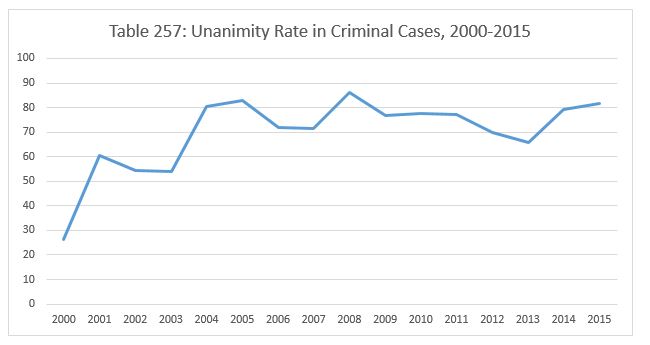
In Table 257 below, we report the overall data for the criminal docket. For the years 2000 through 2003 – years in which the Court was split five Democrats to two Republicans – the unanimity rate for criminal cases was substantially below where it was for civil cases.  The Court was badly split at the beginning of the period in 2000 – only 26.44% of the Court’s criminal cases were decided unanimously (well below the 57.89% unanimity rate for civil cases that year).  The following year, unanimity on the criminal docket was up to 60.34%, but it was still 14 percentage points below the unanimity rate for civil cases.  Unanimity dropped six points in 2002, but was still thirteen points below the civil docket.  In 2003, the margin increased a bit more – unanimity in the criminal docket was 53.85%, but 69.57% of the civil docket was decided unanimously.

Table 257

Everything changed beginning in 2004.  In the twelve years between 2004 and 2015, the unanimity rate for the criminal docket exceeded the unanimity rate on the civil side nine times.  In 2004, 80.36% of the criminal decisions were unanimous, seven points higher than the civil side.  The next year, the unanimity rate on the criminal side was only two points below the civil side; the year after that, it was thirteen points higher.  In 2008, only 71.43% of the civil decisions were unanimous to 86% on the criminal side.

Unanimity rates were quite close on the two sides of the docket between 2009 and 2011 before the margin widened in 2012 – 69.7% unanimous on the criminal side, 55% on the civil.  The criminal side unanimity rate was 65.79% in 2013 to 58.82% on the civil side before the two halves of the docket converged again.  In 2014, 79.41% of the criminal docket was decided unanimously, and 81.82% was unanimous last year.

Image courtesy of Flickr by PRSA-NY (no changes).


6351685787_8960aaccfb_zLast week, we addressed whether the lag time between oral argument and the Illinois Supreme Court’s decisions is an accurate predictor of dissent for the Court’s civil and criminal dockets.  Today, we turn to a different question: the Supreme Court’s unanimity rate.

We report the Court’s rate of unanimous civil decisions in Table 255 below.  The unanimity rate is remarkably stable throughout the sixteen-year period from 2000 to 2015.  Although the rate was relatively low in 2000, with only 57.89% of the Court’s civil cases decided unanimously, the rate varied only five points in all between 2001 and 2004.  In 2005, the unanimity rate jumped all the way to 84.78%, before falling to only 59.18% in 2006.  Between 2007 and 2011, the unanimity rate was between 70 and 80% every year.  Unanimity dropped sharply in 2012 and 2013 before returning to its trend rate in the most recent two years – 77.78% in 2014 and 79.55% in 2015.

Table 255

To what degree have the Court’s occasional dips in its consistent 70-80% unanimity rate been lopsided decisions with only one dissenter? In Table 256 below, we report the “lopsided rate” – the percentage of the Court’s civil docket decided by the Court with zero or one dissenter.  The rate varied in a narrow band between 2000 and 2004 – the 73.68% lopsided rate in 2000 suggests that several of the Court’s non-unanimous cases were decided with only one dissenter.  The lopsided rate went all the way to 95.83% in 2005, dipping only slightly in 2006 before rising again to 90.24% in 2007 and 2009.  For most of the years since, at least four fifths of the Court’s civil cases have been lopsided decisions, with zero or one dissenters.  Most recently, 85.19% of the Court’s civil decisions in 2014 were lopsided, and 88.64% in 2015.

Table 256

Join us back here tomorrow as we turn our attention to the Court’s criminal docket.

Image courtesy of Flickr by Martin Bowling (no changes).

6343655987_7e8f08efc2_zYesterday, we continued our analysis of the Illinois Supreme Court’s time under submission from 2008 to the end of 2015, looking at whether unanimous decisions are generally under submission for substantially less time than non-unanimous ones.  Today, we address the year-by-year data for the criminal docket.  The numbers demonstrate that although, all things being equal, a case pending for substantially longer is more likely to be a divided decision, there are exceptions in nearly every year.

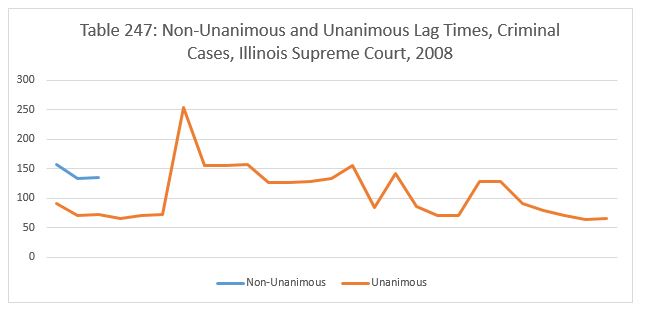
We report the data for 2008 in Table 247 below.  The lag time for virtually every unanimous decision that year was below the lag time for the relatively few non-unanimous decisions.

Table 247

Lag times for non-unanimous decisions converged somewhat towards unanimous decisions in 2009, with unanimous case lag times ranking a bit higher in several cases.  Note that there is considerably more variation in non-unanimous cases, with lag times varying from a low of 86 to a high of 582 days.

Table 248

Lag times for non-unanimous criminal decisions were once again quite variable in 2010, ranging from a low of 93 to a high of 639 days.  Lag times for unanimous decisions were generally lower, and varied from a low of 57 days to a high of 317.

Table 249

In 2011, lag times for non-unanimous decisions remained consistently higher than lag times for unanimously decided cases.  Non-unanimous decisions varied from 86 to 554 days, while unanimous decisions ranged from a low of 77 days to a high of 255.

Table 250

Although the variability of non-unanimous decisions decreased somewhat in 2011, it was still considerably greater than the unanimously decided cases.  Still, only a scattered few unanimous decisions were pending for as long as the most quickly decided non-unanimous decisions.  Non-unanimous decisions ranged from a low of 94 days to a single decision topping out at 442 days, while unanimous decisions varied little – from a low of 64 days to a high of 156 days.

Table 251

In 2013, non-unanimous and unanimous decisions began to converge, with the lag time for the quicker non-unanimous roughly equal to the higher unanimous decisions.  Non-unanimous decisions varied by a lesser factor, ranging from a low of 86 days to a high of 366 days.  Unanimous decisions, on the other hand, ranged from a low of 57 days to a high of 261 days.

Table 252

In 2014, nearly every one of the Court’s non-unanimous criminal cases were pending for more time than the longest-pending unanimous decisions.  With the exception of one outlier non-unanimous decision which was pending for 402 days, non-unanimous decisions varied only from a low of 100 days to a high of 202.  Unanimous decisions ranged from 56 days to 135, but the vast majority were in a narrow band, pending from 70 to 100 days.

Table 253

But once again in 2015, the numbers converged.  Non-unanimous decisions were pending for a low of 86 days to a high of 253, while unanimous decisions were pending for a low of only 35 days to a high of 376 days.

Table 254

Join us back here next week as we turn to another issue – the Illinois Supreme Court’s unanimity rate in civil and criminal cases.

Image courtesy of Flickr by Ron Coleman (no changes).