3282322538_a31b11f9fe_z

Yesterday, we reviewed our data for oral arguments in civil cases from 2008 through 2015.  Today, we turn our attention to the Court’s criminal, quasi-criminal, juvenile and disciplinary docket.

In Table 413, we report the total questions asked by each Justice in criminal cases.  Since 2008, the Court has asked 8,764 questions in criminal matters.  The heaviest questioner is once again Justice Thomas, with 2,623 questions.  Justice Burke is next with 1,066 questions.  Although Justice Fitzgerald was a fairly active questioner across the board, he was noticeably more active in criminal cases, asking 1,054 questions between 2008 and his retirement in 2010.  Justice Garman asked 1,047 questions.  Justice Freeman has asked 904 questions, Justice Karmeier 842, Justice Theis 716 and Justice Kilbride 512.

Table 413

In Table 414, we report the same data as a percentage of the whole.  We see here that calculated as a fraction of the entire Court’s questions, Justice Thomas is slightly less active in criminal matters than in civil ones, accounting for 29.93% of the Court’s questions.  Together, Justice Fitzgerald and Justice Theis have accounted for 20.2% – 12.03% by Justice Fitzgerald, 8.17% by Justice Theis.  Justice Burke has accounted for 12.16% of the questions, Justice Garman 11.95%, Justice Freeman 10.31%, Justice Karmeier 9.61%, and Justice Kilbride has accounted for 5.84% of the questions.  Justices Burke, Karmeier and Theis are about equally active in civil and criminal matters.  Justices Freeman and Fitzgerald have been at least slightly more active in criminal cases, and Justices Garman, Kilbride and Thomas at least somewhat less active.

Table 414

In Table 414, we divide the data into segments of the argument.  Justice Thomas has been the most active questioner in each segment – 1,224 questions to appellants, 1,074 to appellees, and 325 in rebuttal.  Among appellants, Justice Garman is second, having asked 518 questions.  Justice Freeman is next at 503.  Justice Burke has asked 487 questions.  Justice Fitzgerald asked 470 questions. Justice Theis has asked 364 questions, Justice Karmeier 351, and Justice Kilbride has asked 182 questions.

Among appellees, Justice Burke is second with 490 questions.  Justice Fitzgerald has asked 441 questions.  Justice Garman has asked 432, Justice Karmeier 361, Justice Freeman 359 and Justice Kilbride 220 questions.  During rebuttal, Justice Fitzgerald is second with 143 questions.  Justice Karmeier has asked 130, Justice Kilbride 110, Justice Garman 97, Justice Theis 95, Justice Burke 89, and Justice Freeman has asked 42 questions.

Table 415

Join us back here next Tuesday as we address a new issue in our analysis of the Court’s oral arguments.

Image courtesy of Flickr by Scott Tranchitella (no changes).

41357713_c595bf8368_z

Today, we turn our attention back to the Court’s oral arguments.  Over the next several weeks, we’ll be analyzing how the Court’s questioning patterns tend to differ in civil and criminal cases, based upon our database of every oral argument from 2008 through 2015.

First, the most basic question – total questions, Justice by Justice.  Between 2008 and 2015, the Court asked a total of 8,059 questions in civil cases.  The most active questioner was Justice Thomas, who asked 2,523 questions.  Who was second depends on what one means.  In absolute terms, the second most active questioner was Justice Garman with 1,010 questions.  But the Fitzgerald/Theis seat on the Court exceeds that number by a substantial number – Chief Justice Fitzgerald asked 678 questions in civil cases between 2008 and his retirement in 2010, and Justice Theis has asked 703 questions since joining the Court.  Justice Burke is third, having asked 982 questions in civil cases.  Karmeier has asked 744 questions, Justice Freeman has asked 732, and Justice Kilbride has asked 687.

Table 410

In Table 411 below, we report the same data as a percentage of the total.  Justice Thomas has asked 31.3% of the total questions asked during civil cases.  The Fitzgerald/Theis seat on the Court accounts for 17.14% of the questions – 8.41% by Justice Fitzgerald, 8.72% by Justice Theis.  Justices Garman and Burke are nearly tied; Justice Garman has asked 12.53% of the Court’s questions in civil cases, Justice Burke 12.19%.  Justice Karmeier is next, having asked 9.23% of the Court’s questions in civil cases, followed by Justice Freeman (9.08%) and Justice Kilbride (8.52%).

Table 411

Finally, in Table 412, we report the data divided by the three segments of the argument – appellant, appellee and rebuttal.  Justice Thomas is the most active questioner in all three segments – 995 questions to appellants, 1,176 to appellees and 352 in rebuttal.  The second and third most active questioner of appellants are Justices Burke and Freeman, respectively – 484 by Justice Burke, 423 by Justice Freeman.  Justice Garman has asked appellants 396 questions, Justice Theis 363 questions, Justice Fitzgerald 353 questions, Justice Karmeier 283 questions and Justice Kilbride 242 questions.

On the appellee’s side, the second most active questioner is Justice Garman, with 531 questions.  Justice Burke is next at 402, followed by Justice Karmeier at 358.  Justice Kilbride has asked appellees 308 questions, Justice Fitzgerald 261, Justice Freeman 253 and Justice Theis 245.  As for rebuttals, only two Justices aside from Justice Thomas have asked more than 100 questions – Justice Kilbride (137) and Justice Karmeier (103).  Justice Burke has asked 96, Justice Theis 95, Justice Garman 83, Justice Fitzgerald 64 and Justice Freeman 56.

Table 412

Join us back here tomorrow as we turn our attention to the Court’s experience in criminal arguments.

Image courtesy of Flickr by Kal Schreiber (no changes).

13929472776_f21d389735_z

For the past two weeks, we’ve been analyzing the voting dynamics on the Illinois Supreme Court, determining which Justices voted together most and least often over time in non-unanimous cases.  Today, we conclude our analysis with the criminal docket between 2010 and 2015.

Just as we saw on the civil side, Justice Burke’s closest match in criminal cases appears to be Justice Freeman.  She agreed with Justice Freeman in 71.43% of non-unanimous criminal cases in 2010, 100% in 2011, 90% in 2012, 84.62% in 2013, 85.71% in 2014 and 100% last year.  Agreement rates with the two other Democratic Justices were considerably lower.  Justice Burke and Chief Justice Kilbride agreed in 14.29% of non-unanimous criminal cases in 2010, 45.45% in 2011, 30% in 2012, 53.85% in 2013, 42.86% in 2014, and 50% in 2015.  Justice Burke agreed with Justice Theis 50% of the time in 2010, 45.45% in 2011, 60% in 2012, 23.08% in 2013, 28.57% in 2014, and 66.67% in 2015.  Justice Burke’s agreement rates with the Republican Justices were significantly lower.  She voted with Justice Thomas in 14.29% of non-unanimous criminal cases in 2010, 0% in 2011, 50% in 2012, 53.85% in 2013, 42.86% in 2014 and one-third of the time in 2015.  Her agreement rate with Chief Justice Garman was quite similar: 7.14% in 2010, zero in 2011, 50% in 2012, 46.15% in 2013, 42.86% in 2014, and one-third in 2015.  Justice Burke’s agreement rate with Justice Karmeier was virtually identical to the rate with Chief Justice Garman.

Interestingly, the Republican Justices have disagreed somewhat more often in the past three years than they did earlier.  Justice Garman agreed with Justice Thomas 92.86% of the time in 2010, and with Justice Karmeier, 100%.  Her agreement rates were 100% with both Justices in 2011, and 80% with both in 2012.  In 2012, Justice Garman voted with Justice Thomas in 76.92% of cases, and with Justice Karmeier in 69.23%.  In 2014, Chief Justice Garman agreed with Justice Thomas in 100% of non-unanimous criminal cases, but with Justice Karmeier only 71.43% of the time.  For 2015, Chief Justice Garman’s agreement rate was down to two-thirds with both Justices Thomas and Karmeier.  Those rates are comparable to Chief Justice Garman’s agreement rate with Justice Theis in criminal matters: 54.55% in 2011, 70% in 2012, 76.92% in 2013, 57.14% in 2014 and 66.67% in 2015.  Meanwhile, her agreement rate with Justice Freeman is the mirror image of the result with the other Republican Justices – very low initially, but rising significantly in the last few years.  Chief Justice Garman and Justice Freeman agreed in 21.43% of non-unanimous criminal cases in 2010, zero in 2011, but 40% in 2012, 61.54% in 2013 and 57.14% in 2014, before falling back to one-third in 2015.

Table 408

Justice Freeman’s agreement rate in non-unanimous criminal rates was relatively similar for each of the other Justices.  He agreed with Chief Justice Kilbride in only 28.57% of cases in 2010 and 20% in 2012, but 45.45% in 2011, 69.23% in 2013, 57.14% in 2014 and half in 2015.  Justice Freeman agreed with Justice Theis in 45.45% of non-unanimous criminal cases in 2011, 50% in 2012, 38.46% in 2013, 42.86% in 2014, and two-thirds in 2015.  Justice Freeman’s agreement rates with Justices Thomas and Karmeier are quite similar: in 2010, 28.57% for Justice Thomas and 23.08% for Justice Karmeier; in 2011, zero for both; in 2012, half for Justice Thomas and 60% for Justice Karmeier; in 2013, 69.23% for Justice Thomas and 61.54% for Justice Karmeier; in 2014, 57.14% for both, and in 2015, one-third for both.

At times since 2010, Justice Kilbride has voted quite similarly to Justices Thomas and Karmeier in criminal matters.  For 2010, his agreement rate with Justice Thomas was 85.71%, with Justice Karmeier 92.31%.  In 2011, both rates fell to 54.55%, and the next year, both fell to 40%, but in 2013, Justice Kilbride agreed with Justice Thomas 84.62% of the time, and with Justice Karmeier in 92.31% of cases.  Their agreement rates for 2014 were 71.43% (Justice Thomas) and 100% (Justice Karmeier) before both fell to 50% in 2015.  Meanwhile, Justice Kilbride agreed with Justice Theis in 81.82% of cases in 2011, half in 2012, 69.23% in 2013, 85.71% in 2014 and half in 2015.

In view of these results, it’s no surprise that Justices Thomas and Karmeier have been in relatively close accord on criminal matters since 2010.  Their agreement rate was 92.31% in 2010, 100% in 2011, 90% in 2012, 92.31% in 2013, fell to 71.43% in 2014, but was back to 100% in 2015.  Justices Thomas and Theis are on the same side only about half the time in non-unanimous criminal cases.  Their agreement rate was 54.55% in 2011, 70% in 2012, 53.85% in 2013, 57.14% in 2014 and two-thirds in 2015.  Justice Karmeier’s agreement rate with Justice Theis was quite close to those numbers: 54.55% in 2011, 70% in 2012, 61.54% in 2013, 85.71% in 2014 and two-thirds in 2015.

Table 409

Join us back here next Tuesday as we turn our attention to a new subject in our ongoing analysis of the decision making of the Illinois Supreme Court.

Image courtesy of Flickr by Conal Gallagher (no changes).

8588807913_75dc171bd2_z

For the past two weeks, we’ve been studying the voting dynamics of the Illinois Supreme Court, tracking which Justices voted together most (and least) often in non-unanimous civil and criminal cases.  This week, we’ve arrived at the most recent data.  Today, we’re taking a look at agreement rates in civil cases from 2010 to 2015.

In Table 406, we report the data for Chief Justice Garman, Justice Burke, and part of the data for Justice Freeman.  For the most part, Justice Freeman appears to be the closest match in voting patterns to Justice Burke on the civil side.  In 2010, Justices Burke and Freeman voted together in 55.56% of civil cases, but the next year, that number was up to two-thirds.  They voted together in 94.74% of civil cases in 2012, 85.71% in 2013, and two-thirds in 2014 and 2015.  For 2010, Justice Burke voted the same as Justice Garman half the time.  She voted the same as Chief Justice Kilbride and Justice Thomas in only 37.5% of civil cases.  For 2011, Justice Burke voted with Justices Garman, Thomas and Karmeier in 77.78% of civil cases, with Justice Theis in 62.5%, and with Chief Justice Kilbride only 22.22% of the time.  In 2012, Justice Burke agreed in between seventy and eighty percent of non-unanimous civil cases with Justice Theis (77.78%), Justice Thomas (76.47%), and Justices Karmeier and Garman (73.68% each).  She agreed with Chief Justice Kilbride in only 36.84% of civil cases.  For 2013, Justice Burke agreed with Chief Justice Garman and Justices Karmeier and Theis in 57.14% of non-unanimous civil cases.  She voted with Justice Thomas 46.15% of the time, and with Chief Justice Kilbride only 15.38% of the time.  In 2014, Justice Burke agreed with Justices Thomas and Karmeier half the time, with Chief Justice Garman and Justice Kilbride in one-third of civil cases, and with Justice Theis only 16.67% of the time.  Last year, Justices Burke and Karmeier voted together in 88.89% of non-unanimous civil cases.  Justice Theis was the next closest match, with the two Justices agreeing in 77.78% of civil cases.  Justice Burke agreed with Chief Justice Garman and Justice Freeman in two-thirds of non-unanimous civil cases, and with Justice Thomas in 57.14%.  Her agreement rate for civil cases with Justice Kilbride was zero.

Not surprisingly, Chief Justice Garman has voted relatively similarly in recent years to the two other Republican Justices, Thomas and Karmeier.  In 2010, she agreed with Justice Thomas at an 85.71% rate and with Justice Karmeier three quarters of the time.  She agreed with Chief Justice Kilbride in 62.5% of non-unanimous civil cases, and with Justice Freeman in only one-quarter.  In 2011, she voted with Justices Thomas and Karmeier 77.78% of the time, with Justice Theis in 62.5% of cases, and with Justice Freeman and Chief Justice Kilbride in 44.44% of cases.  In 2012, Justice Garman’s agreement rate with Justice Thomas was up to 88.24%, but her rate with Justice Karmeier was down a bit, to 73.68%.  For 2012, Justice Garman agreed with Justice Theis in 72.22% of cases, with Justice Freeman 68.42% of the time, and with Chief Justice Kilbride in 31.58%.  For 2013, Chief Justice Garman agreed with Justice Theis in 92.86% of civil cases, with Justice Thomas 84.62% of the time, with Justices Freeman and Karmeier 71.43% of the time, and with Chief Justice Kilbride in 38.46% of cases.  For 2014, Chief Justice Garman agreed with Justices Thomas and Karmeier in 83.33% of non-unanimous civil cases, with Justices Freeman and Kilbride in two-thirds, and with Justice Theis in half.  Finally, for 2015, Chief Justice Garman agreed with Justice Thomas in 100% of non-unanimous civil cases.  Her agreement rate with Justice Theis was 88.89%.  She agreed with Justice Karmeier 77.78% of the time, with Justice Freeman in 55.56% of cases, and with Justice Kilbride one third of the time.

Table 406

The data demonstrates that the Democratic Justices have arguably not been as close a voting group as the Republican Justices in civil cases in recent years.  For example, as we see in Table 406, Justice Freeman agreed with Chief Justice Kilbride in only 37.5% of non-unanimous civil cases in 2010, 11.11% in 2011, 42.11% in 2012, 23.08% in 2013, two-thirds in 2014, but only one third in 2015.  On the other hand, his agreement rates with Justices Thomas and Karmeier frequently hovered around fifty percent: with Justice Thomas 37.5% in 2010, 44.44% in 2011, 70.59% in 2012, 61.54% in 2013, 50% in 2014 and 71.43% in 2015, and with Justice Karmeier, 44.44% in 2010 and 2011, 68.42% in 2012, 57.14% in 2013, 50% in 2014 and 55.56% in 2015.  With only a one-year exception, Justice Freeman’s voting patterns are even more similar to Justice Theis: 50% in 2011, 72.22% in 2012, 71.43% in 2013, 16.67% in 2014 and 66.67% in 2015.

Chief Justice Kilbride’s agreement rates with Justices Thomas and Karmeier were generally around fifty percent as well.  With Justice Thomas, he was at 57.14% in 2010, 44.44% in 2011, 41.18% in 2012, 58.33% in 2013, 50% in 2014 and 42.86% in 2015.  With Justice Karmeier, his agreement rates were 37.5% in 2010, 44.44% in 2011, 31.58% in 2012, 41.67% in 2013 and 50% in 2014.  In 2015, Justice Kilbride’s agreement rate with Justice Karmeier fell to only 11.11%.  His agreement rate with Justice Theis followed a similar course, hovering at around 50% from 2011 through 2014 before falling to 22.22% in 2015.

Justice Thomas’ agreement rate with Justice Karmeier remained high throughout the period – 87.5% in 2010, 100% in 2011, 76.47% in 2012, 76.92% in 2013, 100% in 2014 and 71.43% in 2015.  His agreement rate with Justice Theis tended to be about ten to fifteen points lower – 62.5% in 2011 and 2012, 76.92% in 2013, 66.67% in 2014, and 85.71% in 2015.  Finally, Justices Karmeier and Theis voted the same in 62.5% of divided civil cases in 2011, 72.22% in 2012, 71.43% in 2013 and 66.67 in 2014 and 2015.

Table 407

Join us back here tomorrow as we address the Court’s voting patterns in criminal cases during these same years.

Image courtesy of Flickr by Amy Meredith (no changes).

3886306246_0abfa60fe3_z

Yesterday, we analyzed the agreement rates between all combinations of the Justices in non-unanimous civil cases between 2005 and 2009.  Today, we turn our attention to the Court’s criminal docket during the same years.

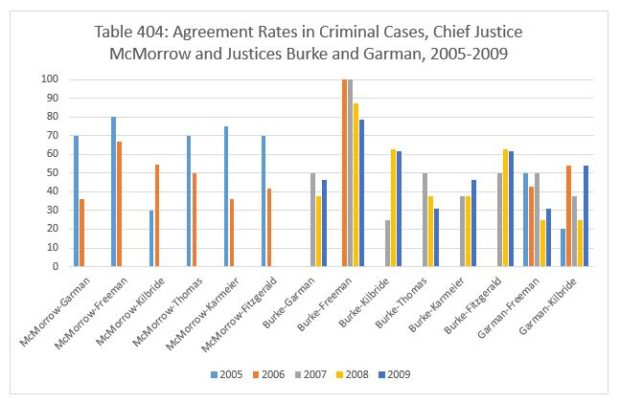
We report the data for Chief Justice McMorrow, Justice Burke and Justice Garman in Table 404 below.  Chief Justice McMorrow’s closest match for criminal cases on the Court during 2005 was Justice Freeman, but not by a wide margin.  Chief Justice McMorrow and Justice Freeman voted together in 80% of non-unanimous criminal cases that year.  She voted with Justice Karmeier 75% of the time, with Chief Justice Thomas and Justices Garman and Fitzgerald 70% of the time, but with Justice Kilbride only 30% of the time.  Chief Justice McMorrow’s agreement rates with other Justices fell across the board in 2006, her final year on the Court.  She voted with Justice Freeman in two thirds of non-unanimous civil cases, with Justice Kilbride 54.54% of the time, with Chief Justice Thomas half the time, with Justice Fitzgerald in 41.67% of cases, and with Justice Garman only 36.36% of the time.

Justice Burke participated in only one non-unanimous criminal cases in 2006, voting with Justice Freeman.  For 2007, Justice Burke’s agreement rate remained at 100% for Justice Freeman, but was quite low otherwise: Chief Justice Thomas and Justices Garman and Fitzgerald were at 50% each, Justice Karmeier was at 37.5%, and Justice Kilbride was at 25%.  The patterns were similar in 2008.  Justice Burke agreed with Justice Freeman in 87.5% of non-unanimous criminal cases, with Chief Justice Fitzgerald and Justice Kilbride 62.5% of the time, but with Chief Justice Thomas and Justices Garman and Karmeier only 37.5% of the time.  Justice Burke’s agreement rate with Justice Freeman fell a bit in 2009 to 78.57%, but across the rest of the Court, agreement rates rose a bit.  She agreed with Chief Justice Fitzgerald and Justice Kilbride 61.54% of the time, with Justices Garman and Karmeier in 46.15% of cases, but with Justice Thomas only 30.77% of the time.  The Table shows that Justice Garman was not closely aligned in criminal cases with either Justice Freeman or Justice Kilbride.  In 2005, she voted with Justice Freeman in only half of non-unanimous criminal cases, and only 20% of the time with Justice Kilbride.  Her agreement rates for both Justice Freeman (42.86% in 2006; 50% in 2007; 25% in 2008; 30.77% in 2009) and Justice Kilbride (53.85% in 2006; 37.5% in 2007; 25% in 2008; 53.85% in 2009) remained comparatively low in the years that followed.

Table 404

As we see in Table 405, Justice Garman voted quite closely in criminal cases to the records of the other Republicans on the Court.  Justice Garman’s agreement rates with Chief Justice Thomas were 100% in 2005, 92.86% in 2006, 100% in 2007, 75% in 2008, and 84.62% in 2009, and with Justice Karmeier were 87.5% in 2005, 85.71% in 2006; 87.5% in 2007, and 100% in 2008 and 2009.  Chief Justice Fitzgerald was relatively close to the Republicans in voting patterns in criminal cases during these years too.  Chief Justice Fitzgerald agreed with Justice Garman in 100% of cases in 2005, 85.71% of the time in 2006, 75% of the time in 2007 and 2008, and 84.62% of the time in 2009.  For 2005, Justice Freeman agreed with Justice Karmeier in 62.5% of criminal cases, and with Chief Justice Thomas and Justices Kilbride and Fitzgerald in 50%.  The following year, he agreed with Justice Kilbride 64.29% of the time, and with Chief Justice Thomas 53.33% of the time, but with Justice Fitzgerald in only 46.67% of non-unanimous criminal cases, and with Justice Karmeier in only 42.86%.  For 2007, he agreed with Chief Justice Thomas and Justice Fitzgerald in half of the non-unanimous criminal cases, but with Justice Karmeier only 37.5% of the time, and with Justice Kilbride only 25%.  For 2008, Justice Freeman agreed with Justice Kilbride in three quarters of the non-unanimous criminal cases, but with Chief Justice Fitzgerald only half the time, and with Justices Thomas and Karmeier in only a quarter of the cases.  For 2009, Justice Freeman agreed with Chief Justice Fitzgerald and Justice Kilbride in 46.15% of non-unanimous criminal cases, with Justice Karmeier 30.77% of the time, and with Justice Thomas in 15.38% of cases.

Justice Kilbride’s agreement rates in criminal cases with Chief Justice Thomas and Justice Karmeier were quite low.  Justice Kilbride voted with Chief Justice Thomas in only 20% of non-unanimous criminal cases, in 57.14% of cases in 2006, 37.5% of the time in 2007, 0% in 2008, and in 69.23% of cases in 2009.  He agreed with Justice Karmeier 37.5% of the time in 2005, 53.85% in 2006, 25% in 2007 and 2008, and only 53.85% of the time in 2009.  Justice Kilbride’s agreement rate with Chief Justice Fitzgerald was higher, but not much: 20% in 2005, 64.29% in 2006, 50% in 2007 and 2008, 69.23% in 2009.  Chief Justice Thomas and Justice Karmeier voted quite similarly in criminal cases, with agreement rates of 87.5% in 2005, 92.86% in 2006, 87.5% in 2007, 75% in 2008 and 84.62% in 2009.  Chief Justice Thomas’ agreement rate with Justice Fitzgerald was 100% in 2005 and 93.33% in 2006, but dropped to 75% in 2007, 50% in 2008 and 69.23% in 2009.  Justice Karmeier agreed with Justice Fitzgerald in 87.5% of cases in 2005, 85.71% in 2006, 62.5% in 2007, 75% in 2008 and 84.62% in 2009.

Table 405

Join us back here next Tuesday as we turn our attention to the Court’s voting dynamics in the most recent period – 2010-2015.

Image courtesy of Flickr by Bari D (no changes).

19513523646_1ece12afdf_z

Last week, we began our study of the Court’s voting dynamics.  We analyzed agreement rates between all combinations of the Justices in non-unanimous civil and criminal cases between 2000 and 2004.  This week, we’ll turn our attention to the second five years of the period, 2005 to 2009.  We’ll begin with the Court’s civil cases.  (A note for newer readers of our blog – unlike many states, the Chief Justice of Illinois is chosen for a three-year term by the members of the Court from among the serving Justices.  Since we write about sixteen years of the Court’s history, we try to refer to Justices as “Chief Justice” when writing about their tenure in that position, and as “Justice” during all other periods.)

For 2005, her last full year on the Court, Chief Justice McMorrow voted quite similarly to Justices Fitzgerald (88.9%), Garman (87.5%) and Chief Justice Thomas (85.7%).  She voted with Justice Karmeier in 80% of non-unanimous civil cases.  Chief Justice McMorrow’s agreement rate with Justice Freeman was 55.6%, and her agreement rate with Justice Kilbride was 44.4%.  For 2006, Justice Freeman was the closest match to Justice McMorrow’s voting at 84.62%.  She agreed with Justice Karmeier and Justice Fitzgerald in 69.23% of cases, with Justice Kilbride and Chief Justice Thomas half the time, and with Justice Garman in 45.45% of cases.  Justice Burke participated in only two non-unanimous civil decisions during 2006, voting with Chief Justice Thomas and Justices Fitzgerald, Kilbride and Karmeier in both, and with Justices Garman and Freeman in one.  For 2007, Justice Burke’s voting was most similar to Justices Freeman and Fitzgerald (85.7% each) and Chief Justice Thomas (83.3%).  She voted with Justice Kilbride 71.4% of the time, and with Justice Garman in 57.1% of non-unanimous civil cases.  For 2008 and 2009, Justice Burke’s closest match on the civil side was Justice Freeman – 100% agreement rate in both years.  For 2008, she agreed with Chief Justice Fitzgerald in half of non-unanimous civil cases, with Justice Kilbride and Chief Justice Thomas in 44.44% of cases, and with Justice Garman 40% of the time. For 2009, Justice Burke agreed with Chief Justice Fitzgerald in 85.7% of cases, with Justice Thomas 80% of the time, with Justice Garman 71.4% of the time, with Justice Kilbride in 57.1% of non-unanimous civil cases, and with Justice Karmeier only 28.6% of the time.

The data for Justice Garman is reported in Tables 402 and 403.  Justice Garman agreed with Justice Freeman in three quarters of non-unanimous civil cases, and with Justice Kilbride half the time.  Justice Garman’s agreement rate with Justice Kilbride remained low: 64.71% in 2006, 50% in 2007, only 18.18% in 2008 and 37.5% in 2009.  Justice Garman voted with Justice Freeman in 55.56% of non-unanimous civil cases in 2006, 75% of the time in 2007, and half the time in 2008, but in 85.7% of cases in 2009.

Table 402

In 2005, Justice Garman agreed in 100% of non-unanimous civil cases with Chief Justice Thomas and Justices Fitzgerald and Karmeier.  The agreement rates between those three Justices fell in the four years that followed.  For 2006, she voted with Justice Fitzgerald in 77.78% of cases, with Chief Justice Thomas 73.33% of the time, and with Justice Karmeier in two-thirds of cases.  For 2007, she agreed with Justice Fitzgerald three-quarters of the time, with Chief Justice Thomas 57.1% of the time, and with Justice Karmeier only 42.9% of the time.  In 2008, Justice Garman voted with Chief Justice Thomas in every non-unanimous civil case.  Justice Garman voted with Justice Karmeier in 90.91% of cases, and with Chief Justice Fitzgerald half the time.  For 2009, Justice Garman’s agreement rates with those three Justices were almost identical: Justice Thomas 66.7%, Justice Karmeier and Chief Justice Fitzgerald, 62.5%.

During these years, Justice Freeman’s closest matches in civil cases were probably Justices Thomas and Fitzgerald.  In 2005, Justice Freeman voted with Chief Justice Thomas 71.4% of the time, and with Justice Fitzgerald 66.67% of the time.  For 2006, he voted with Justice Fitzgerald 80% of the time, and his agreement rate with Chief Justice Thomas was 64.71%.  For 2007, Justice Freeman’s agreement rate with Justice Fitzgerald was 100%, and with Chief Justice Thomas, 85.7%.  Both agreement rates fell sharply in 2008 – Chief Justice Fitzgerald 50%, Chief Justice Thomas 54.55%, but they were back up the following year.  For 2009, Justice Freeman and Chief Justice Fitzgerald voted together in 85.7% of civil cases, and Justices Freeman and Thomas voted together 80% of the time.  Justice Freeman’s agreement rates were for the most part significantly less than these two Justices.  He agreed with Justice Karmeier in 80% of cases in 2005, 60% in 2006, 42.9% in 2007, 41.67% in 2008 and 42.9% in 2009.  He voted with Justice Kilbride 44.4% of the time in 2005, 63.16% in 2006, 75% in 2007, 36.36% in 2008 and 57.1% of the time in 2009.

In 2005, Justice Kilbride’s agreement rate with Chief Justice Thomas was 57.1%, 55.6% with Justice Fitzgerald, and 40% with Justice Karmeier.  For 2006, he voted with Chief Justice Thomas 81.25% of the time, and with Justice Fitzgerald 80% of the time, but with Justice Karmeier only 52.63% of the time.  For 2007, his agreement rate with Justice Fitzgerald remained fairly high – 75% – but he voted with Chief Justice Thomas and Justice Karmeier only 57.1% of the time.  The following year, all three agreement rates fell.  Justice Kilbride agreed with Chief Justice Fitzgerald 63.64% of the time, with Justice Karmeier 27.27% of the time, and with Chief Justice Thomas 20% of the time.  All three agreement rates were up in 2009, however.  For 2009, Justice Kilbride voted with Justice Thomas in 83.3% of non-unanimous civil cases, with Chief Justice Fitzgerald 75% of the time, and with Justice Karmeier three-quarters of the time.  Chief Justice Thomas’ agreement rates with Justices Karmeier and Fitzgerald in 2005 were 100%.  In 2006, his agreement rate with Justice Fitzgerald was 76.47%, and with Justice Karmeier, 64.71%.  In 2007, his agreement rate with Justice Fitzgerald was 85.7%, and with Justice Karmeier 50%.  For 2008, Chief Justice Thomas’ agreement rate with Justice Karmeier was 90.91%, and with Chief Justice Fitzgerald, 54.55%.  For 2009, Justice Thomas and Chief Justice Fitzgerald agreed in 100% of non-unanimous civil cases, and Justices Thomas and Karmeier agreed half the time.  Finally, Justice Karmeier agreed with Justice Fitzgerald in 100% of non-unanimous civil cases in 2005, but in only 70% in 2006.  For the three years following, their agreement rate hovered around half – 42.9% in 2007, 53.85% in 2008 and half in 2009.

Table 403

Join us back here tomorrow as we review agreement rates for the criminal docket between 2005 and 2009.

Image courtesy of Flickr by David Wilson (no changes).

21451500436_c45e4b442b_z

Yesterday, we began our review of the Court’s voting dynamics, analyzing the Justices’ agreement rates in non-unanimous civil cases between 2000 and 2004.  Today, we turn to the Court’s agreement rates in non-unanimous criminal cases.

We showed yesterday that Chief Justice McMorrow voted most often with Justice Freeman in civil cases.  That was true on the criminal side as well (90.32% in 2000, 87.5% in 2001, 90.63% in 2002, 100% in 2003 and 76.92% in 2004).  She also voted quite similarly to Justice Rarick in criminal cases (100% in 2002, 84.62% in 2003, 90.91% in 2004).  For 2000, Chief Justice McMorrow voted most often with Justices Freeman and Bilandic (70.49%), and least often with Justice Heiple (59.68%) and Chief Justice Harrison (40.32%).  For 2001, Chief Justice McMorrow voted most often with Justice Freeman and Justice Fitzgerald (79.17%), and least often with Justices Miller and Kilbride (50% each) and Chief Justice Harrison (41.67%).  For 2002, Chief Justice McMorrow voted most often with Justice Freeman, Justice Fitzgerald (75%) and Justice Garman (70.97%), and least often with Justice Kilbride (50%) and Chief Justice Harrison (14.29%).  For 2003, Chief Justice McMorrow voted most often with Justices Freeman and Rarick (84.62%), and least often with Justices Garman, Thomas and Kilbride (26.67%, 26.67% and 23.33%, respectively).  For 2004, Chief Justice McMorrow voted most often with Justice Rarick (90.91%) and least often with Justice Thomas (38.46%).

Table 400

In Table 401, we report data for Justices Miller and Freeman.  In 2000, Justice Miller voted 80% of the time in non-unanimous criminal cases with Justice Bilandic, 75.41% of the time with Justice Rathje, but only 27.42% of the time with Chief Justice Harrison.  Justice Freeman voted roughly half the time with Justice Heiple (58.73% in 2000) and Justice Kilbride (58.33% in 2001, 53.13% in 2002, 23.33% in 2003, 76.92% in 2004), more often with Justice Rathje (70.49% in 2000), and less often with Chief Justice Harrison (38.1% in 2000, 45.83% in 2001, 19.05% in 2002).  Justice Freeman voted with Justice Thomas about two-thirds of the time in 2001 and 2002 (66.67% in 2001, 65.63% in 2002), but that figure fell off sharply in the two years that followed (26.67% in 2003, 30.77% in 2004).

Table 401

On the other hand, Justice Freeman voted quite similarly to the remaining three Justices reported on Table 402.  He voted with Justice Rarick in 100% of criminal cases in 2002, 84.62% in 2003 and 90.91% in 2004.  He voted with Justice Bilandic in 77.05% of non-unanimous criminal cases in 2000.  He voted with Justice Fitzgerald 87.5% of the time in 2001, 78.13% in 2002 and 80% in 2003.  Justice Heiple voted 78.69% of the time with Justice Rathje, with Justice Bilandic 73.77% of the time, but with Chief Justice Harrison only 30.16% of the time.  Justice Rathje voted with Justice Bilandic 83.05% of the time, but with Chief Justice Harrison in only 36.07% of non-unanimous criminal cases in 2000.  Chief Justice Harrison voted with Justice Bilandic in 34.43% of non-unanimous criminal cases in 2000, and with Justice Fitzgerald 45.83% of the time in 2001, and 28.57% in 2002.  Justice Garman voted with Justice Freeman about two-thirds of the time in 2001 and 2002 (75% in 2001, 67.74% in 2002), but much less often after (26.67% in 2003, 54.55% in 2004).  Justice Garman seldom voted with Chief Justice Harrison in criminal cases (18.75% in 2001, 25% in 2002).

Table 402

Just as we saw in the civil cases, Justice Garman voted quite similarly to Justice Thomas in these years (93.75% in 2001, 96.77% in 2002, 90% in 2003, 81.82% in 2004).  Justice Garman voted almost as often with Justice Fitzgerald in 2001 and 2002 (87.5% in 2001, 90.32% in 2002), but far less often in the following two years (50% in 2003, 54.55$ in 2004).  Justice Garman voted less than half the time with Justice Kilbride (37.5% in 2001, 22.58% in 2002, 50% in 2003, 63.64% in 2004) and Justice Rarick (50% in 2002, 26.92% in 2003 and 70% in 2004).  Justice Kilbride voted relatively closely with Chief Justice Harrison (70.83% in 2001, 71.43% in 2002), and for the most part with Justice Rarick (100% in 2002, 26.92% in 2003, 81.82% in 2004).  But he voted less than half the time in criminal cases with Justice Thomas (37.5% in 2001, 18.75% in 2002, 56.67% in 2003, 38.46% in 2004) and Justice Fitzgerald (58.33% in 2001, 31.25% in 2002, 20% in 2003, 60% in 2004).  Justice Thomas voted with Justice Fitzgerald in half to three quarters of all criminal cases during these years (79.17% in 2001, 87.5% in 2002, 50% in 2003 and 2004), but seldom voted with Chief Justice Harrison (25% in 2001, 23.81% in 2002) or Justice Rarick (20% in 2002, 32% in 2003, 45.45% in 2004).  Justice Rarick’s agreement rate with Justice Fitzgerald was quite high for his first two complete years on the Court (84.62% in 2003, 87.5% in 2004).

Table 403

Join us back here next Tuesday as we begin our analysis of the Court’s voting dynamics during the years 2005-2009.

Image courtesy of Flickr by David Wilson (no changes).

23529249642_7550788869_z (1)

Last week, we completed our comparison of the Justices’ majority opinions in civil and criminal cases.  This week, we begin our study of the Court’s voting dynamics.  Which Justices agreed most (and least) often?  Today, we track how often every combination of Justices voted together in non-unanimous civil cases between 2000 and 2004.

In Table 396, we report Chief Justice McMorrow’s rate of agreement with the other Justices who served on the Court during these years.  Chief Justice McMorrow’s closest match during these years appears to have been Justice Freeman.  They agreed in 68.75% of non-unanimous civil cases in 2000 and 61.54% in 2001, but 93.75% in 2002, 92.86% in 2003 and 86.67% in 2004.  For 2000, Chief Justice McMorrow voted most often with Justices Miller, Heiple and Bilandic (75% each), and least often with Chief Justice Harrison (53.33%).  For 2001, she voted most often with Justice Freeman (61.54%) and Justice Kilbride (53.85%), and least often with Chief Justice Harrison (30.77%).  In 2002, Chief Justice McMorrow voted with Justice Rarick in the only non-unanimous civil case on which they both sat.  She voted with Justice Freeman in 93.75% of non-unanimous civil cases.  The third highest agreement rate was with Justice Kilbride at 60%.  Chief Justice McMorrow voted least often with Justice Fitzgerald (46.67%) and Chief Justice Harrison (46.15%).  For 2003, Chief Justice McMorrow voted most often with Justice Freeman (92.86%) and Justice Rarick (80%), and least often with Justice Kilbride (35.71%).  Finally, for 2004, Chief Justice McMorrow agreed most often with Justice Freeman (86.67%) and Justice Garman (85.71%) and least often with Justice Kilbride (56.25%) and Justice Rarick (37.5%).

Table 396

In Table 397, we review the agreement rates for Justices Miller and Freeman.  No particular Justice stands out in Justice Miller’s voting data as a close match.  He voted with Chief Justice McMorrow and Justice Heiple 75% of the time in 2000.  He voted with Justice Freeman 56.25% of the time in 2000, and in half of the divided cases in 2001.  He voted with Justice Rathje in 64.29% of divided civil cases in 2000, with Justice Bilandic in 62.5% of divided cases, and with Chief Justice Harrison only 30.77% of the time.  Justices Miller, Thomas and Fitzgerald all participated in only two non-unanimous civil cases in 2001, and voted together in both.  Aside from Chief Justice McMorrow, Justice Freeman had no other close matches in voting patterns during these years.  He voted with Justice Heiple in 68.75% of non-unanimous civil cases in 2000, but about half the time with Justices Kilbride (53.85% in 2001, 68.75% in 2002, 42.86% in 2003 and 56.25% in 2004) and Thomas (41.67% in 2001, 52.94% in 2002, 53.85% in 2003 and 75% in 2004).  Justice Freeman voted with Chief Justice Harrison less than half the time (46.67% in 2001, 46.15% in 2001 and 35.71% in 2002).

Table 397

In Table 398, we report additional data for Justice Freeman, and data for Justices Heiple, Rathje, Garman and Chief Justice Harrison.  We see here that Justice Freeman voted relatively often with Justice Rarick in 2003 (90%), but much less often in 2004 (50%).  He voted with Justice Fitzgerald slightly more than half the time (53.85% in 2001, 50% in 2002, 78.57% in 2003 and 62.5% in 2004).  Justice Heiple voted with Justices Rathje and Bilandic about two-thirds of the time in 2000 (64.29% and 62.5%, respectively), but voted with Chief Justice Harrison in only 26.67% of non-unanimous civil cases.  Justice Rathje voted with Chief Justice Harrison in 30.77% of non-unanimous civil cases in 2000, and with Justice Bilandic in 42.86% of cases.  We’ve seen already that Chief Justice Harrison disagreed much of the time with several other Justices in non-unanimous civil cases.  His agreement rate with Justice Bilandic was 53.33% in 2000.  He agreed with Justice Fitzgerald 61.54% of the time in 2001 and 46.15% in 2002.  Similarly, Justice Garman voted with Justice Freeman (45.45% in 2001, 56.25% in 2002, 57.14% in 2003 and 71.43% in 2004) and Chief Justice Harrison (45.45% in 2002, 53.85% in 2003) only about half the time.

Table 398

Finally, we report the rest of the data for Justices Garman, Kilbride, Thomas and Rarick in Table 399 below.  Justice Garman voted quite similarly to Justice Thomas from the beginning of their tenures (100% in 2001, 93.75% in 2002, 84.62% in 2003 and 85.71% in 2004).  The next most similar voting record was Justice Fitzgerald’s (72.73% in 2001, 93.33% in 2002, 50% in 2003 and 71.43% in 2004).  Justice Garman was often on opposite sides of non-unanimous cases from Justices Kilbride (45.45% in 2001, 66.67% in 2002, 28.57% in 2003 and 42.85% in 2004) and Rarick (40% in 2003, 35.71% in 2004).  Justice Kilbride’s closest matches on the Court during these years in civil cases were Chief Justice Harrison (61.54% in 2001, 69.23% in 2002) and Justice Rarick (100% in 2002, 70% in 2003, 68.75% in 2004).  He voted with Justice Fitzgerald only a shade less often (69.23% in 2001, 53.33% in 2002, 50% in 2003 and 78.57% in 2004), and with Justice Thomas even less often (41.67% in 2001, 56.25% in 2002, 23.08% in 2003 and 56.25% in 2004).  Aside from Justice Garman, Justice Fitzgerald was probably the Justice most similar to Justice Thomas’ views in civil cases (75% in 2001, 100% in 2002, 69.23% in 2003, 87.5% in 2004).  He voted with Justice Rarick about half the time (55.56% in 2003, 50% in 2004), and with Chief Justice Harrison less often (41.67% in 2001, 42.86% in 2002).  Justice Rarick voted with Justice Fitzgerald in 90% of non-unanimous civil cases in 2003, and 62.5% of the time in 2004.

Table 399

Join us back here tomorrow as we review the Justices’ agreement rates for criminal cases between 2000 and 2004.

Image courtesy of Flickr by Travis Wise (no changes).

19077779244_1f787d168d_z

Yesterday, we began our examination of the Court’s majority opinions in the past six years by analyzing the opinions in civil cases.  Today, we turn our attention to the Court’s majority opinions criminal cases between 2010 and 2015.

We begin by once again reviewing the number of opinions written by each Justice.  In 2010, Chief Justice Kilbride led the Court, writing twelve majority opinions in criminal cases.  Justice Garman was next with ten opinions, followed by Justice Thomas (nine), Justice Karmeier (seven) and Justice Burke (six).  For 2011, the opinions were quite evenly distributed in criminal cases: Chief Justice Kilbride led again with eight, but Justice Freeman had seven, and Justices Burke, Garman, Thomas and Karmeier all had six apiece.  For 2012, Justices Burke, Garman and Theis led the Court with seven majority opinions each in criminal cases.  Justice Karmeier wrote four opinions, Justice Thomas three and Chief Justice Kilbride and Justice Freeman wrote two.

In 2013, Justices Karmeier and Theis led with seven majority opinions apiece in criminal cases.  Chief Justice Garman and Justices Freeman and Thomas were next, writing six opinions apiece.  Justice Burke wrote five opinions in criminal cases.  For 2014, Chief Justice Garman led, writing seven majority opinions.  Justices Freeman, Kilbride and Thomas wrote six each, and Justices Karmeier and Theis wrote four apiece.  Finally, in 2015, Justice Thomas led the Court, writing six majority opinions in criminal cases.  Justices Burke, Kilbride and Theis wrote five each, and Chief Justice Garman and Justices Freeman and Karmeier wrote four apiece.

Table 394

We turn next to the mean length of each Justices’ majority opinions in criminal cases.  For the past six years, majority opinions in criminal cases have averaged a bit longer, but the data is significantly impacted by occasional very long opinions.  For 2010, Justice Garman led the Court, averaging 28.6 pages.  Chief Justice Fitzgerald averaged 19 pages. Justice Karmeier was next at 18.43 pages, followed by Justice Freeman at 15.2 pages.  In 2011, Justice Garman again led, with her average majority opinion coming in at 21 pages.  Justice Karmeier averaged 19.33 pages, followed by Justice Thomas at 14.83 pages, Justice Freeman (11.14 pages), Chief Justice Kilbride (10.88 pages) and Justice Theis (10 pages).  In 2012, Justice Garman led, averaging 16.14 pages per majority opinion.  Justice Theis was next at 14 pages, but every remaining Justice averaged less than ten pages per majority opinion – Justice Burke (9.71 pages); Justice Karmeier (9.5 pages); Justice Thomas (8.67 pages); Chief Justice Kilbride (8.5 pages); and Justice Freeman (7.5 pages).  For 2013, Justice Theis led the Court, averaging 13.14 pages per majority opinion for criminal cases.  Justice Garman was next at 12.83 pages, followed by Justice Karmeier (11.29 pages) and Justice Burke (10 pages).  All the remaining Justices once again averaged below ten pages per majority.

For 2014, four of the seven Justices averaged more than ten pages per opinion – but just barely.  Justice Karmeier led the Court, averaging 15.5 pages per opinion.  Chief Justice Kilbride averaged 14 pages, followed by Chief Justice Garman (11.57 pages), Justice Freeman (10.17 pages), Justice Thomas (9.67 pages), Justice Theis (9.5 pages) and Justice Burke (9 pages).  Last year, opinions edged up slightly, but remained quite short.  Justice Thomas led the Court, averaging 14.67 pages per majority opinion in criminal cases.  Justice Theis was next, averaging 13.2 pages.  They were followed by Justices Karmeier (13 pages), Kilbride (12.6 pages), Burke (11.6 pages), and Chief Justice Garman (10.25 pages).  Justice Freeman wrote the shortest majority opinions in criminal cases last year, averaging only 7.25 pages.

Table 395

Join us back here next Tuesday as we turn our attention to a new question in our continuing study of the Illinois Supreme Court’s decision making.

Image courtesy of Flickr by Phil Roeder (no changes).

2790633051_d730b34da6_z

For the past few weeks, we’ve been tracking the Justices’ individual majority opinions, looking at whether any of the Justices tend to write longer (or shorter) majority opinions.  Today, we’ve reached the majority opinions in the Court’s civil cases between 2010 and 2015.

We begin as usual by reviewing the number of majority opinions written by each Justice in each year.  In 2010, Justice Karmeier led the Court with eight majority opinions in civil cases.  Justice Burke was next, writing six majority opinions.  Chief Justice Fitzgerald and Justice Thomas were next, with each writing five majorities.  In 2011, Justices Burke and Thomas led, writing seven majority opinions apiece.  Justices Garman, Freeman and Theis wrote six each.  For 2012, Justice Freeman wrote seven majority opinions in civil cases.  Justices Garman, Thomas and Theis wrote six majority opinions each.  Justices Burke and Karmeier wrote five majority opinions apiece.  For 2013, Justices Burke and Karmeier led, with each writing seven majority opinions in civil cases.  Justice Thomas wrote six opinions and Justice Garman and Justice Theis wrote five apiece.  The following year, Justice Burke led the Court, writing six majority opinions in civil cases.  Justices Thomas and Theis wrote five each, and Justices Freeman, Kilbride and Karmeier wrote three apiece.  Finally, in 2015, Justice Karmeier led with nine majority opinions in civil cases.  Justices Freeman, Thomas and Theis were next, writing seven majorities apiece.  Justice Burke wrote six opinions, and Justice Kilbride wrote five.

Table 392

We address the average length of each Justice’s opinions in Table 393 below.  For the past six years, the data suggests that no Justice tends to write, year after year, longer or shorter majority opinions.  For 2010, Justice Garman led the Court, averaging 21.33 pages per majority opinion.  Justice Karmeier was next at 18 pages, followed by Chief Justice Fitzgerald at 16 and Justice Thomas at 15.6 pages.  For 2011, Justice Garman once again led the Court, but averaging only 15.67 pages per majority opinion.  Justice Theis averaged 15.5 pages, and Justice Thomas averaged 14.71 pages.  Justice Burke was next, averaging 12.14 pages.

Majority opinions were quite short in 2012.  Justice Theis led the Court, but averaged only 14.83 pages per majority opinion.  Justice Garman was next at 12.67 pages, followed by Justice Karmeier (12 pages), Justice Thomas (10.67 pages) and Justice Burke (10 pages).  For 2013, the average opinion was up a bit, as Justice Kilbride – historically, one of the shorter opinion-writers on the Court – led with an average of 15 pages per majority opinion.  Justice Thomas was next at 12.67 pages, followed by Justices Karmeier and Garman at 12 pages and Justice Burke at 9.86 pages.  In 2014, Justice Kilbride once again led the Court, averaging 15 pages for his majority opinions.  Justice Thomas averaged 14.6 pages.  Justice Freeman was at 12.67 pages, Justice Burke was at 12.5 pages, Justice Theis averaged 11 pages, and Justice Garman averaged 10 pages.  Last year, Justice Karmeier led the Court, averaging 15.44 pages for his majority opinions in civil cases.  Justice Thomas was next, averaging 14.14 pages, followed by Justice Garman (14 pages), Justice Burke (13.67 pages), Justice Kilbride (12.6 pages) and Justice Freeman (12.14 pages).

Table 393

Join us back here tomorrow as we turn our attention to the Court’s criminal opinions between 2010 and 2015.

Image courtesy of Flickr by Katherine Johnson (no changes).