The average votes to affirm the Third District in criminal cases decided by the Supreme Court in 1990 was 2.25. The average was 2.86 in 1991, 1 in 1992, 4.67 in 1993, 3.5 in 1994, 3.8 in 1995, 3.33 in 1996, 1.17 in 1997, 1 in 1998 and 4 in 1999.

The average was 3.75 in 2000, 3.5 in 2001, 2.43 in 2002, 1.91 in 2003, 2.55 in 2004, 3.4 in 2005, 3 in 2006, 0.33 in 2007, 2.08 in 2008 and 4.4 in 2009.

Average votes to affirm the Third District was 2.92 in 2010, 0 in 2011, 2.6 in 2012, 2 in 2013, 3.75 in 2014, 3.5 in 2015, 1.5 in 2016, 5.8 in 2017, 2 in 2018 and 2.33 in 2019.

Join us back here next week as we review the data for the Fourth and Fifth Districts.

Image courtesy of Flickr by David Wilson (no changes).

This time, as we continue our series tracking average votes to affirm every District and Division of the Appellate Court in criminal cases, we review the data on Second District cases.

The 1990s began at a low point for Second District cases, with an average votes to affirm of only 0.25. In 1991, average votes to affirm rose to 4.83, but that turned out to be the high point for the decade. The average was 1.5 in 1992, 2.4 in 1993, 4 in 1994, 2.63 in 1995, 2.75 in 1996, 4.2 in 1997, 3.2 in 1998 and 3.64 in 1999.

Average votes to affirm the Second District was 3.57 in 2000, 5.67 in 2001, 2.44 in 2002, 3.38 in 2003, 2.13 in 2004, 5.18 in 2005, 1.5 in 2006, 2.2 in 2007, 3.5 in 2008 and 5.5 in 2009.

Average votes to affirm was consistent for the first three years of the next decade: 3.31 in 2010, 3.67 in 2011 and 3.33 in 2012. The average was 5.4 in 2013, 4.2 in 2014, 2 in 2015, 0 in 2016, 1.75 in 2017, 3.83 in 2018 and 1.67 in 2019.

Next time, we’ll review average votes to affirm criminal cases from the Third District.

Image courtesy of Flickr by GPA Photo Archive (no changes).

The Court decided no criminal cases from Division Six of the First District in 1990, 1994 or 1997. Average votes to affirm Division Six was 3.5 in 1991, zero in 1992, 7 in 1993, 3.5 in 1995, 6 in 1996, zero in 1998 and 1 in 1999.

The Court decided no criminal cases from Division Six in 2001, 2003 or 2008. Average votes to affirm was 7 in 2000, 1 in 2002, 7 in 2004 and 2005, zero in 2006, 4.4 in 2007 and 2 in 2009.

Average votes to affirm was 7 in 2010, 5 in 2011, 7 in 2012, 2.33 in 2013, 7 in 2014 and 2.67 in 2015. The Court decided no criminal cases from Division Six in 2016 or so far in 2019. In 2017, average votes to affirm was 7. The following year it was 2.5.

Join us back here next week as we review the data for the Second District.

Happy Holidays, everyone!

Image courtesy of Flickr by Ken Lund (no changes).

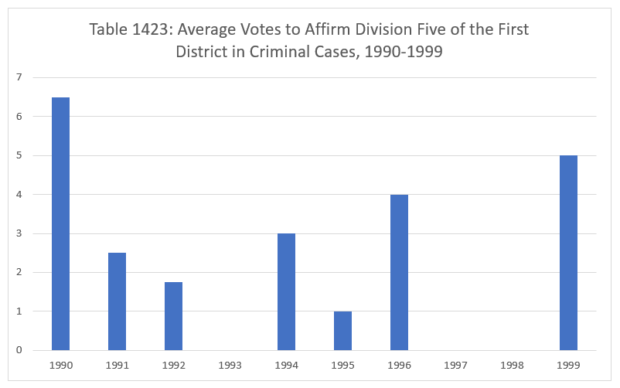
In 1990, average votes to affirm Division Five of the First District in criminal cases was 6.5. From there, the average fell sharply: 2.5 in 1991, 1.75 in 1992, 3 in 1994 and 1 in 1995. In 1996, average votes to affirm was 4. There were no criminal cases from Division Five in 1993, 1997 or 1998. In 1999, average votes to affirm was 5.

The Supreme Court decided no criminal cases from Division Five in 2000. Average votes to affirm was 3.5 in 2001 and 3 in 2002. There were no criminal cases from Division Five in 2003. Average votes to affirm was 0.33 in 2004, 0 in 2005 and 3.5 in 2006. There were no criminal cases from Division Five in 2007. Average votes to affirm was 4 in 2008. There were no criminal cases from Division Five in 2009.

There were no criminal cases from Division Five decided in 2010, 2014 or 2018. Average votes to affirm was 3 in 2011, 6 in 2012, 4.33 in 2013, 5.5 in 2015, 6 in 2016, 4 in 2017 and zero in 2019.

Join us back here next time as we review the data for Division Six of the First District.

Image courtesy of Flickr by Matt Turner (no changes).

The Supreme Court decided no criminal cases which came from Division Four of the First District in 1991, 1993, 1994, 1998 or 1999. Average votes to affirm was 7 in 1990, 6 in 1992, 2 in 1995, zero in 1996 and 4.33 in 1997.

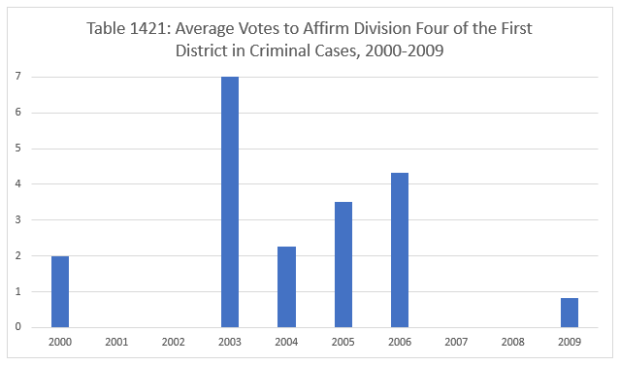
The Court decided no criminal cases from Division Four in 2001, 2002 or 2007. Average votes to affirm Division Four was 2 in 2000, 7 in 2003, 2.25 in 2004, 3.5 in 2005, 4.33 in 2006, zero in 2008 and 0.83 in 2009.

There have been no criminal decisions which arose from Division Four in 2015, 2018 or so far in 2019. Average votes to affirm was 3.5 in 2010 and 2011, 2 in 2012, 1.67 in 2013, 7 in 2014 and 2016 and 2.67 in 2017.

Join us back here next Tuesday as we turn our attention to Divisions Five and Six of the First District.

Image courtesy of Flickr by David Wilson (no changes).


This week, as we continue to review the data from the Court’s criminal decisions, we’re reviewing the yearly average votes to affirm criminal decisions from Division Three of the First District.

In 1990 and 1991, average votes to affirm was zero. It was 2.2 in 1992, 6 in 1993, 1.33 in 1994 and 2.5 in 1995 and 1996. The Supreme Court decided no criminal cases from Division Three in 1997. Average votes to affirm was 7 in 1998 and 6 in 1999.

The Supreme Court decided no criminal cases from Division Three in 2001 or 2007. Average votes to affirm was 3 in 2000, 4 in 2002 and 2003, 4.67 in 2004, 2.5 in 2005, 2.8 in 2006, zero in 2008 and 2.33 in 2009.

There were no criminal cases from Division Three in 2011. Average votes to affirm was 4.33 in 2010, 3.5 in 2012, 3 in 2013, 5 in 2014, 3.5 in 2015 and 2017 and 7 in 2016, 2018 and so far in 2019.

Join us back here tomorrow as we review the numbers for Division Four of the First District.

Image courtesy of Flickr by A Syn (no changes).

Today, we’re reviewing average votes to affirm Division Two of the First District year by year in criminal cases. There were no criminal cases from Division Two decided by the Supreme Court in 1990, 1992 or 1999. Average votes to affirm was 2.25 in 1991, zero in 1993, 3 in 1994, 6 in 1995, 1 in 1996, 4 in 1997 and 7 in 1998.

Comparatively few criminal cases from Division Two were decided between 2000 and 2009 – there were none in 2000, 2003, 2004 and 2006. Average votes to affirm was zero in 2001 and 2002, 2.33 in 2005, 3 in 2007, 7 in 2008 and 4 in 2009.

Average votes to affirm Division Two was 5 in 2010, 4 in 2011, 3.5 in 2012, zero in 2013, 3.5 in 2014, 2.33 in 2015, 2 in 2016, 5.33 in 2017 and zero in 2018 and so far in 2019.

Join us back here next Tuesday as we review the data for Divisions Three and Four of the First District.

Image courtesy of Flickr by Matt Turner (no changes).

For the past several weeks, we’ve been surveying the yearly average votes to affirm each District and Division of the Appellate Court in civil cases. Beginning today, we’re turning our attention to criminal cases – first up, Division One of the First District.

Division One had no criminal cases decided by the Supreme Court in 1994, 1996 or 1999. Average votes to affirm was 2.5 in 1990, zero in 1991, 4.67 in 1992, 3.5 in 1993, zero in 1995, 5.5 in 1997 and 6 in 1998.

There were no criminal cases from Division One in 2001, 2003, 2005 or 2006. Average votes to affirm was 2 in 2000, 2002 and 2004, zero in 2007, 5.5 in 2008 and 6.67 in 2009.

There were no criminal cases from Division One in 2012 or 2015. Average votes to affirm was 5.25 in 2010, 2.33 in 2011, zero in 2013 and 2014, 2.25 in 2016, 1 in 2017 and 2019 and zero in 2018.

Join us back here tomorrow as we review the data for Division Two of the First District.

Image courtesy of Flickr by Doug Kerr (no changes).

This time, we’re reviewing the average votes to affirm at the Supreme Court for civil cases from the Fifth District. The Fifth’s average votes to affirm remained under four throughout the nineties: 2.36 (1990), 1.89 (1991), 1.55 (1992), 3.29 (1993), 2.64 (1994), 1.38 (1995), 1.75 (1996), 2.14 (1997), 2.63 (1998) and 1.17 (1999).

Average votes to affirm was 3.33 in 2000, 1.6 in 2001 and 2.88 in 2002 before rising to 3.5 in 2003 and 3.57 in 2004. In 2005, average votes to affirm was 1.25. In 2006, it rose to 2.86 and the next year, the average was 3.5. Average votes to affirm was zero in 2008 and 0.14 in 2009.

In 2010, average votes to affirm the Fifth District was 1.75. It rose to 2.33 votes in 2011 before falling to 1 in 2012 and zero in 2013 and 2014. The average was 1.33 in 2015. In 2016, average votes to affirm the Fifth District was 5.2. In 2017, the average was again zero. Last year the average was 1.5 and so far in 2019, it has been 2.33.

Join us back here next week as we begin our review of average votes to affirm in criminal cases.

Image courtesy of Flickr by Doug Kerr (no changes).

Macon, Illinois

This week, we’re continuing our review of the data on average votes to affirm the Districts of the Appellate Court in civil cases at the Supreme Court.

During the 1990s, the Fourth District’s average votes to affirm was typically on the low side. In 1990, average votes to affirm was 1.63. In 1991, it fell to 0.33. For the rest of the decade, average votes to affirm rose beyond four only twice: 2.73 (1992), 2.5 (1993), 4.1 (1994), 2.56 (1995), 2.25 (1996), 1.67 (1997), 4.33 (1998) and 3.8 (1999).

In 2000, Fourth District civil decisions averaged five votes to affirm. The average then fell for the next four years: 4.2 (2001), 3 (2002), 2.73 (2003), 2.4 (2004). In 2005, average votes to affirm was 6.67. In 2006, it fell to 3.2. Average votes to affirm was 2.6 in 2007, 3 in 2008 and 3.2 in 2009.

In 2010, average votes to affirm was 2.33. The average rose to 4.33 in 2011 and 4.75 in 2012 before falling to 1.9 in 2013. Average votes to affirm was 3.75 in 2014, 5.8 in 2015 and 7 in 2016. In 2017, average votes to affirm was 3.75. The average was zero in 2018 and has been 5.2 so far this year.

Next time, we’ll conclude our review of the civil data with a look at the Fifth District.

Image courtesy of Flickr by Dave Wright (no changes).