We continue our analysis of the individual Justices’ voting records in insurance law cases with Chief Justice Burke.

During her tenure, the Chief Justice has sat on 24 civil cases involving insurer parties. She has split her votes down the middle: 12 votes for the insurer, 12 votes against. Those totals hold even when we consider a narrower span of years. From 2006 to 2010, Chief Justice Burke voted with insurer parties seven times and against them seven times. For the years 2011 to 2019, the Chief Justice has voted with insurers five times and against them five.

Relatively few of these cases involved decisions won by the insurer below. Across her tenure, the Chief Justice has voted to affirm decisions won by the insurer at the Appellate Court on four occasions (all four in 2007 and 2008) and has voted to reverse insurer wins five times.

Since joining the Court in 2006, Chief Justice Burke has voted to reverse in cases lost by the insurer at the Appellate Court eight times, while voting to affirm seven insurer losses. Between 2006 and 2012, the Chief Justice voted five times to reverse insurer losses while voting to affirm four times. From 2013 to last year, Chief Justice Burke has split her votes evenly in six cases – three to reverse, three to affirm.

Join us back here next Tuesday and we will wrap up our seven-part post on the Justices’ voting record in insurer cases.

Image courtesy of Pixabay by Steppinstars (no changes).

Today, we’re continuing our seven-part post analyzing the individual Justices’ voting records in civil cases involving insurer parties.

Justice Karmeier joined the Court in 2005. Since that time, he has supported the insurer’s position in 18 civil cases, while opposing the insurer in 14 cases. From 2005 to 2008, he voted for insurers in 11 cases while voting against five times. However, since that time, as insurer cases have become a less frequent part of the Court’s docket, Justice Karmeier has voted with insurers seven times and against them in nine cases.

Next, we split the insurer cases into two groups by the winner at the Appellate Court. Between 2005 and 2008, Justice Karmeier voted to affirm seven decisions won by the insurer below while voting to reverse only twice. Since that time, the Court has considered only four cases won by the insurer parties below, and Justice Karmeier has voted to reverse in all four.

Between 2005 and 2008, Justice Karmeier voted to reverse decisions lost by an insurer party at the Appellate Court four times, while voting to affirm an insurer loss three times. Since 2009, he has voted to reverse seven decisions lost by the insurer below while voting to affirm five times.

Join us back here tomorrow when we will consider the voting record in insurance law cases of Chief Justice Burke.

Image courtesy of Flickr by Alan Light (no changes).

Today, we address the voting record of Justice Thomas throughout his entire tenure on the Court in civil cases involving an insurer party. Since 2001, Justice Thomas has voted for insurers’ position in 23 civil cases while voting against insurers 20 times. From 2001 to 2010, Justice Thomas voted for insurers 18 times to 15 votes against. From 2011 to 2019, Justice Thomas split his votes down the middle in ten civil cases involving insurer parties.

Between 2001 and 2010, Justice Thomas voted to affirm nine times in cases won by an insurer party below, voting to reverse seven times. Since 2011, he has voted to reverse in both insurer cases.

Between 2001 and 2010, Justice Thomas voted to reverse in nine cases lost by an insurer party below while voting to affirm eight times. From 2011 to 2019, he voted to reverse insurer losses five while voting to affirm three times.

Join us back here next Tuesday as we address two more Justices’ voting records in insurer cases.

Image courtesy of Pixabay by Steppinstars (no changes).

Last week, we began our seven-post series, reviewing each Justice’s voting record by the area of law involved – first up, insurance law cases.

In our first Table, we show Justice Kilbride’s year-by-year votes for and against the position of insurer parties in civil cases. Since 2001, Justice Kilbride has split his votes evenly – 21 votes against insurers’ positions, 21 votes for. In 2001, Justice Kilbride voted against insurers in three of our cases. The following year, he supported insurers in both cases. From 2003 to 2005, he voted for insurers in four of ten cases. From 2006 to 2010, he voted for insurers in ten cases to seven votes against. There were no insurer cases in 2011, 2014, 2016 or 2017. Since 2012, Justice Kilbride has voted for insurers in four of nine cases.

In the next Table, we show Justice Kilbride’s votes in cases won by the insurer below. From 2001 to 2010, he voted to affirm nine insurer wins while voting to reverse seven times. Since 2011, there have been only two cases before the Court won by the insurer below, and Justice Kilbride evenly split his votes.

Finally, we review Justice Kilbride’s votes in cases lost by the insurer below. Between 2001 and 2010, Justice Kilbride voted to affirm insurer losses in nine cases while voting to reverse eight times. From 2011 to last year, he voted to reverse three insurer losses while voting to affirm four times.

Join us back here tomorrow as we take a look at Justice Thomas’ voting in insurer cases.

Image courtesy of Pixabay by 350543 (no changes).

Today, we begin a seven-post series, reviewing how each Justice has voted in insurer cases overall. First up is the Court’s senior Justice, Justice Rita Garman.

In our first table, we report Justice Garman’s votes for and against insurer parties in civil insurance law cases. Since 2001, Justice Garman has voted for insurers in twenty-three cases while voting against insurers twenty-one times. Justice Garman voted for insurers in only one of four cases in 2001 and one of three in 2003 and 2004. She voted for insurer parties in eleven of sixteen cases from 2005 to 2008. There were no insurance law cases in 2014, 2016 or 2017. Justice Garman has voted for insurer parties in only one of three cases in 2018 and 2019.

Below, we report Justice Garman’s votes for insurer parties who won at the Appellate Court. Overall, Justice Garman has voted for such parties half the time – nine of eighteen cases. Insurers won Justice Garman’s vote in only two of six such cases from 2001 to 2005. She voted for insurers seven of eight times from 2006 to 2008. She has voted against insurers’ position in such cases in all four insurer wins decided by the Supreme Court since 2009.

Since 2001, Justice Garman has voted to reverse in fourteen cases where the insurer lost below, while voting to affirm twelve times. Justice Garman voted to reverse in nine of fifteen cases lost by insurers below between 2005 and 2013. Since that time, there have only been six such cases, and Justice Garman has split her votes 3-3.

Join us back here next Tuesday as we examine the voting records in these cases of two more Justices.

Image courtesy of Flickr by Roger W (no changes).

Today, we’re reviewing the overall data for the most recent decade in the Court’s insurance law decisions. From 2010 to 2019, insurers won six and lost eight as parties to civil cases. They were 1-3 in 2010, 1-2 in 2013 and 0-2 in 2018, 1-0 in 2011, 2012 and 2019.

Insurers won virtually none of these cases at the Appellate Court, as we see in the next chart. Focusing only on wins at the Appellate Court, insurers were 0-1 in 2010, 2013 and 2018.

In our final chart, we show insurers’ won-loss record in cases lost by the insurer below. Overall, insurers won six while losing five. Insurers were 1-2 in 2010, but 1-0 in 2011 and 2012. Insurers split two cases in 2013 and 2015. Insurers lost once in 2018 and won one case in 2019.

Join us back here tomorrow morning as we begin our review of the individual Justices’ voting records in civil cases involving insurer parties.

Image courtesy of Flickr by Jimmy Baikovicius (no changes).

We continue our review of the how insurers have fared at the Supreme Court, this time reviewing the years 2000 to 2009.

For the decade, insurers did reasonably well, winning nineteen cases while losing fourteen. Between 2005 and 2008, insurers won eleven cases while losing only five.

As we saw last time, defending wins from the Appellate Court at the Supreme Court can be difficult. But during this decade things were different. Where the insurance industry had successfully defended only five of fifteen Appellate Court wins between 1990 and 1999, for the years 2000 to 2009, insurers won nine times while losing only seven. Between 2006 and 2008, insurers won seven out of eight cases at the Supreme Court which they had won at the Appellate Court.

Insurers were relatively successful in overturning Appellate Court losses too, winning ten cases which they had lost below while losing only seven. Such cases were relatively evenly distributed through the weekend. Insurers were 2-0 in cases they lost below in 2000 and 1-0 in 2002, but they lost two of three in 2001. They won three of four in 2005 but had only one case per year from 2006 to 2009 – losing it in 2006 and 2007, winning it in 2008 and 2009.

Join us back here next week as we review the voting data for the decade just concluded as well as beginning to review the individual Justices’ voting numbers for insurance cases.

Image courtesy of Flickr by Curtis Abert (no changes).

Today we’re beginning a multi-part post, emphasizing how the insurance industry has fared over the past thirty years at the Illinois Supreme Court. Later this week, we’ll begin a similar series over at the California Supreme Court Review.

First, we report the most basic number of all – insurer parties’ won-lost record at the Supreme Court each year from 1990 to 1999. For the decade, insurers batted slightly over .500, winning twenty-two cases and losing nineteen. The insurers’ best year was 1992, when they won five of eight, followed by 1997, when they were 4-3. Insurers won three cases in 1993 and 1995 – they were 3-1 both years – and in 1998, when they were 3-2.

Next, we split the data up according to which party won below. In Table 1442, we review the year by year numbers in cases where the insurer was the winning party below. This shows that in the nineties, insurers had a rough time trying to defend wins from the Appellate Court, winning five while losing ten. Insurers successfully defended two wins in only one year of the decade, 1992 (and even then, they lost three for the year).

Next, we review the numbers where the Court was reviewing an insurer’s loss from the Appellate Court. Insurers succeeded in obtaining reversal in seventeen of those cases, losing only nine. In 1992 and 1993, insurers successfully flipped five of five losses, and in 1995 and 1996, they flipped four in a row.

Join us back here tomorrow as we review the data for the next decade.

Image courtesy of Flickr by Rennett Stowe (no changes).


Average votes to affirm for criminal cases from the Fifth District in 1990 was 4.22. The average was 5.5 in 1991, 0.6 in 1992, 2 in 1993, 3.2 in 1994, 7 in 1995, 4.33 in 1996, 4.67 in 1997, 2.33 in 1998 and 4 in 1999.

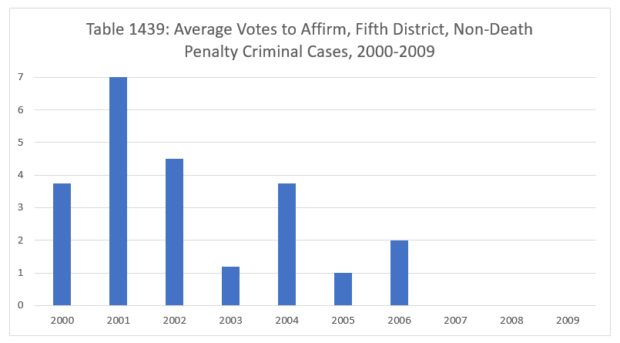
Average votes to affirm was 3.75 in 2000, 7 in 2001, 4.5 in 2002, 1.2 in 2003, 3.75 in 2004, 1 in 2005 and 2 in 2006. There were no criminal cases from the Fifth District in 2007, 2008 or 2009.

Average votes to affirm was 3 in 2010 and zero in 2011. There were no criminal cases in 2012. The average was 2 in 2013, 2.2 in 2014, 3.5 in 2015, 1.75 in 2016 and 2.33 in 2017. There were no criminal cases from the Fifth decided in 2018 or 2019.

Join us back here next Tuesday as we turn our attention to a new area.

Image courtesy of Flickr by Matt Turner (no changes).

Today, we’re reviewing the yearly average votes to affirm decisions of the Fourth District in criminal cases. The average votes to affirm was zero in 1990, 7 in 1991, 5.25 in 1992, 2.33 in 1993, 4.25 in 1994, 2 in 1995, 1.33 in 1996, 2.56 in 1997, 5.5 in 1998 and 0.67 in 1999.

Average votes to affirm the Fourth District was 2 in 2000, 1.92 in 2001, 3.13 in 2002, 5.14 in 2003, 2 in 2004, 5.22 in 2005, 3.88 in 2006, 4.67 in 2007, 3.43 in 2008 and 3.63 in 2009.

Average votes to affirm the Fourth District was 7 in 2010, 3.13 in 2011, 2.5 in 2012, 4.67 in 2013, 5 in 2014, zero in 2015, 2.33 in 2016, 4.25 in 2017, 1.2 in 2018 and zero in 2019.

Join us back here tomorrow as we turn our attention to non-death criminal cases from the Fifth District.

Image courtesy of Flickr by Gary Todd (no changes).